

Filmtools
Filmmakers go-to destination for pre-production, production & post production equipment!
Shop Now
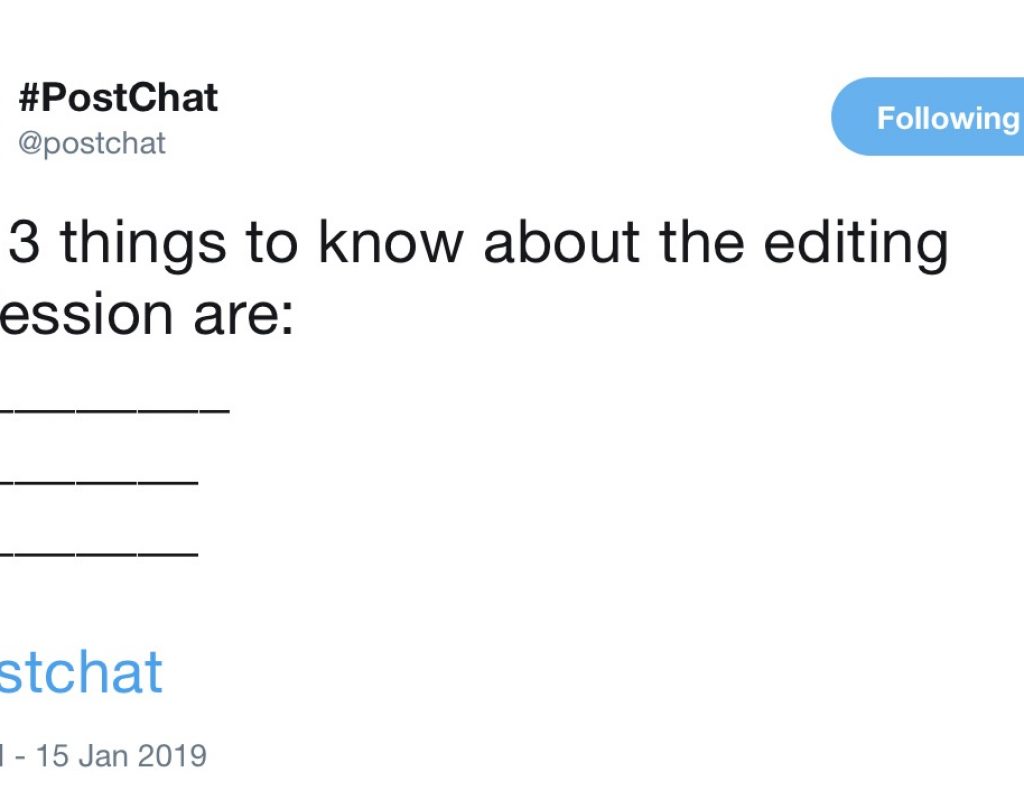
The long-time post-production Twitter account #PostChat asked this interesting question:
The 3 things to know about the editing profession are:
1__________
2_________
3_________#postchat— #PostChat (@postchat) January 16, 2019
It was a question tailored to what Twitter does best: take a simple short topic and generate short discussions around that topic. I crossed out simple as there is little that is simple about that big and important topic. There were some great replies to that question so they deserve a blog post. I’ll comment on some of them. If you aren’t on Twitter or have your own list of three then feel free to comment below. These are in no particular order.
https://twitter.com/ChristianGlawe/status/1085386410834694147
That long game is hard for many to stomach these days. Everyone wants instant gratification, me among them. But it seems like it’s harder and harder to find those that can appreciate the apprentice model that used to train editors. YouTube can’t teach everything and even though it would seem like it can what it teaches is often wrong.
https://twitter.com/Xhaust/status/1085391023755407366
We all get so wrapped up in the tools discussion (point #1 above) we can forget that our story is the most important part (point # 3 above) no matter what the editor is editing. We’ll come back to point #2 above.
The technology changes but the craft does not. A lot of it is just client management. Your best work never sees the light of day. #postchat
— Turtle Titans 🏈 (@isaiahheaden) January 16, 2019
It’s important for new editors to learn that editors almost always work for someone else (director, showrunner, ad agency). There comes a point when the editor’s best versions of a job must be set aside to serve the client. That may mean the editor’s best work never sees the light of day. That’s okay as the editor is working in service of the client. Everyone’s end goal is the same.
1. anyone can edit, not everyone can tell a story.
2. use everything you can that makes sense.
3. it doesn't have to be 4K. https://t.co/SkDhIJlO6g
— @aeriform.bsky.social (@aeriflame) January 16, 2019
Along with the which NLE is the best discussion that we have on the Internet these days the resolution debate always rages. We’re currently in the coming 8K realm (NAB 2019 will be packed with 8K) but just because you have the resolution at your disposal doesn’t mean you always need to capture in it. Have that discussion with post-production before you decide on the latest and biggest.
1. It’s a business.
2. Often you’ll have to make changes you hate.
3. Sometimes you were wrong and that change is actually better.#PostChat https://t.co/63O9ijHTrg— Total waste of snakes (@videoalex) January 16, 2019
This reply above goes back to an earlier one about the editor being part of a team that works for the best of the project. Filmmaking is a collaborative art form so any singular vision might benefit from that other set of eyes, that other set of artistic sensibilities.
1) It’s all about the feels. Timing/Pacing/Tone
2) Know your tools inside & out so that technology doesn’t get in the way of telling a good story
3) Cover black first, then finesse. Don’t spend an hour frame f#cking if the shot doesn’t really work in the scene.#postchat
— Brian Mulligan (@BKMeditor) January 16, 2019
In one sentence we’ll say technology doesn’t matter and then in another technology does matter … so which is it? You can tell any story with an NLE and no one NLE is better than another, just different. But if you know your technology well it becomes second nature and helps you get that Timing/Pacing/Tone right a whole lot faster.
https://twitter.com/mironkundzicz/status/1085457314965045248
One would think being nice would be a no-brainer but it’s good to be reminded of that every once and awhile. While your colleagues won’t tell that many stories about the nice people they encountered in the edit suites of the world they sure will remember them.
1) Find a mentor
2) Seek out challenges daily
3) Share what you've learned freely— :/ (@DanLDEon) January 16, 2019
I like point 3 above. I once had someone ask me years ago why I started a free post-production blog. Wasn’t I afraid that I was essentially teaching others to take my job? My thought was that being helpful always ends up well in the end. Writing blog posts, doing webinars and creating tutorials helped me learn more and be a better editor in the end. I still believe that today.
https://twitter.com/jeffedits/status/1085604099423383553
Point 2 above is an important one. Too often those in video production and post immerse themselves in the business and do very little outside of the business. Find hobbies, meet non-production people, get out of the edit suite. I hope you find Something to Love that is not film and video related.
https://twitter.com/MuenchFilms/status/1085472970519314432
Those above ideas point back to some of the other lists. Always good to reiterate good points.
https://twitter.com/scottskaja/status/1085494231765082112
What do you call a group of editors? A complaint.
1. Business
2. After Effects
3. Audio https://t.co/TQXWC4stOE— Scott Simmons (@editblog) January 16, 2019
Above was my reply. A little back story on these three items. Years age at NAB I led a session called Skills I Wish I Had Learned Early in my Editing Career. Those three items above were the top three. Years later I did that again at the Student Television Network convention when it visited Nashville. The room was packed full of young television students from middle school through high school (and perhaps a few more scattered in). I think a lot of those students expected a session of tips and tricks in the NLE. While many of them left the session disappointed it wasn’t tips and tricks many others told me after that is was an unexpectedly eye-opening session as it made them think beyond the NLE. Perhaps that topic would make a good webinar!
This is the correct answer. @editblog https://t.co/nG6qFwP4gA
— Barry Clegg (@cleggthis) January 16, 2019
https://twitter.com/TRBLLGHTFLMS/status/1085393163857088512
And of course there’s always this:
1. Good
2. Fast
3. CheapEditing, like everything, is about compromise. Pick two.
— Matt Riley (@mattriley) January 16, 2019
Yep.
And one more:
When picture is locked clean (flatten) your timeline.
When picture is locked clean (flatten) your timeline.
When picture is locked clean (flatten) your timeline.Messy timelines look good on Social Media, they're pain in real life.#PremierePro #FCPx #DavinciResolve #PostChat
— Charles Coleman (@coletypical) January 15, 2019
Ok that last tweet wasn’t in response to the original #PostChat question but it’s 3 points and they are good ones. It’s like tidying up your house … it feels better when it is clean, it’s easier to find and make sense of the space around you and your neighbors don’t think you are a slob.