

Filmtools
Filmmakers go-to destination for pre-production, production & post production equipment!
Shop Now
We are living in an era of astonishing innovation and relentless obsolescence. Every year, new cameras are announced, marketed, bought, used, and then, eventually, sold. As camera technology advances, the cycle repeats. Throughout the history of digital acquisition, the pathway to ever more capable digital cameras was shaped by the history of film capture.
35mm became Super 35. Super 35 became VistaVision. VistaVision gave way to 65mm. 65mm eventually evolved into 15-perf IMAX.
At this moment, 15-perf IMAX represents the absolute upper limit of practical image acquisition. There simply isn’t a larger, standardized film format capable of dramatically capturing more information. Once we reached a frame nearly the size of a postcard running horizontally through the camera, physics won.
IMAX
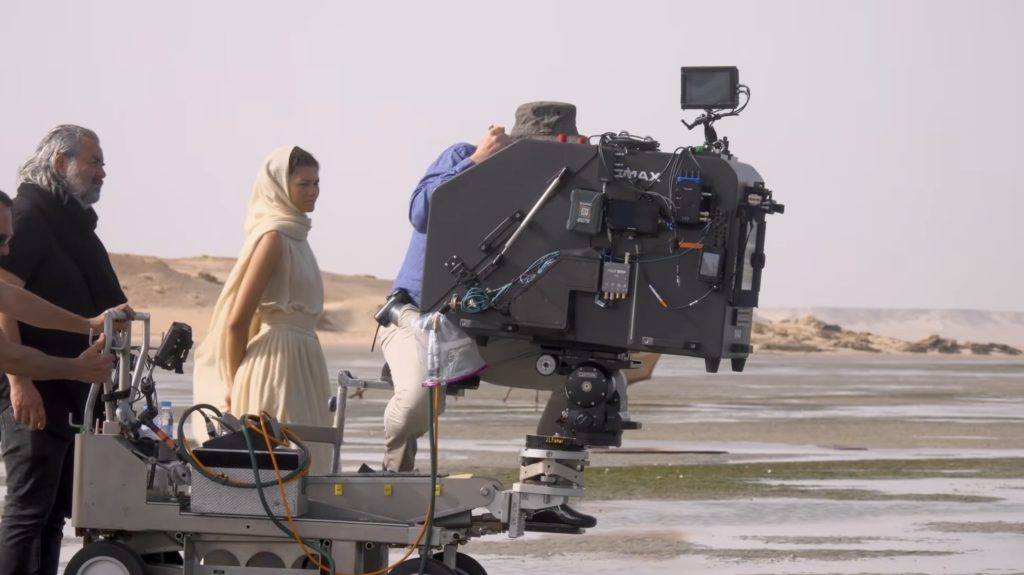
15-perf IMAX represented the practical endpoint of analog image acquisition. At approximately ten times the image area of a standard 35mm four-perforation frame, it pushed nearly every mechanical aspect of filmmaking to its limit.
For example, the IMAX camera Christopher Nolan used on this summer’s blockbuster, “The Odyessy,” can only capture 3 minutes of film on a roll. To project the movie in specialized theaters, the film may measure around 11 miles long, as it did for Nolan’s “Oppenheimer.” As you can guess, there is a physical limitation to IMAX filmmaking. Considering Christopher Nolan, his cinematographer Hoyte Van Hoytema, and the crew, it is an amazing creative achievement.
Digital imaging will eventually fundamentally alter that equation.
Digital
Unlike film, a digital sensor is not constrained by perforations, transport mechanisms, or the physical dimensions of a magazine. Its boundaries are defined primarily by semiconductor fabrication, electronic architecture, and data processing. As manufacturing techniques continue to improve, those boundaries become increasingly flexible.
Recent developments in very-large-format digital cinematography, such as Sony’s new 65mm Rialto system, ARRI’s Alexa 65 and Alexa 265 cameras, Blackmagic Design’s URSA Cine 17K 65mm platform, and Fujifilm’s continued investment in large-format digital imaging with GFX Externa 55, illustrate a broader industry trajectory. Although these systems differ substantially in design philosophy and intended application, they collectively point toward an important trend: image acquisition is becoming progressively less constrained by the historical limits established during the film era.
The significance of these cameras extends well beyond resolution. While public discussion often centers on headline specifications such as 12K or 17K, the more consequential development is the steady expansion of the sensor area itself. A larger sensor does not simply accommodate more pixels; it enables different optical relationships, improved photon collection, reduced noise, broader dynamic range, and greater flexibility in post-production.
This distinction is frequently overlooked. Resolution measures sampling density. Sensor size governs how much of the optical image is sampled in the first place.
That difference will likely define the next era of cinema technology.
A Change in Initiative
We will see a time when digital sensors match or surpass those of 15-perf IMAX and in a much smaller camera package. What happens then? Digital development will have hit the ultimate goal of matching or bettering 15 perf IMAX. This is an engineering Rubicon of sorts. You see, achieving the look and feel of film was a goal from the very start for digital sensors. The development of film in the 20th century paved the way for digital cameras. Will digital cameras blaze the way for future film advancement?
Film’s ceiling is physical.
Film formats evolved because filmmakers wanted larger negatives.
Larger negatives meant finer grain, smoother tonal transitions, higher apparent resolution, shallower depth of field, and wider fields of view without the need for extreme focal lengths. Eventually, engineers arrived at IMAX.
15-perf 65mm remains astonishing today because its image area is enormous
Yet, IMAX’s greatest strength also became its greatest limitation. Every increase beyond IMAX requires a larger camera, larger magazines, larger projectors, more film, more weight, and more cost.
Digital has no equivalent wall.
Unlike film, digital sensors don’t have standardized perforations, constrained by magazine size, and they aren’t constrained by projector mechanics.
Once sensor manufacturing achieves sufficient yield rates, there’s no theoretical reason cameras couldn’t use sensors substantially larger than today’s 65mm formats.
Digital isn’t replacing film. It will never be able to replace the physical chemical reaction of exposing film, but it is replacing film’s limitations.

The Quiet Arms Race Toward Larger Sensors
Over the past several years, we’ve watched manufacturers steadily increase sensor size. ARRI’s Alexa 265 and Sony’s new Rialto 65mm system demonstrate just how portable very-large-format cinematography has become.
Blackmagic Design has pushed resolution to astonishing levels with its 65mm 17K platform, capturing amounts of image information that would have sounded absurd only a decade ago.
Fujifilm’s growing interest in digital large-format imaging continues to blur the historical line between medium-format photography and motion-picture acquisition.
Viewed individually, these products look like isolated engineering achievements. Viewed together, they reveal something different.
They’re all pointing in the same direction.
The Future Where Digital Leads The Way
The future isn’t simply larger sensors or higher resolution. The future may be removing the concept of a maximum image size altogether.
Film may have a 15-perf IMAX finish.
Digital does not.
The largest film format humanity ever standardized, 15-perf IMAX, may ultimately be remembered not only as the pinnacle of film acquisition, but as the last time cameras were constrained by the size of a strip of film.
The next generation of digital cinema cameras won’t be measured by how closely they emulate IMAX.
They’ll be measured by how completely they move beyond the idea that image capture ever needed a physical limit in the first place.