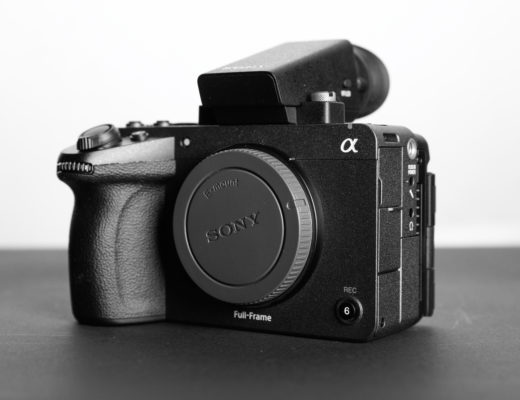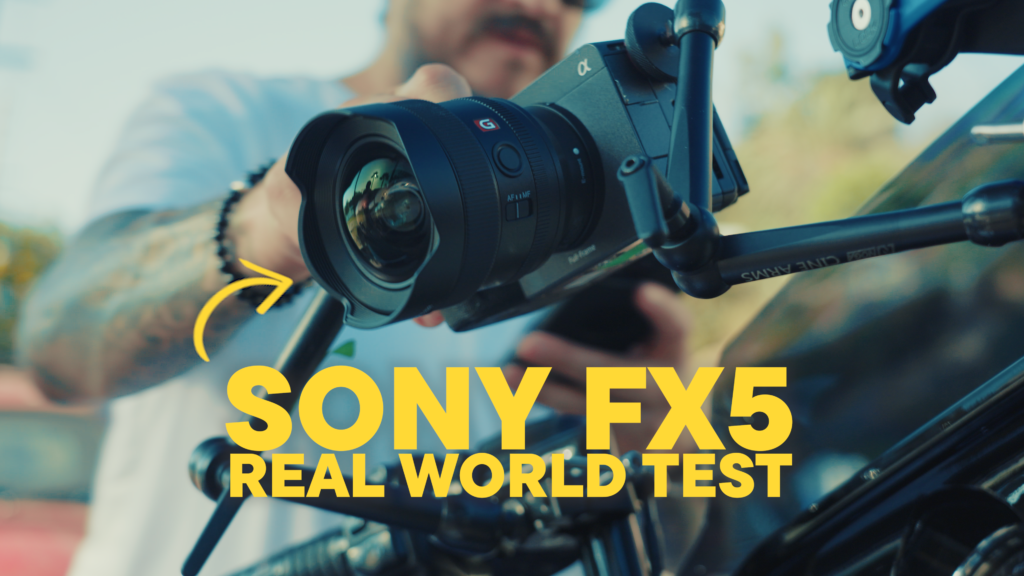


We love the new camera, but there are a couple of things to keep in mind before you click “buy.”

Sony is positioning the new FX5 as a compact cinema camera, and after spending a day shooting with it around Los Angeles, it’s easy to see the appeal. We took the camera out with a tiny crew, no lighting and a stripped-down production setup to see how it performed in the kind of situations where a compact cinema camera should shine.
The FX5’s body immediately proved useful. Its compact form factor made moving between handheld, gimbal, motorcycle and car-mounted configurations relatively painless. Let’s chat through the ins and outs of this camera that we expect to be massively popular.
A New 5K Open Gate Sensor
The FX5 features a new fully stacked 5K 3:2 Open Gate sensor. Capturing the full sensor gives filmmakers considerably more flexibility in post, whether that means reframing, stabilizing footage without compromising a 16:9 composition, maximizing the image circle of full-frame anamorphic lenses, or extracting horizontal and vertical deliverables from the same shot.
That last benefit is particularly relevant for productions expected to deliver both traditional long-form content and vertical social assets. We used this method extensively when putting together the above video and social clips.
The FX5 also offers impressive high-frame-rate recording. At launch, it can capture 5K up to 60 fps, 4K up to 120 fps, and Full HD up to 240 fps. Sony has announced a future firmware update adding 5K 120 fps and 2K 240 fps.
Another significant addition is internal RAW recording with X-OCN RAW. Unlike the FX3, which could output RAW over HDMI but couldn’t record it internally, the FX5 brings the RAW workflow inside the camera.
Our pre-release workflow came with an important caveat: at the time of testing, we could only transcode the footage using DaVinci Resolve Studio. Once we had the workflow running, however, we were impressed by the manageable file sizes, highlight retention, and grading flexibility.
Autofocus and Stabilization Impress
The fully stacked sensor also helps reduce rolling shutter and contributes to one of our favorite aspects of the camera: autofocus performance.
We didn’t have a first AC on our shoot and relied heavily on autofocus throughout the day. Focus transitions were remarkably smooth, even in demanding run-and-gun situations.
In-body stabilization was similarly impressive. The FX5 provides Standard, Active, and Dynamic Active modes. Dynamic Active introduces approximately a 1.3x crop, but produced some of the smoothest in-camera stabilization we’ve encountered in any camera. This was particularly noticeable during frontal motorcycle shots, which can easily develop an unpleasant jitter.
Sony rates the camera at more than 15 stops of dynamic range in S-Log3 and introduces a triple-base ISO system at 800, 4,000 and 12,800.
We frequently found ourselves at the 4,000 base while shooting at night. It provided a useful middle ground, maintaining a natural nighttime appearance without requiring us to introduce artificial lighting.
A More Cinema-Focused FX Camera
Several smaller changes make the FX5 feel increasingly like a dedicated cinema camera.
The new four-axis LCD proved surprisingly useful, allowing monitoring positions that aren’t practical with a conventional flip-out display. Sony has also brought the interface closer to its higher-end Cinema Line cameras, with built-in false color, waveforms and vectorscopes.
There are two notable optional accessories. The XLR handle adds physical audio controls while unlocking 32-bit float recording, making it particularly attractive for solo operators and small crews. The optional EVF was another welcome addition when shooting exteriors in bright Los Angeles sunlight.
The Compromises
Positioned below the FX6, the FX5 lacks internal ND, SDI output, and built-in timecode connectivity. For our style of production, those tradeoffs felt reasonable given the camera’s compact body.
There is one additional expense potential buyers should consider: media.
Taking advantage of many of the FX5’s highest-quality recording modes requires VPG400 CFexpress Type A cards. At the time of our shoot, a 250GB card cost roughly $250 and provided approximately 18 minutes of recording at the highest resolution RAW setting. Those files also have downstream storage implications.
That isn’t necessarily a reason to avoid the FX5, but it should be part of the purchasing decision.
After a day of shooting, the FX5 struck us as a highly capable compact cinema camera rather than an all-purpose hybrid. Shooters who also require professional still photography may be better served by cameras such as the a7S III, FX2 or FX3.
For filmmakers prioritizing a compact body, Open Gate recording, internal RAW, strong autofocus and excellent stabilization, however, the FX5 makes a compelling case for itself.