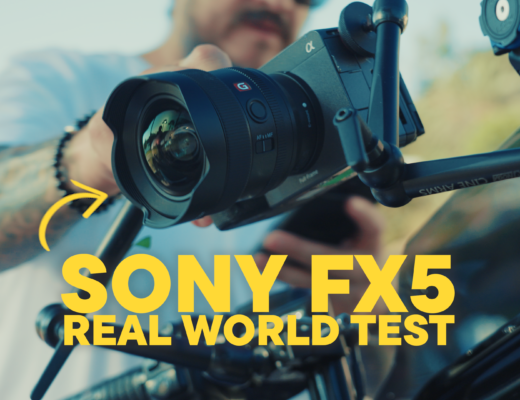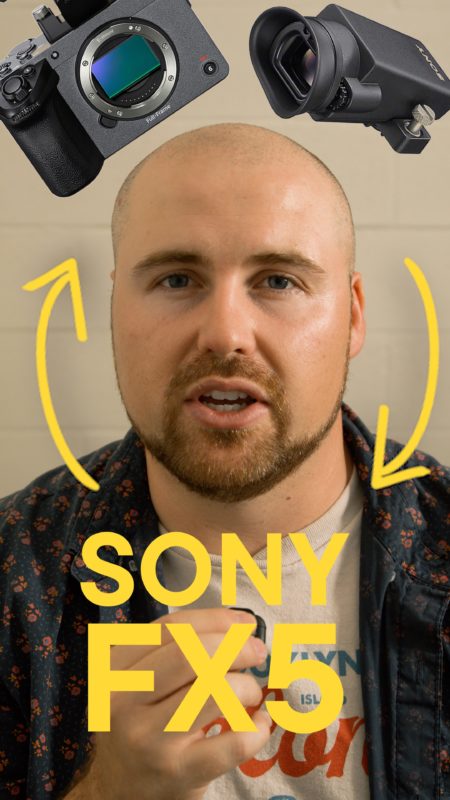



After months of speculation, Sony has officially unveiled the FX5, the newest addition to its Cinema Line. More importantly, it’s a camera that feels like a direct response to years of feedback from filmmakers and content creators who have been asking for a more capable step between the FX3 and the larger FX6.
On paper, the FX5 checks many of the boxes fans have been requesting. At its core is a new stacked full-frame 16.6-megapixel sensor capable of recording 5K open gate in a 3:2 aspect ratio with internal 16-bit RAW. It features three native ISO settings: 800, 4000, and 128000, while launch specifications include 4K up to 120 fps and 5K up to 60 fps. Sony has also committed to a firmware update in August 2027 or sooner that will unlock 4K 240 fps and 5K 120 fps, giving the camera even more longevity.
Sony also appears to have focused heavily on usability. Improved in-body image stabilization, enhanced subject recognition, stronger low-light autofocus, and a new AI processing engine promise more reliable tracking and automatic white balance. These are the kinds of quality-of-life improvements that matter just as much as headline specs for working creators.
Perhaps the biggest story, however, is how closely Sony listened to the filmmaking community. The addition of false color, waveform monitors, vectorscopes, a redesigned cinema-focused interface, and support for 32-bit float recording through the top handle addresses several of the most common requests from FX3 users. For solo shooters and documentary shooters, these aren’t just nice additions; they’re workflow-changing upgrades.
Sony has also embraced one of the fastest-growing production formats: vertical video. The monitoring interface automatically rotates when the camera is turned vertically, making it feel purpose-built for social-first production. With brands investing heavily in TikTok, Instagram Reels, and YouTube Shorts, the FX5 could quickly become one of the most compelling cameras for vertical micro-series, branded content, and creator-led productions. Rather than treating vertical video as an afterthought, Sony has acknowledged it as a legitimate professional format.
Of course, Sony didn’t erase every compromise. The FX5 still lacks internal ND filters, SDI connectivity, and the larger battery system found on higher-end Cinema Line models. Those omissions will disappoint some professionals, but they also seem intentional. Sony clearly wants to preserve separation between the FX5 and the FX6 while keeping the new camera accessible at a lower price point.
That leaves an interesting question: is there now room for an FX7?
Many filmmakers have long imagined a camera that combines the sensor and specs of the FX5 with built-in electronic ND filters, SDI, larger battery compatibility, and higher-end connectivity; essentially a true bridge between the FX5 and flagship cinema cameras. If Sony ever decides to build that camera, the FX7 name feels like the obvious home.
The Sony FX5 starts at $4,899 for the body, $5,499 with the XLR handle, while the optional electronic viewfinder costs $699. At those prices, Sony has created what could become one of the most attractive entry points into professional cinema production.
The FX5 may not be everything filmmakers have asked for—but it’s arguably the closest Sony has come yet. And if community feedback continues shaping the Cinema Line, the next chapter could be even more exciting.