

Filmtools
Filmmakers go-to destination for pre-production, production & post production equipment!
Shop Now
In many regards, media production – film, television, AV, video games – is a lot like building a house.
Stay with me, please.
Both require ambition, collaboration, and a guiding hand to see a vision through to completion. Not to mention, a successful project will involve physical labor, specialized departments, and, of course, tools, gear, and all manner of tailored equipment. If something goes awry on set, and something absolutely will, a competent crew will need the right tools and expertise at their disposal to ensure an overall smooth, schedule-adhering production.
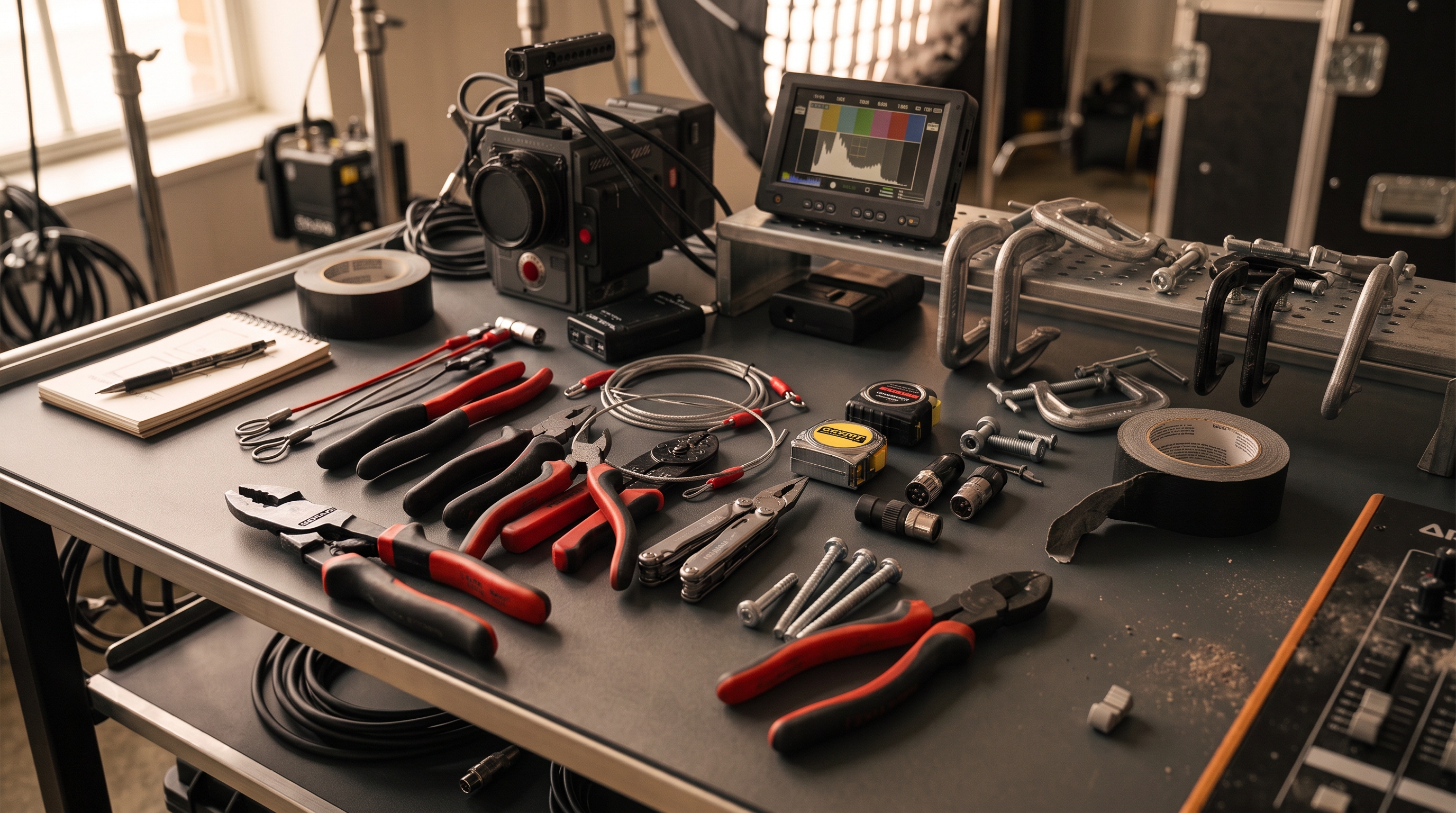
Key grips are typically the ones handling the “construction” of a film set, coming equipped with claw hammers, wrenches, screwdrivers, tape measurers, wire cutters, and pliers: a standard “hardware store suite” of equipment, just a toolkit away to use at a moment’s notice.
However, not every issue can be solved with a one-size-fits-all solution, and a key grip can’t be everywhere at once, especially when filming gets chaotic. When presented with a specific problem, whether its gaffing, physical set design, or AV, the right person with the right tool can confront said problem, head-on and without hesitation.
Gaffing, Wires, and Connectors
Power and signal are the lifeblood of any production: a metaphor so apt, you could almost call the veins literal.
Cameras, monitors, lighting consoles, LED walls, intercoms, networked audio, and video distribution all depend on reliable cable infrastructure. While a bad cable or loose termination might seem like a minor inconvenience, it can quickly become a production-halting issue when schedules are measured in minutes rather than hours.
For technicians working with structured cabling, networking, or custom installations, Belden has long been a trusted name in professional connectivity. Its lineup extends beyond the cable itself to the specialized tools that make fast, reliable terminations possible in the field.
A dedicated crimping tool, for example, is indispensable. Whether restoring a damaged Ethernet cable for a production network or building custom-length communication lines to reduce clutter on set, a quality crimper delivers consistent, secure connections that stand up to repeated use. Instead of replacing an entire cable run, technicians can often restore functionality in just a few minutes. It saves both time and an unnecessary expense. However, these tools are not universal, and are dependent on the specific type of plugs you’re working with. If you’re working with RJ11 (6-position) and RJ45 (8-position) modular plugs, you use the Belden CPRJ11-45 Crimp and Strip Tool, which is specially designed to handle those connections. It also cuts and strips cables without requiring a separate tools or an interchangeable die set, helping speed up field repairs and new installations.
That’s something else to take into consideration: how much functionality can one tool offer? If you’re able to delegate multiple tasks to a single “jack-of-all-trades” piece of equipment, it can help trim production costs and help expedite maintenance. The Belden CPRJ11-45 crimps very specific types of plugs, but it makes up for this limitation by being more than just a crimping tool.
Belden’s REVConnect Universal Termination Tool takes a similarly practical approach for modern network installations. Designed specifically for the company’s REVConnect connectivity system, it streamlines cable terminations with a repeatable, installer-friendly process that minimizes guesswork while maintaining consistent performance.
For productions relying on IP-based video transport, Dante audio, or expanding network infrastructure, tools like these help crews build dependable connections that can withstand the demands of a busy set.
It’s the kind of equipment that often goes unnoticed. That is, until it’s needed. Suddenly, it’s Excalibur.
Like a multi-tool in a grip’s pouch or a voltmeter in an electrician’s kit, specialized cable tools rarely become the star of the day. But when a connector fails moments before rolling or a network drop needs to be added before the next setup, having the right termination tool within arm’s reach can mean the difference between a brief delay and a disrupted shooting schedule.
Workflow Kits
Broadcast cameras, video routers, patch panels, monitors, recorders, and countless pieces of production hardware continue to rely on BNC connections to move high-bandwidth video reliably over long distances. And unlike a standard patch cable, a poorly terminated BNC connector can introduce signal loss, intermittent failures, or complete dropouts that are notoriously difficult to diagnose in the middle of a shoot. It becomes a situation far beyond a mere inconvenience, which is why technicians who regularly build or repair coaxial cable assemblies often turn to dedicated tooling rather than general-purpose crimpers.
Neutrik, a company long associated with professional-grade audio and video connectors, offers a purpose-built BNC Tool Case designed specifically for assembling its BNC cable connectors. Rather than simply including a crimp tool, the kit brings together the complete workflow: the HX-R-BNC ratcheting crimp frame, PT-BNC pliers, the CS-BNC coax cable stripper, shield-spreading tool, hex key, and carrying case, creating a portable workstation for field cable assembly. Crimp dies are selected separately to match the specific connector and cable combination being used, allowing the same platform to support a range of broadcast and AV applications.
That modular approach is particularly valuable on productions where crews may encounter multiple cable types over the course of a project. A damaged SDI cable during a live broadcast, an equipment rack that needs custom-length patch cables, or a last-minute camera position that requires a new coax run are all situations where having the proper termination tools nearby can keep production moving. It’s an investment in both cable assembly and peace of mind: knowing that every connector has been installed consistently, securely, and to the specifications the hardware was designed for.
Maintaining Wireless Networks
Wireless networks have quietly become part of the backbone of filmmaking, supporting everything from script distribution and cloud-based collaboration to wireless monitoring, file transfers, IP control systems, and crew communications. As productions grow more connected, maintaining strong, reliable WiFi across a soundstage, production office, or temporary location has become just as important as managing power or signal distribution.
Unlike permanent installations, film sets are constantly evolving. Equipment moves. Walls go up. Production offices relocate. Video village migrates across the lot. A wireless network that performed perfectly during morning setup can suddenly develop dead zones by the afternoon simply because the physical environment has changed.
That’s where networking hardware becomes another essential addition to the filmmaker’s toolbox. Dedicated WiFI 6 routers such as Netgear’s Nighthawk RAX50 provides the central hub capable of supporting numerous connected devices simultaneously. Cameras may still record internally, but tablets used for script supervision, wireless video receivers, production laptops, lighting control systems, and cloud-connected asset management all benefit from the increased bandwidth and efficiency offered by WiFi 6. Rather than competing for limited wireless resources, multiple departments can work concurrently without bringing the network to a crawl.
Of course, a router is only as effective as the coverage it can provide.
Large stages, warehouses, historic buildings, and sprawling location shoots often create coverage gaps where signal strength drops off dramatically. In those situations, range extenders offer a practical solution by expanding the existing wireless network without requiring an entirely new infrastructure. Instead of relocating production offices or running additional temporary cabling simply to improve connectivity, crews can extend reliable coverage into areas where digital paperwork, media transfers, or wireless control systems are actively being used. More often than not, all crews need is a spare power outlet.
Like so many tools on set, networking equipment often fades into the background when everything is working correctly. Then, without warning, file uploads stall, wireless control systems lose connectivity, or a crew member has to walk halfway across the stage just to reconnect. Much like a properly terminated cable or a dependable power distribution system, a well-designed wireless network isn’t glamorous, but it’s one of the invisible systems that keeps modern productions running efficiently from the first call sheet to final wrap.