

Filmtools
Filmmakers go-to destination for pre-production, production & post production equipment!
Shop NowA base M5 chip, but no new Pro or Max versions yet

Apple’s new M5 chip is behind updates to three of their product lines today, but video professionals may not want to update just yet. If your workflow relies on the additional video acceleration or GPU power found in the Pro and Max variants found in Apple’s higher-spec Macs, you’ll have to wait a little longer to update. On the other hand, if you’re happy with a lower-spec, less expensive machine, that machine is now more powerful.
Let’s take a look at the new chip, and the devices it’s powering.

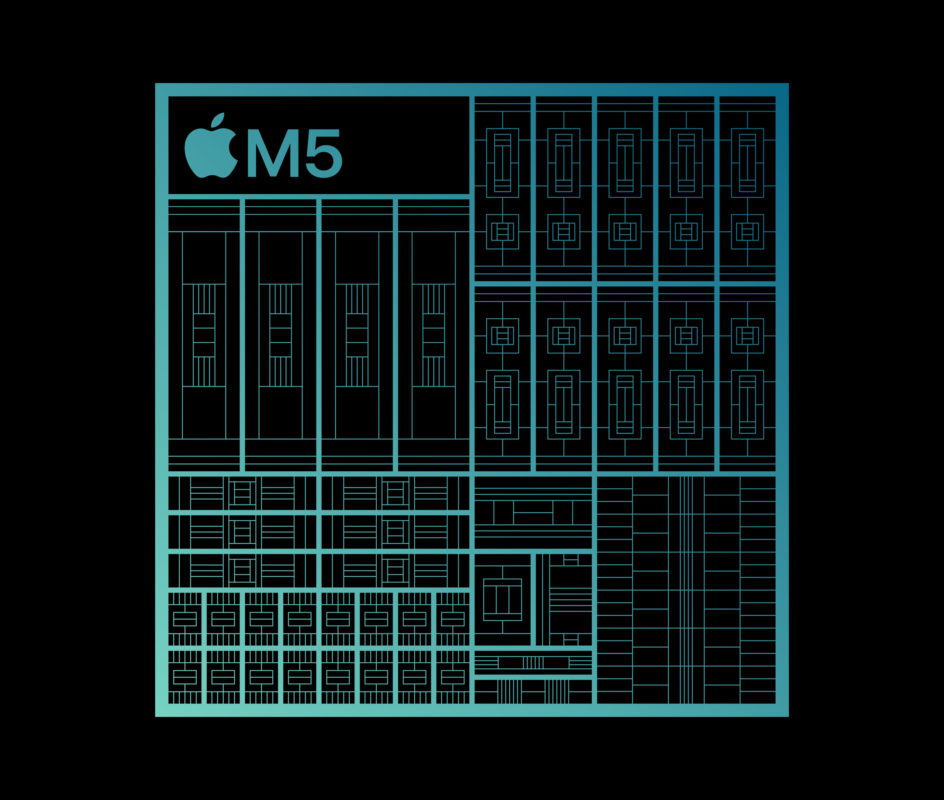
The M5 chip
Modern Apple chips combine many components, including the CPU cores, GPU cores, Neural Engine cores, storage and RAM all together in a single package. This integration is why you can’t easily upgrade an SSD after purchase, but it’s also why modern Macs can access huge amounts of GPU RAM when they need to — it’s all one pool.
Some AI workflows require large amounts of GPU RAM, and the Max chips have provided a solution that (for some tasks at least) doesn’t require heavy-duty dedicated GPU cards. Other workflows can be accelerated with the Neural Engine, a component common to many Apple chips that’s faster in the M5. But this year’s chips, including the A19 Pro in the latest iPhone, also include a new Neural Accelerator in each GPU core to boost these workflows even further — great for locally-run AI tasks.
With additional improvements to ray tracing and a new GPU architecture, there’s a claimed boost of 4x peak GPU compute compared to M4, and over 6x peak GPU compute for AI performance. There’s also increased unified memory bandwidth of 153GB/s. But how will that impact the devices we use? Let’s start with the MacBook Pro 14”.
14-inch MacBook Pro with M5
This Mac looks the same as the previous model, with the same excellent screen, battery life, camera, microphones, speakers and so on. But note that so far, only the entry level MacBook Pro is using the new chip. If you upgrade to the Pro or Max chips, you’ll be getting better GPUs and media accelerators, but slightly slower single-core performance. For some tasks, I’d expect to see those factors balance out, but if you use complex video effects then GPU improvements are likely to be more important.

We’ll have to wait to see how AI tasks compare, though. While improvements to AI-based jobs won’t impact every app, useful features like Magic Mask in DaVinci Resolve, Magnetic Mask in Final Cut Pro and Object Select in the next major Premiere Pro release (currently in beta) should now be even faster. Quoted video-related improvements include:
- Up to 7.7x faster AI video-enhancing performance in Topaz Video when compared to the 13‑inch MacBook Pro with M1, and up to 1.8x faster than the 14-inch MacBook Pro with M4.
- Up to 6.8x faster 3D rendering in Blender when compared to the 13‑inch MacBook Pro with M1, and up to 1.7x faster than the 14-inch MacBook Pro with M4.
If we take these tests as accurate (they have been in the past) and Blender’s Open Data benchmarks as accurate (they have matched my own tests) then we can expect the M5 to sit at a Blender benchmark score of around 1827. (The M4 with 10 cores has a median score of 1074.59.) UPDATE: some real benchmarks have now arrived, and after just two tests, the M5 with 10-cores sits at 1751.57. Check for the latest numbers.
While that’s a solid improvement in just one generation, serious 3D creators on the Mac will likely be using Pro or Max chips already. Here’s a graph, measuring Blender performance, CPU type and the number of GPU cores:

That means that the base M5 is likely to outpace the M3 Pro in Blender renders and other GPU-related tasks, but won’t touch recent Max chips or the M4 Pro. If you’re still on a M1 of any variety though, it’ll smoke it. Rumors have the M5 Pro and M5 Max coming out early next year, but (of course) nobody outside Apple knows for sure. If 3D performance is important, I’d wait. For anyone with simpler needs, the M5 will be a good option.

iPad Pro with M5
This update is largely about the new chip, and the quoted speed improvements are:
- Up to 6.7x faster 3D rendering with ray tracing in Octane X when compared to iPad Pro with M1, and up to 1.5x faster than iPad Pro with M4.
- Up to 6x faster video transcode performance in Final Cut Pro for iPad when compared to iPad Pro with M1, and up to 1.2x faster than iPad Pro with M4.
- Up to 4x faster AI image generation performance in Draw Things for iPad when compared to iPad Pro with M1, and up to 2x faster than iPad Pro with M4.
- Up to 3.7x faster AI video upscaling performance in DaVinci Resolve for iPad when compared to iPad Pro with M1, and up to 2.3x faster than iPad Pro with M4.
120Hz is now supported on external displays, and Adaptive Sync (variable refresh rate) is supported too. There’s also a new N1 chip for improved wireless networking, including Wi-Fi 7 support.
Apple Vision Pro with M5
This awesome yet expensive device has been updated to the latest M5 chip, and also includes a new Dual Knit Band by default. This strap is heavier than the old one, as it now includes counterweights, and is compatible with the now-discontinued Vision Pro with M2 chip.

The M5 chip pushes the refresh rate up to 120Hz when using the passthrough cameras to view the world, and renders 10% more pixels. Some previously-announced accessories are now available for purchase too, including the PlayStation VR2 Sense controllers and the Logitech Muse input device that lets you draw in 3D.
While I love using my Vision Pro, there’s unfortunately no upgrade path to the newer model, and no trade-in discount. As a glimpse into the future, the Apple Vision Pro is easily the most wondrous device in my house, but I don’t use it every day. I’ll continue to explore stereoscopic workflows and 3D apps, but I’d love it to be accessible to a wider audience.
Next week, I’ll be picking up the new Dual Knit Band and comparing it against my current favorite solution, the excellent ANNAPRO headstrap. Long-term comfort has been a factor that many users have struggled with, and I look forward to seeing how this has changed.
Conclusion
A new chip from Apple rolls by every year or so, and while the Pro and Max variants usually arrive alongside the base model, a staggered upgrade isn’t unheard of. Hopefully we’ll get the Pro and Max versions soon, and with luck they’ll push the already-great (for a laptop!) GPU performance even further. But for anyone whose budget doesn’t extend beyond the base models, this is a welcome upgrade.

If you’re in the market for any of these devices, you can order now and have it next week — but note that you might need to pick up some parts in person. Delivery dates for the new Apple Vision Pro strap were much than in-store availability here in Australia, so be sure to check both options where you are.
All devices available to order from Apple.com.