

Filmtools
Filmmakers go-to destination for pre-production, production & post production equipment!
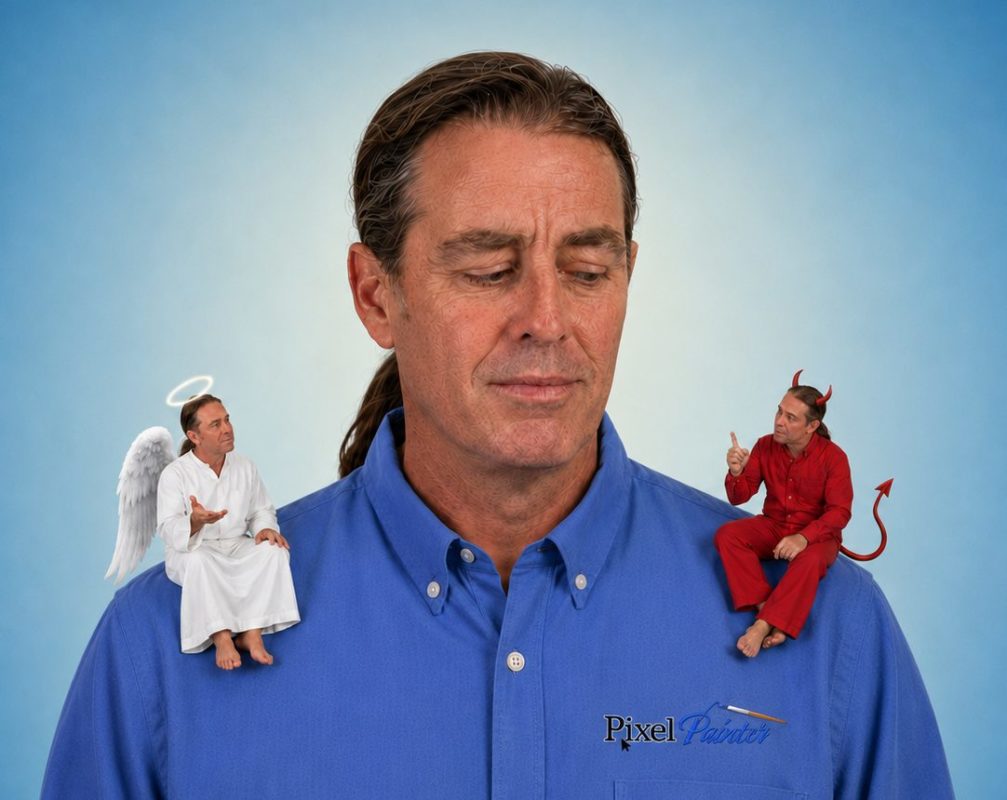
Shop NowFor the past few years, it feels like I’ve had two voices sitting on my shoulders every time the topic of AI comes up.


Every Creative Revolution Looks Like the End of Creativity
For the past few years, it feels like I’ve had two voices sitting on my shoulders every time the topic of Artificial Intelligence comes up.
One tells me AI is one of the most exciting creative tools I’ve seen in my lifetime.
The other warns about copyright concerns, job displacement, misinformation, deepfakes, concerns about resources consumption and the growing flood of AI generated content (slop) appearing online every day.
The uncomfortable truth is that they’re both right.
As someone who has spent more than four decades working in illustration, publishing, photography, video production, animation, visual effects, interactive media, and technology training, I’ve learned that every major technological shift arrives with both opportunity and consequences.
AI is no different.
What is different is the speed.
The technology is evolving faster than any creative tool I’ve witnessed before. New image generators, video tools, voice cloning systems, music generators, virtual actors, and AI assistants seem to appear almost weekly. The capabilities improve so rapidly that it’s difficult to keep up, even for those of us who spend our days testing them.
It’s no wonder people are excited.
It’s also no wonder people are concerned.
Why Everyone Is Arguing About AI
The concerns surrounding AI aren’t imaginary.
Artists worry their work was used to train systems without permission. Writers question how intellectual property should be protected. Musicians fear unauthorized cloning of voices and styles. Creative professionals wonder which jobs may disappear as AI-generated content becomes more capable.
Then there are the broader societal concerns.
- Deepfakes.
- Misinformation.
- Scams.
- Identity theft.
The ability to generate convincing but completely fictional images, audio, and video at scale. These are legitimate issues that deserve serious discussion. But while the technology may be new, the arguments themselves sound remarkably familiar.
In fact, I’ve heard many of them before.
What’s new is the concern about environmental and resource consumption that is very real, but with the miniaturization of technology that happens in all phases of evolutionary growth of an industry, the need for gigantic data centers will be short-lived, as AI models and smaller, cooler-running hardware can become localized and customized for the user without accessing the cloud – and the data centers to perform the “magic”.
I’ve Heard This Before
When photography first emerged, some artists believed it would destroy painting.
It didn’t. Painting evolved. Photography became its own art form.
When desktop publishing arrived in the 1980s and 1990s, many designers feared that anyone with a computer could suddenly claim to be a graphic designer.
In some cases, they were right. A lot of terrible design work was created. But desktop publishing also democratized communication and opened creative opportunities for millions of people.
When Photoshop became mainstream, critics argued that digital image manipulation wasn’t “real” photography. “People won’t know what is real or not!” “We don’t want to be fooled!”

Yet, long before Photoshop came on the scene, clever compositors armed with an airbrush and photo stripping processes could manage to fool millions of people in print for years.

Yes, I remember those debates well. And some still continue…
Today, Photoshop is one of the most widely accepted tools in the creative industry.
The same thing happened when digital cameras arrived. Film photographers argued that digital images lacked authenticity. Some claimed photography would lose its craftsmanship.
Instead, photography exploded. More people took pictures than ever before. More stories were told. More businesses were able to create visual content. Professional photographers continued to thrive by doing what professionals always do: creating work that rises above the crowd.
- Then came the internet.
- Suddenly anyone could publish.
- Anyone could write.
- Anyone could create content.
Again, critics weren’t entirely wrong. The internet introduced information overload, misinformation, and an endless stream of low-quality content. (Remember all the bandwidth-robbing over-designed FLASH SLOP that filled web browsers in the early 2000’s?)

But the Internet became the greatest global publishing and communication platform in human history.
The pattern repeats itself over and over.
Every new tool lowers barriers to entry.
Every new tool creates disruption.
Every new tool sparks fear that creativity itself is somehow being diminished.
Yet creativity has survived every technological revolution we’ve thrown at it.
What AI Actually Changes
Much of the current debate assumes AI is replacing creativity.
From what I’ve seen, that’s not really what’s happening.
What AI is replacing is friction.
For decades, there has often been a significant gap between having an idea and bringing that idea to life.
- Creating a film required expensive equipment.
- Creating animation required specialized software and years of training.
- Producing music often required access to studios, instruments, engineers, and collaborators.
- Publishing a book required editors, designers, printers, and distribution channels.
Today, a single individual can write a story, generate concept art, create a soundtrack, storyboard scenes, design marketing materials, build a website, and distribute their work globally.
That doesn’t automatically make the work good. It doesn’t guarantee success. And it certainly doesn’t replace talent.
But it does make creative exploration accessible to far more people than ever before.
The distance between imagination and execution has never been shorter.
For instance, a friend recently contacted me out of concern that his new band logo and fliers were being criticized by colleagues and others for being AI generated. He doesn’t want to stir up shit in his community, so he’s backing off out of the unbased concerns. “People are saying that you’re stealing from graphic artists who could have made some money designing for your band instead!”
To which my reply was, “Please tell me how much $$ you’ve spent in the past decade for a graphic designer to design your band logos and create fliers for your various live gigs around town. Please write it down.”
He just went blank.
“Exactly.”
The Part That Excites Me Most…
Of everything I’ve witnessed during this AI transition, the thing that excites me most isn’t the technology itself.
It’s the people.
For much of my career, I’ve written books, created training videos, taught workshops, spoken at conferences, and helped creative professionals learn new tools and workflows. The most rewarding part was never the software or the technology itself. It was watching someone have that moment when the light suddenly turned on.
The “AHA!” moment.
The moment they realized they could finally create something they previously thought was beyond their reach.
Today, I’m seeing that happen again and again and again.
I’ve watched people return to projects they’ve carried around for years.
- The unfinished novel.
- The song sitting in a notebook.
- The children’s book they never illustrated.
- The short film concept they never had the budget to produce.
- The business idea they never had the resources to market.
AI didn’t create those ideas.
Those ideas already existed.
The creativity was already there.
The passion was already there.
The dream was already there.
What AI is doing is helping remove some of the barriers that prevented those ideas from moving from imagination into reality.
For someone who has spent over 35 years helping people learn creative tools, that’s difficult to ignore.
Experience Still Matters
One misconception I hear frequently is that AI somehow eliminates the need for experience. Or talent.
My experience has been exactly the opposite.
- AI can generate images.
- It can generate video.
- It can generate music.
- It can generate words.
What it cannot generate is wisdom.
- It cannot generate taste.
- It cannot generate life experience.
- It cannot generate creative judgment.
The same prompt placed in the hands of an experienced storyteller often produces dramatically different results than when used by someone who has never developed those skills.
AI can generate a thousand possibilities.
Experience knows which one matters.
The technology may accelerate production, but the human element remains the most important part of the process.
It always has.
Creativity Isn’t Going Anywhere
The angel on one shoulder tells me AI will unlock creativity for millions of people.
The devil on the other warns about misuse, abuse, misinformation, copyright conflicts, and unintended consequences.
They’re both right.
Every creative revolution brings challenges.
Every creative revolution creates opportunities.
And every creative revolution sparks predictions that creativity itself is somehow under threat. I’ve watched those predictions surface repeatedly throughout my career.
The tools continue to change. The workflows continue to evolve. The technology becomes more powerful every year.
But the fundamental human desire to create, communicate, teach, inspire, entertain, and tell stories remains exactly the same.
Technology changes.
Storytelling doesn’t.
To learn more about Jeff and his business, visit pixelpainter.com