Filmtools
Filmmakers go-to destination for pre-production, production & post production equipment!
Shop NowModern lights becoming great.

The plummeting used prices of 575W HMIs suggest that there might soon be a dwindling of people in the world who remember what one looks like, at least among those of us who aren’t perpetually unloading half a dozen 18Ks at every new location. That has a number of side-effects, not least of which is the fact that nobody gets to use the word “striking!” any more without attracting a sidelong glance.
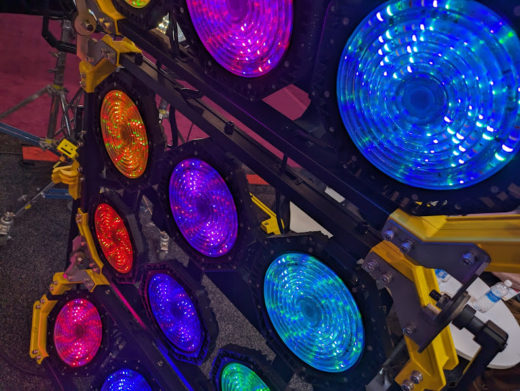
Another effect is that there is now a range of colours that many people simply have not seen in years. This is something which became clear recently when your correspondent was testing some vintage moving-mirror club lighting from decades ago, with the idea of approximating the famous sweeping beams of Blade Runner’s famous xenon spotlights.
In the end, it turns out this sort of thing might not always work very well, because ancient disco lights often aren’t that powerful. Even after we’ve scraped off all the nicotine stains provoked by late-nineties nightclub environments, they’re often only based around a 250W MSR light source. MSR is a close sibling of HMI, so it’s reasonably efficient. Even so, the optical path is full of rotating mechanics so that we can, by remote control, have a pink and blue beam with a cluster of four rotating flowers projected in it.
An appetite for intrepidity
That doesn’t tend to lead to a very low effective f-number through the light’s optical system (yes, f-numbers work both ways), so not many of the photons coming out of that 250W bulb make it to that moving mirror. There are better, brighter ones, often based around 575W or 1200W HMI sources, although anyone who wants to balance a 1200W Cyberlight on a combo stand had better have a few burly friends and an appetite for intrepidity.
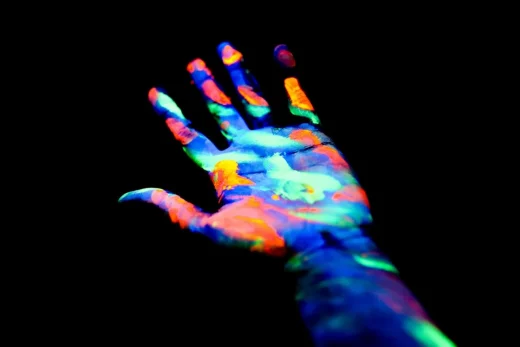
One thing that’s common to all these lights, however, is a colour wheel of dichroic filters. Most of them are designed to produce punchy, saturated effects colours, and one of those effects colours is often a very deep blue, designed to allow the light to create an almost-blacklight effect which will make dayglo objects fluoresce. It’s somewhat akin to the #181 filter called Congo Blue, which is an extremely powerful hue. Add atmos, and the air more or less seems to vibrate.
There was a time when these ultra-deep blues were a common tool in theatre and club lighting, but most of the world’s LED lighting doesn’t emit any blue light that’s deeper than the blue of a blue LED. The physics of phosphors allow them to turn bluer light into redder light, but not vice versa. As a result, most of the LEDs we now use in film and TV work (and night clubs) simply can’t produce that sort of blacklight effect.
Old club lights – and a very few recent LEDs – can.

Brilliant white
Experiencing surprise at the perception of a colour – which is what happened to your narrator – is something that is difficult to describe in print. Certainly, that deep violet-purple is a colour that exists more rarely than ever in the modern world, because many of our lights simply don’t create it. White light which includes that blue looks pure and brilliant in a way which recalls the comparison between HDR and SDR images, where SDR looks fine until the more capable format makes it look downright faulty by comparison.
It’s not even clear that the extremes of colour we’re talking about are even covered by high-capability gamuts such as Rec. 2020. If cameras can’t even see these colours, the whole thing might seem like an interesting dead-end for film and TV people. There’s likely to be an even larger range of cyan-green colours which modern systems struggle to handle.
The reason this matters – and the reason it’s been pursued in recent lighting designs – is partly because there are still blues cameras can see but many LEDs can’t light. It might seem that dayglo objects are rare in production design, which is true if we think only in terms of 1980s beachwear. What’s less well known is that human beings are somewhat fluorescent, so yes, blue affects skintones, because both elastin and collagen glow. So do the dyes which laundry detergent manufacturers describe as leaving your whites looking whiter.
It will likely be a while before this technology is in every light on the market. LEDs capable of generating a really powerful violet light are a recent invention and come at a price. About a year ago, we talked about LED colour quality, and how the greatest opportunity for improvement was no longer the sort of light we might expect to illuminate human skin. Back then, the price of emitters capable of really shortwave blue was too high. That seems to have changed, and as we move into the 2025 trade show season it’ll be interesting to see what comes next.