

Filmtools
Filmmakers go-to destination for pre-production, production & post production equipment!
Shop NowSometimes we want to prove the existence of a biased source, without encouraging others to discover it out of context.

Although I have been aware of its existence for several years (or decades), the other day when I published the article: E-commerce sales tax: Let’s stand our ground. Don’t let them bully you!, it was the first time I actually invoked the Nofollow setting in a linked web page. Nofollow is a setting on a web page link (aka hyperlink) that directs search engines not to use it for page ranking calculations. It is specified in the page as a type of link relation; that is: <a rel=”nofollow” …>
Because search engines often calculate a site’s importance according to the number of hyperlinks from other sites, the nofollow setting allows website authors to indicate that the presence of a link is not an endorsement of the target site’s importance.
Although the actual code will look like this: <a href=”https://example.com/” rel=”nofollow”>Link content</a>
<a href="https://example.com/" rel="nofollow">Link content</a>
Fortunately, in WordPress it is handled quite simply with the popup dialog box which we see when creating or editing an existing link.
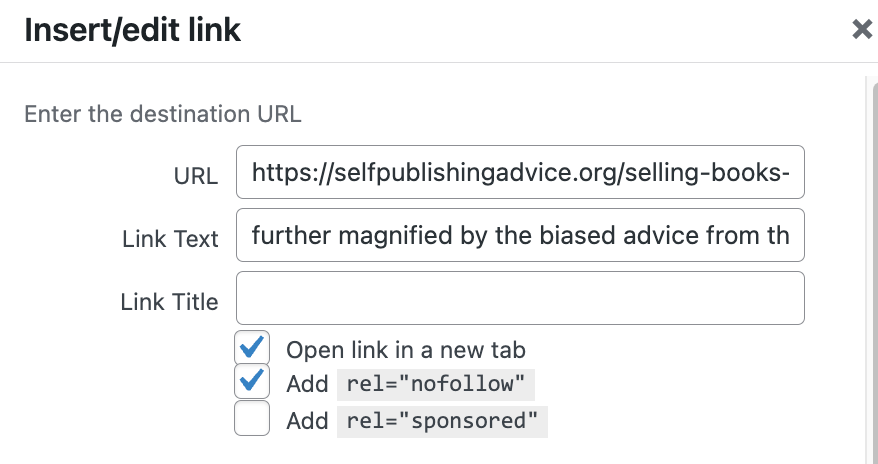
If your WordPress user interface is set for English, it will be the second option as shown in the screenshot above, labeled: Add rel=”nofollow”
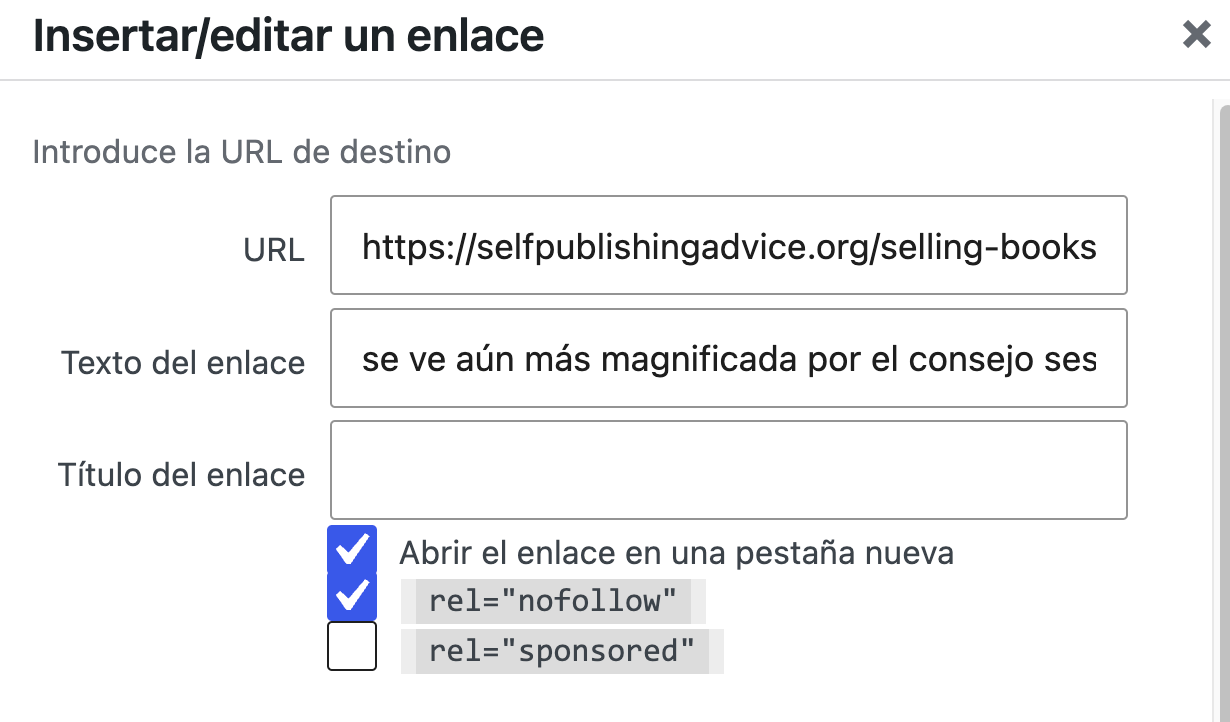
If your WordPress interface is set for Castilian (aka «Spanish» or «español»), it will be the second option as shown in the screenshot above, labeled: rel=”nofollow”
The reason is because I was making reference to very biased advice from a source called the Alliance of Independent Authors (ALLi). The details about the biased advice and the reason for it is covered in my article:
E-commerce sales tax: Let’s stand our ground. Don’t let them bully you!
I am very glad that WordPress simplifies creating a link using nofollow for cases like this one.
Behavior of different search engines
Per my research, while all engines that use the nofollow value exclude links that use it from their ranking calculation, the details about the exact interpretation of it vary among search engines.
- Google states that their engine «in general» takes nofollow literally and does not «follow» the link.
- Yahoo! follows it, but excludes it from their ranking calculation.
- Bing may not follow it, but they exclude it from their ranking calculation.
Despite that variance among search engines, the nofollow value is currently the best option we have when our goal is to link to a biased source for reference and prove something otherwise unbelievable, but avoid increasing the biased source rank page.
Lee este artículo en buen castellano
Cómo usar el ajuste Nofollow (No seguir) en los enlaces de los sitios web para fuentes sesgadas
(Re-)Subscribe for upcoming articles, reviews, radio shows, books and seminars/webinars
Stand by for upcoming articles, reviews, books and courses by subscribing to my bulletins.
In English:
- Email bulletins, bulletins.AllanTepper.com
- In Telegram, t.me/TecnoTurBulletins
- Twitter (bilingual), AllanLTepper
En castellano:
- Boletines por correo electrónico, boletines.AllanTepper.com
- En Telegram, t.me/boletinesdeAllan
- Twitter (bilingüe), AllanLTepper
Most of my current books are at books.AllanTepper.com, and also visit AllanTepper.com and radio.AllanTepper.com.
FTC disclosure
None of the listed individuals or companies mentioned above has paid for this article. Some of the manufacturers listed above have contracted Tépper and/or TecnoTur LLC to carry out consulting and/or translations/localizations/transcreations. So far, none of the manufacturers listed above is/are sponsors of the TecnoTur, BeyondPodcasting, CapicúaFM or TuSaludSecreta programs, although they are welcome to do so, and some are, may be (or may have been) sponsors of ProVideo Coalition magazine. Some links to third parties listed in this article and/or on this web page may indirectly benefit TecnoTur LLC via affiliate programs. Allan Tépper’s opinions are his own. Allan Tépper is not liable for misuse or misunderstanding of information he shares.