

Filmtools
Filmmakers go-to destination for pre-production, production & post production equipment!
Shop NowAfter Effects is dead again, and other obvious stuff.

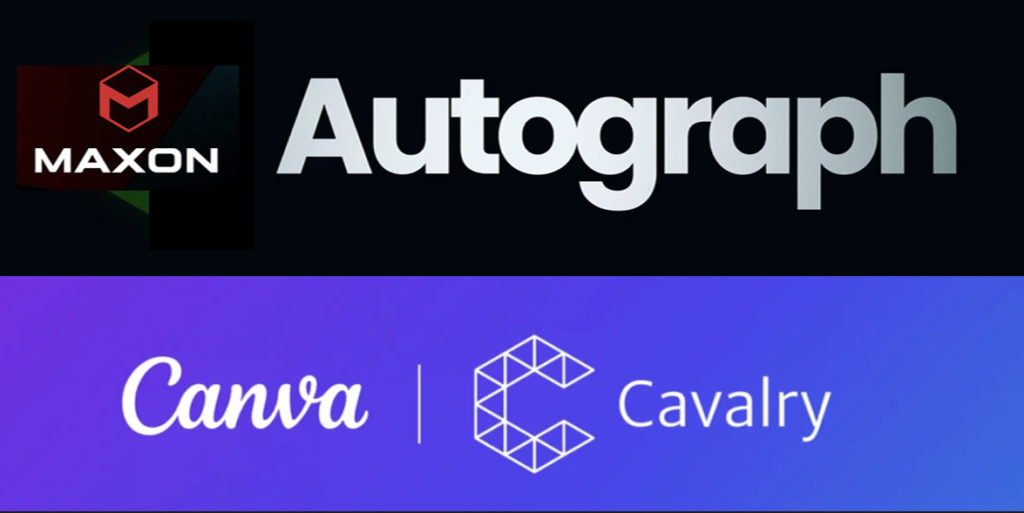
 Despite Adobe going full bore on feature releases (especially in After Effects), its subscription model is still very unpopular and Wall Street is looking for a takeover and backing AI tools instead. With announcements of free versions of Maxon Autograph and Canva Cavalry at the NAB 2026 (National Association of Broadcasters) convention, we might be at the beginning of another era of competition in motion graphics and compositing software.
This seems like a shakedown cruise, and there’s no end in sight. Are these freemium apps just loss-leaders for the competing suites or ecosystems? Are those ecosystems enough? How long will they remain free? Should we hedge bets and treat the free apps like plug-ins to AE? Should you boycott AI? What role will local apps have in relation to gen AI? Will metered-by-use through credits be required for major new features?
Of course, none of these questions have firm answers!

So, now we see headlines (predicted by Eran Stern) like After Effects Killers Cavalry *AND* Autograph NOW FREE!, After Effects Is Actually Cooked Now — Cavalry Just Went Free, and After Effects is Actually Cooked Now — Autograph Just Went Free.
Really? But we could reasonably ask Why Are All Apps Suddenly “Free”? (lifted from Grayson). Michael Sturgill has a reasonable if hostile argument in Why Everyone Is Leaving Adobe? He leaves out retraining costs, although his target audience is younger and there’s trouble in the economy.
Of course, if the economy does take a big turn for the worse, and it does seem that a big war destroying energy supplies is possible, yes that could cause a mass exodus away from Adobe. This could be a collapse effecting all subscriptions as well as AI alternatives.
The “After Effects killers” of the past (mainly Commotion and Combustion) failed because they were a bit more expensive and AE responded with competitive feature updates. Plus Adobe already positioned their apps in education, and cracked versions could be safely had and installed. After Effects remains a common touchstone.
The challengers of 2026 may succeed by offering professional-grade tools for cheap, as a loss-leader for suite or ecosystem, or to gain a foothold targeting the next generation of artists, or being front-ends or adjuncts of a generative AI future. Who knows if the AI bubble will burst as the bills arrive, or what “timeline” will unfold. Perhaps AI will remain unable to fulfill client fantasies of cheap magic buttons, and creative apps will remain crucial.
Oddly, the markets of both creators (the kids keep coming) and creative software seems oversaturated. Here are some of the players courting creatives in motion graphics and VFX. There’s certainly no denying that, right now, indies can easily build an old-style pro video graphics suite for free.
- Canva Cavalry is now free
- Maxon Autograph is now free
- Canva Affinity is free (consider also Affinity’s AI Connector for Claude), with charges for new of AI features.
- Lightroom Classic is mostly free to use except the Develop module, says Tony Photo Pilot.
- Davinci Resolve has a free version, just added a Raw Photo Mode, and imports layered Affinity Studio .af files.
- Da Vinci Fusion (poor man’s Nuke) is part of the inexpensive Black Magic Design Suite, which features new AI tools
- Unreal Engine a free game engine (ignoring World engines and gaussian splats)
- Blender is free and has an improved compositing tool (Netflix support and Copy to Autograph for Blender).
- Nuke from The Foundry has a hobbled free version.
- Autodesk Flame
- Motion from Apple is inexpensive.
- Rive, apparently
- Moho for animation has educational pricing
- An AE browser-based clone and Mac app, Plate.video from Marco van der Vlag. It has basic image processing, displacement and some fun noise effects.
- Open source software doesn’t offer much aside from Blender. Natron has been static since 2022, and Jahshaka is discontinued. Wait… Friction is a newer open source mograph tool getting updates.
Kashu Universe has a handy industry overview, though it reflects trends beyond standard filmmaking aspiration. See The real tools that will define motion graphics in 2026. If you need more, see the extensive review from School of Motion last December, The HONEST Truth About Motion Design in 2025 | Year in Review. If you can spare some of the 11 hours of review, you’ll find plenty of expert perspectives on current apps and the current role of AI.
Note: The creative software industry has declared war on Adobe, “If you can’t beat them, undercut them on price,” by Jess Weatherbed on The Verge, was good. Hopefully the free link works.
 There are more players than ever in motion creation software and that’s apart from the many generative AI tools backed by investors. It’s not only about the perception of weakness of Adobe on Wall Street, or getting existing users away from Adobe subscriptions, but software creators are also playing the long game of getting young creatives to learn these alternatives in addition to the Adobe Creative Cloud. Perhaps Adobe also benefits from a strong ecosystem of varied apps and third-party utilities and tutorials. Who else has something as amazing as aescripts.com?
Many don’t realize that After Effects survived a couple of very capable direct contenders in the late 1990’s and 2000s — Puffin Designs Commotion and the Denim/Discreet/Autodesk paint and effect app.

Denim Software Illuminaire Paint and Effect premiered at NAB circa 1997, courted by Kodak, but snatched immediately by Discreet Logic. It was later bought and released by Autodesk as Combustion, and finished as Combustion 2008. Maybe they could make more money selling Flame.
Puffin Designs Commotion was at first positioned as a rotoscoping, tracking, RAM preview player tool adjunct to AE — though soon Adobe copied some features and Puffin added multiple layers and a similar timeline to become direct competition.
Puffin Designs was later acquired by Pinnacle Systems in 2000. It was too late to help Pinnacle, who really pined over “Combustion” and had vowed to take over Avid — though instead, Avid acquired Pinnacle amidst the dot-com bubble and delay of web video. As a side note, Avid is not as moribund as it might seem on the outside, but it still seems to be playing catch-up (looking at Integrating ComfyUI & Avid: Google AI’s Big Move).
 Roland Kahlenberg also has some observations on this news in Motion Design Tools – April 2026.

Maxon bought Autograph, and Left Angle, developer of motion design tool Autograph, shut down about a year ago. AE plug-in maker RE:Vision Effects distributed the software.
Maxon just made this USD-native compositor free for individuals, even the formerly premium features (later they made it free for teams too). Autograph is an alternative to After Effects, with which it shares a layer-based compositing workflow, although it shares some feel of Fusion’s 3D mode.
It’s fair that Maxon responds to the Adobe “excursion” into 3D, and even though the market for 3D creation on a grand level is saturated, users shouldn’t expect prices much cheaper than Adobe. Maxon seemed destined to challenge After Effects (fxguide’s history) given the newer staff that came from Adobe and the Puffin Design/Red Giant nexus.
There’s some good comments on Autograph in the “The Autograph Curveball” section of the Motion Design in 2025 | Year in Review from SoM. A few days ago Jake In Motion went commando, opening Autograph cold, and that mainly showed that there’s a big learning curve even for advanced AE users. While Autograph seems unlikely to disappear, Maxon could shut users out in 7 days (online weekly resubscription is required), as they did when they bought Autograph last year.
Other observers are jumping in. In addition to Motion By Scott, Momo PTFL says that Autograph is back and completely free! But… (promising but dropped Linux and requires log into Maxon each week). And Jorge Lega offers another orientation in Maxon Autograph is FREE — First Look at 3D Compositing, Lights, and USDZ Import.
Maxon already offers training on Autograph – Getting Started on Cineversity from old AE hand Chad Perkins (another into).

Canva bought Affinity for 2D graphics, which merged and became free. Then Canva bought Scene Group’s Cavalry and MangoAI. Cavalry is a quite powerful adjunct but doesn’t replicate After Effects compositing tools. Having been around for some years, Cavalry already has current training available, Getting Started | Your First Scene in Cavalry and a Cavalry series.
We’ll have to wait to see if complaining about Adobe costs might look silly when the AI bills hit for real, since credits are metered. Yes some newer tools are free. The first taste is always free! Affinity, Blackmagic Design, Apple Motion Studio have exclusive features for subscription fees. Perhaps it comes down to which ecosystem you prefer, unless money and time is no object, assuming the economy rebounds from oil price shocks, aimless costly wars, and other questionable investments.
Another free app, HitFilm provides another example of what is possible in the brave new world of creative apps. For an overview, see the HitFilm founder’s story.
FXhome Hitfilm was shut down and the company sold to Artlist, which quickly pivoted to AI. They now have AI Toolkit, a platform for generative AI image, video, voiceover and music generation, using top AI models and additional assets. Their claim is that Artlist Studio helps create high-end production with full control to “change everything.”
Improving AI usability and precision is something that Adobe (and many others) is working on a variety of fronts. With the new experimental technology MotionStream, video creators can interact with AI-generated video while it’s being created, directing the movement of objects and changing camera angles in real-time with the simple use of their cursor and sliders. See also Adobe’s Introducing Project Graph: Creative workflows reimagined.
It’ll be interesting if Adobe Firefly AI features ever come to After Effects (apart from third-party extensions and plug-ins).
If you’re on the $200 a month Claude AI plan, you can replicate this short video by Nate Herk | AI Automation, Claude Just Destroyed Every Video Editing Tool. There are other guides, like Video Editors… don’t die, adopt Claude Code I beg, but don’t expect free or cheap usage credits!
Plate.video is a new free vibe-coded web/Mac app in Alpha, from Marco van der Vlag. It has basic image processing, displacement and some fun noise effects. The video covers every major feature: shapes, keyframing, the timeline and graph editor, effects, replicators and modifiers, blend modes, adjustment layers, and export.
This proves that basics can be free or cheap, even if highly ambitious apps like Autograph and Cavalry end up having a limited run as free apps. Or perhaps they can remain free as an ecosystem sweetener, or even complement another ecosystem, like how Canva and Cavalry help complete the Blackmagic bundle. And additional features might require an upgrade charge, again like Affinity and the Blackmagic Design apps.
Later: There is yet another new competitor, Caddis. See A Vibe-Coded After Effects competitor? from Jake In Motion, who was joined by the creator of Caddis to help answer questions and explain the project.