

Filmtools
Filmmakers go-to destination for pre-production, production & post production equipment!
Shop NowA lot of people – but what of gear?

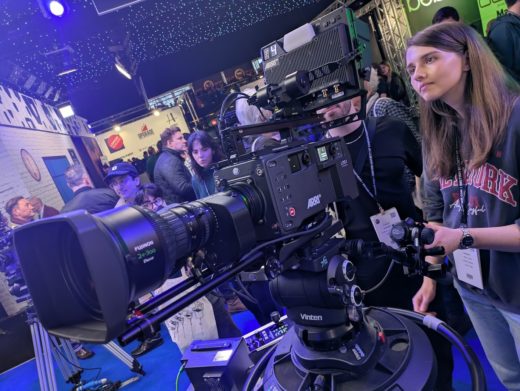
There is sometimes a feeling that a well-attended film and television trade show suggests that crew are lacking other things to do. London’s BSC Expo, though, has often seemed equally full of humans in times of both scarcity and plenty, so it is perhaps less of an economic bellwether than other shows. Either way, it is determinedly high end, but naturally, space precludes mentioning every exhibit, so this will inevitably be a pick of eye-catching new tools.
At least one manufacturer seems to have realised that things can be made eye-catching by painting them red. Very near the entrance was a piece of equipment embodying just the kind of speculative technological daring that film equipment people enjoy – and yes, the big, red elephant in the room is the K65K high-sped 65mm camera. It’s a comprehensive rebuild of the Photo-Sonics 10B, made originally to shoot high speed 10-perf 70mm negative (yes, 70mm negative) in research and engineering applications.
The K65K modifies that platform to handle 6-perf 65mm at up to 800 frames per second, or 12-perf at half that speed. 12-perf yields a square frame, causing meanies like your narrator to jest that this is the world’s most spectacular Instagram camera. There are some drawbacks: the oddball formats are not readily handled by scanners (the company has stitching software), the viewfinder is parallax, and the cost of care and feeding means there’s no surprise that Kodak was willing to host the camera on its own booth – but anyone with deep enough pockets can hardly fail to be impressed.
The ambitious midrange
Back on a more sensible plane of reality, Tilta showed Nucleus, a device which gifts many of the benefits of modern autofocus to people using more traditional lenses. The concept is simple: the PL-E mount (seen at the show) interprets signals from the mount on a mirrorless camera and uses it to drive a cinema-style focus motor operating a cinema-style lens. The combination of a mechanical lens plus focus motor mostly have usually the performance of a dedicated mirrorless stills lens, but it seems like an attractive way to both have and eat cake for people working on increasingly ambitious midrange productions.
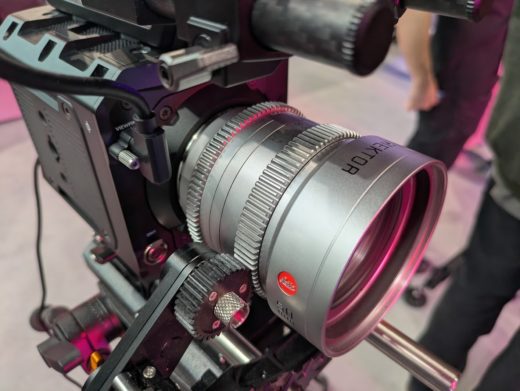
That part of the lens market might find another good match in the Hektor series which took pride of place on Leitz’s exhibit, having been announced in September last year. A compact set of six T2.1 primes from 18 to 100mm available in E, L, RF and Z mounts, Hektor is very much in the vein of Cooke’s spectacularly successful SP3 range (though the Leitz option is still somewhat more expensive). Leitz builds Hektor, which it describes as being inspired by the M series of the early twentieth century, at the same facilities as its established cinema lenses.
There seems huge confidence in the endless buoyancy of the lens market. Arri showed Enso, Zeiss showed the high-performance T1.5 Aatma, and Sigma showed its AF zooms, which are another novel idea inasmuch as they combine, as much as possible, the characteristics of a mechanical cinema zoom with the AF options of a stills design. This sort of thing has been tried a lot – Sony’s SELP series of power zooms, in particular – but rarely with such clear dedication to matching the feel of a real mechanical zoom.
Lighting has grown up
The question is whether electronically-controlled focus really feels like a true manual mechanical focus, and the honest answer is not quite, but it’s very close, and very respectable. These lenses are too limited in zoom range (there’s a 28-105 T3 and a 28-45 T2) to scare Fujifilm. Still, they seem likely to sell in large numbers to people whose desires run to tradition, but whose needs demand modernity. We could discuss lenses forever – Sigma also showed its Aizu primes, its first ground-up cinema design, and True Lens Services had not only its Nikon-AFS-based Vega 65 series but also a new zoom, an Angenieux-based 45-90mm, to follow up on the successful Morpheus.
Away from glass, the increasingly mature world of LED lighting seems increasingly ready to specialise. Aputure’s Nova range now includes a design projecting a nine-degree beam. Making full use of this will require plenty of space, but the option to create highly parallel, low-falloff illumination is likely to appeal to certain parts of the market. Large arrays could cover some very large setups. On a smaller scale, the company’s Nova II range packs 500 watts (and its high-quality colour engine) into a foot-square panel, which is… a lot, in comparison to previous norms.
So, exhibitors at the 2026 event seemed at least as confident as the bustling crowd. The crossover between worlds hinted at by Tilta’s Nucleus and Leitz’s Hektor seems more influential year on year. What that means for actual techniques deployed in the field remains to be seen, but like it or not, the need to travel light and move fast is pushing people at all levels in directions that once might have been – to put it mildly – counterintuitive. Auto focus on a film set? Apparently so.