

Filmtools
Filmmakers go-to destination for pre-production, production & post production equipment!
Shop NowFree from the conventional fine metal mask (FMM) process that makes the process expensive, the new technology FLiPP paves the way for the next OLED technology.

 FliPP monitors enable displays to increase brightness by 1.6 times, extend lifespan by 2.4 times, and reduce power consumption by 13%. LG Display promises they will arrive in 2029.
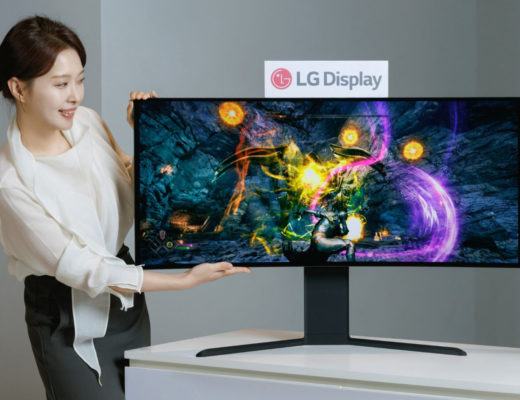
LG Display announced the introduction of new OLED monitors and technologies at CES 2026, saying that its Tandem technology opens a new chapter for OLED, with boundless potential and limitless scalability. During the event the company announced a rebranding of its Tandem technology, suggesting that the name change unfolded the full spectrum of what OLED can become. But… the story was to continue!
Since 2013 when the company successfully mass-produced the world’s first large-sized OLED TV panels, that LG Display’s journey has been defined by continuous breakthroughs that push beyond structural limitations, and the new direction was first revealed last August, when LG Display announced the successful development of a dream OLED patterning method that is free from the conventional fine metal mask (FMM) process, using its own proprietary technology. Its groundbreaking FMM-less method delivers much greater flexibility in mass production as well as brighter panels with longer lifespan and lower power consumption.
Unveiled at the International Meeting on Information Display (IMID) 2026 in Busan, last August, FLiPP (FMM-Less innovative Pixel Patterning) technology eliminates the disadvantages associated with the metal plates used in the FMM process that has been the mainstream OLED manufacturing method for over a decade. LG Display explains that “FLiPP eliminates the disadvantages associated with the metal plates used in the FMM process that has been the mainstream OLED manufacturing method for over a decade. The FMM process requires large mother glass substrates, such as 8.6th-generation or other 8th-generation (2,200 × 2,500 mm) substrates, to be divided and processed as half-cut substrates due to the limited size of FMM sticks.”
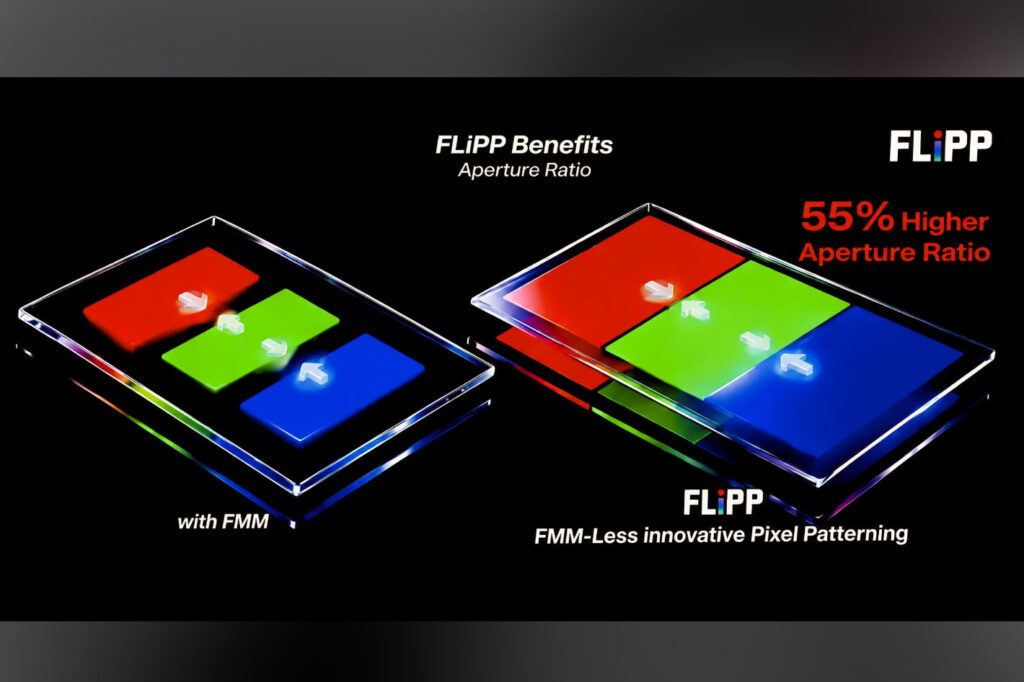
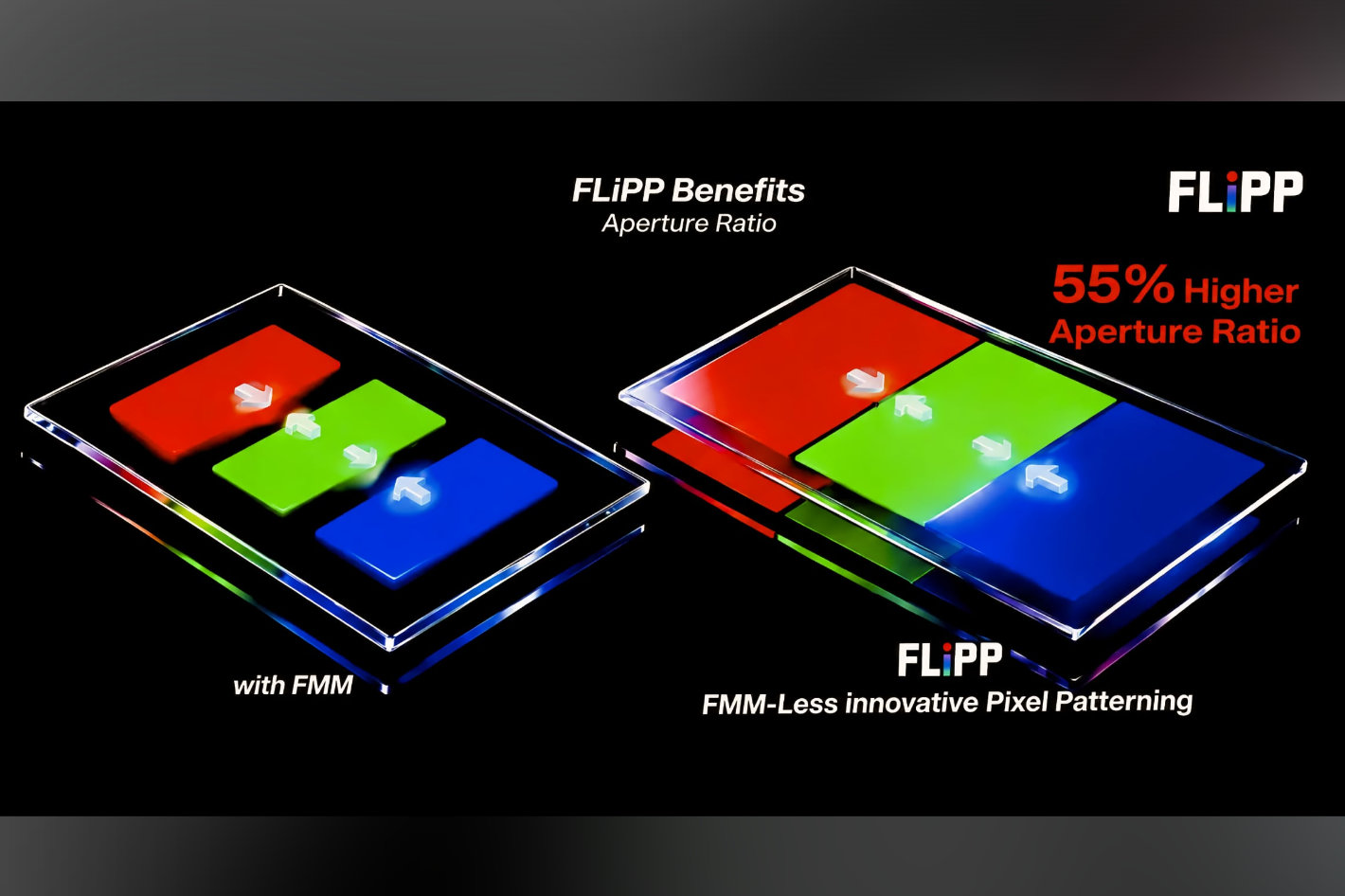
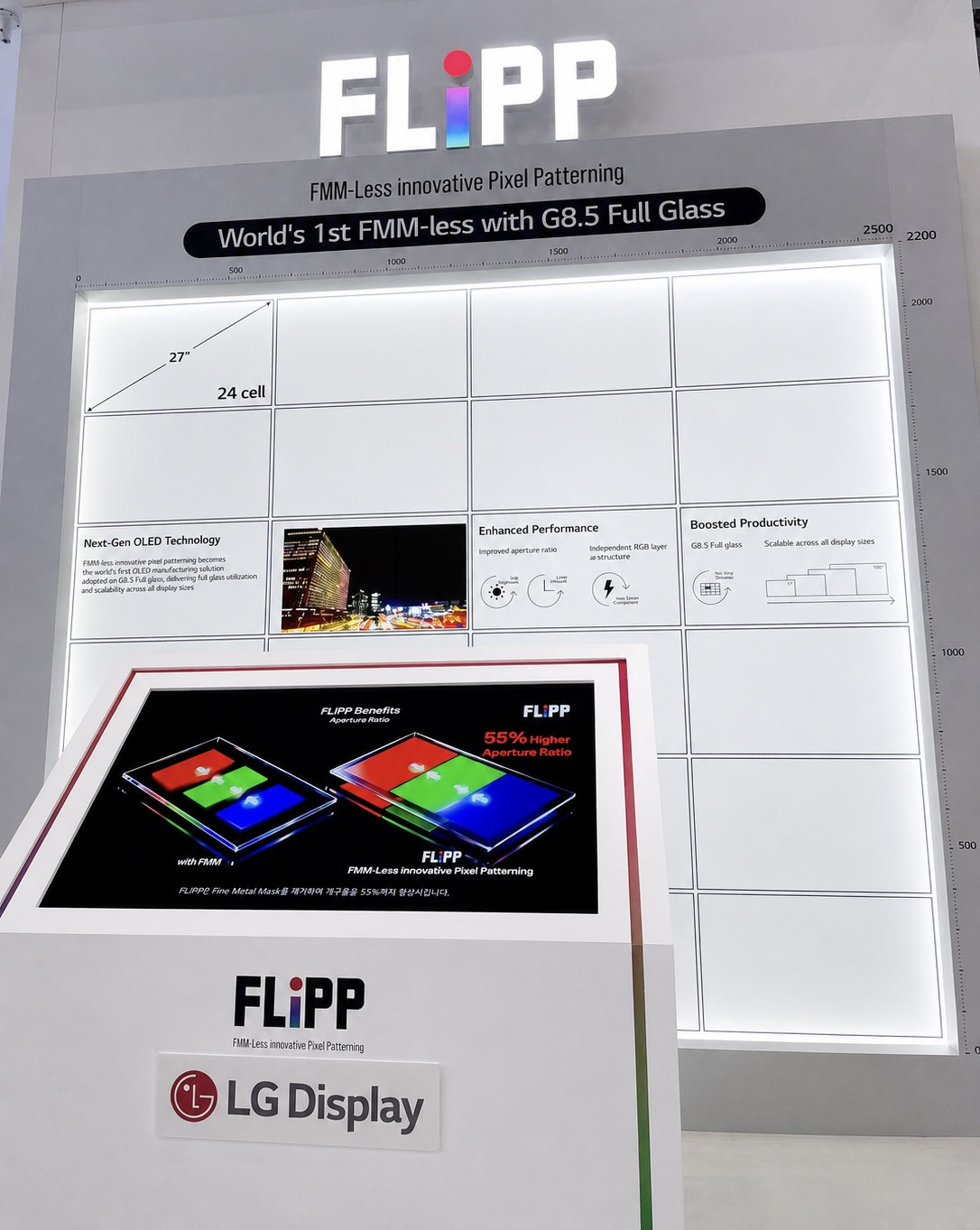 What’s interesting for consumers is that when compared with panels produced using FMMs under identical conditions, FLiPP enables displays to increase brightness by 1.6 times, extend lifespan by 2.4 times, and reduce power consumption by 13%. This is because FLiPP, free from the physical constraints of the FMM, improves the aperture ratio — the proportion of the total display area occupied by RGB pixels — by approximately 55%.
The process translates into cheaper TV and monitors, as the new panels will not use the FMM method, which adds to manufacturing costs as expensive new FMMs must be produced whenever the panel size or resolution changes. This leads to another advantage of FLiPP: as it is free from panel size and resolution constraints, it can be used, in theory, LG Display claims, to produce displays ranging from 1 inch to 100 inches and can be applied not only to conventional panels but also to VR and AR displays, making it a virtually universal, “ultimate technology.”
The revolution that FLiPP represents has made LG Display change course, starting by scrapping plans for a new 10.5-generation factory that was first announced in 2019, while preparing to convert one of its actual factories, producing 8.5th-generation mother glass, for mass production of the new FLiPP.
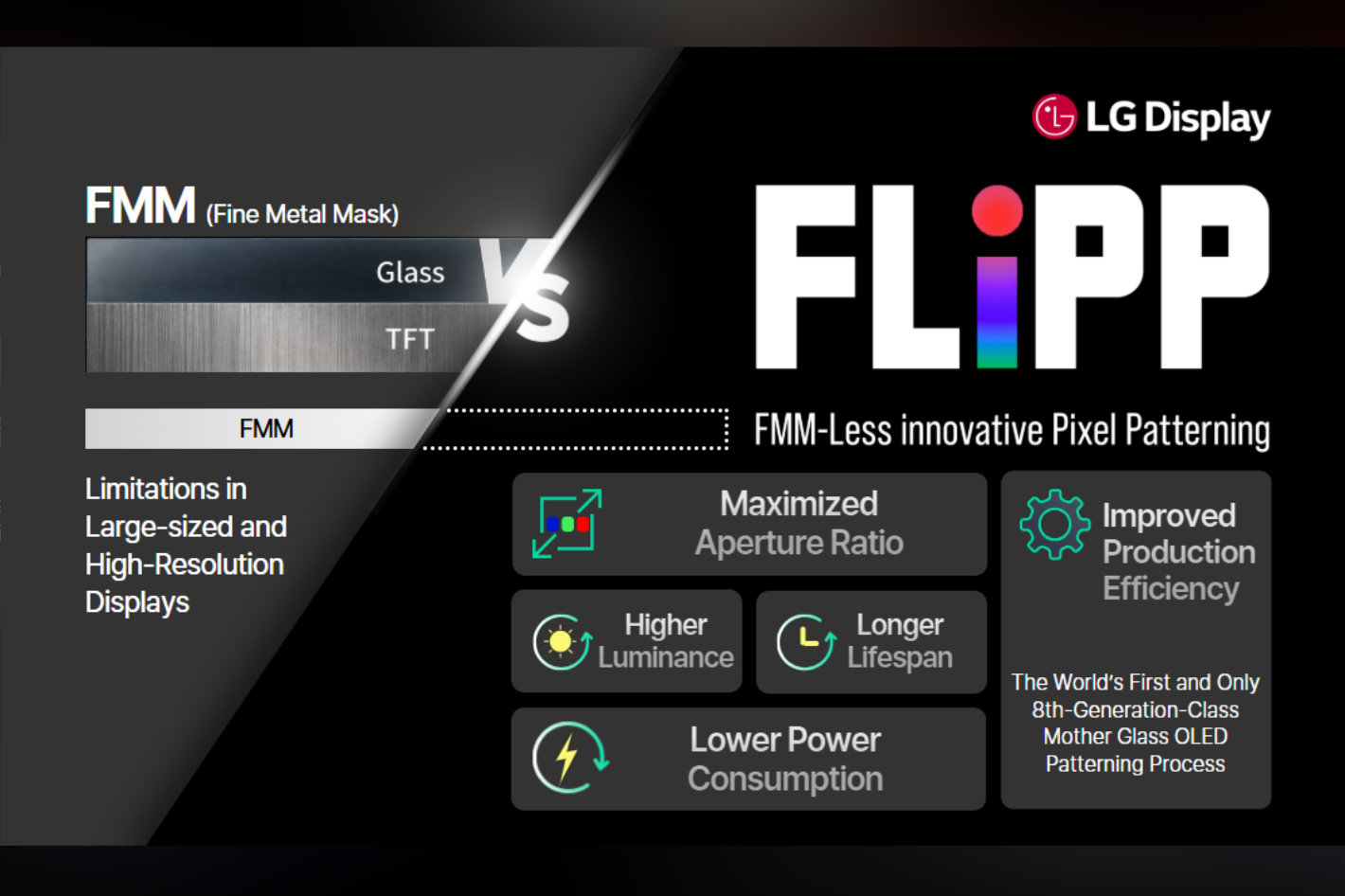 According to LG Display, “leveraging its existing large-sized Tandem WOLED production infrastructure and technical expertise, FLiPP has allowed LG Display to become the first display company to manufacture FMM-less OLEDs using 8.5th-generation mother glass as a single whole piece. Compared to the production of OLED laptop panels of the same size made using FMMs or other FMM-less methods that require divided substrates, FLiPP delivers up to 64% higher mother glass utilization efficiency. As a result, less substrate material is wasted and FLiPP directly translates into higher productivity and lower manufacturing costs.”
Although there are other companies exploring the technology, LG Display offer, the company claims, “the world’s only FMM-less manufacturing process for 8.5th-generation OLED panels” and the company has filed trademark applications for FLiPP in Korea and key global markets. The company is also strengthening its OLED technology leadership by combining RGB OLED, widely regarded as the most advanced OLED technology available today, with FLiPP, its next-generation innovative manufacturing process, to maximize production flexibility and efficiency.
The first LG Display products using the technology will be available in 2029, starting with IT applications such as tablets and monitors, and expanding its range of FLiPP-manufactured panels to cover a range of products from 1-inch wearable devices to ultra-large TVs — tailoring products to customer needs.
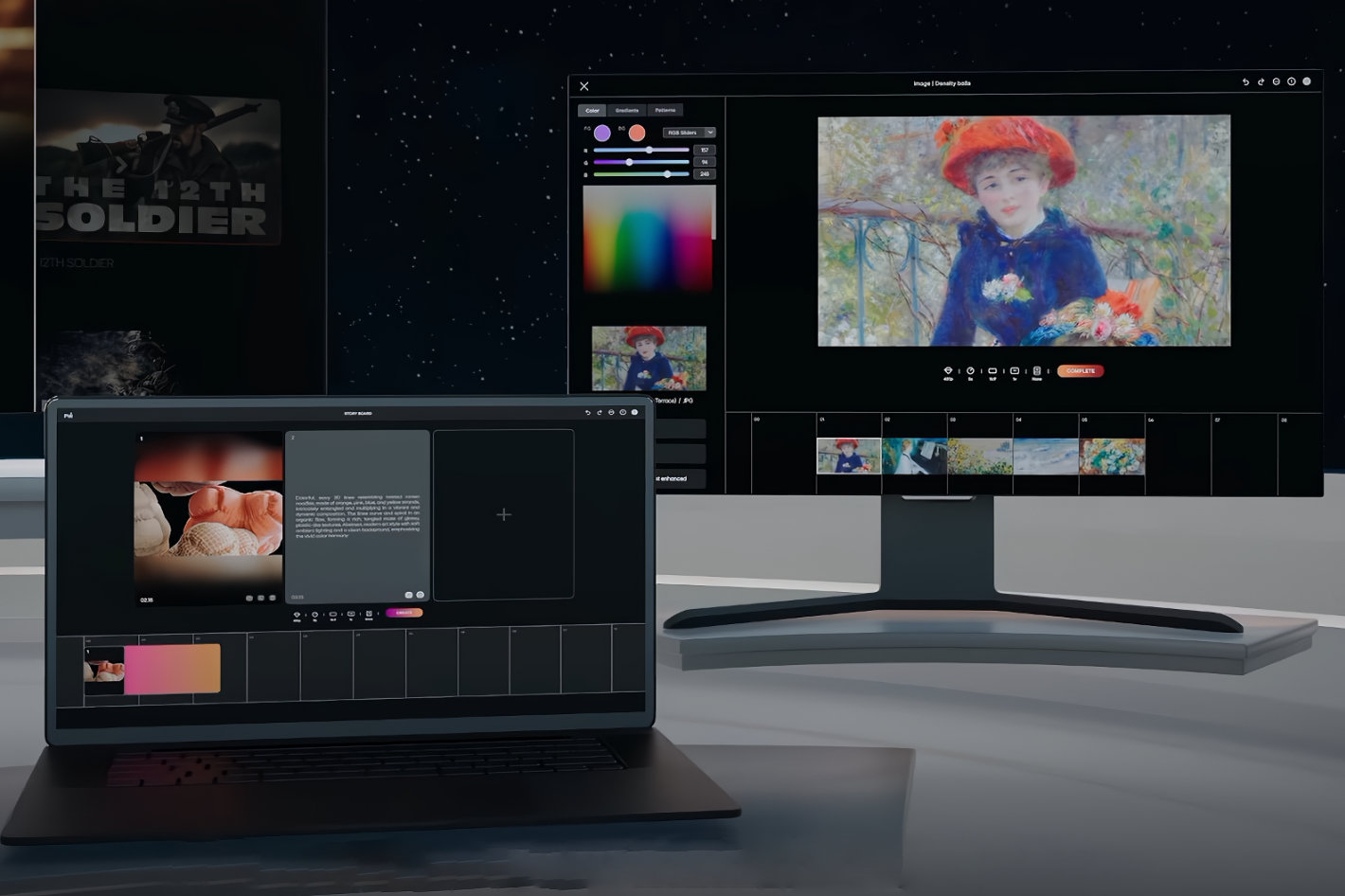 FLiPP also enables individual optimization of red, green and blue devices, allowing pixel designs to be tailored to the characteristics of each emitter. This improves OLED device efficiency while enabling a wider color gamut and wider viewing angles. For the end user it translates into enhanced colour accuracy, meaning that whether you’re editing photos or watching your favorite series, what you see is faithful to the original creation. It also means that, thanks to wider viewing angles, colour and clarity are maintained even if you’re not sitting directly in front of the monitor.
The first products using FLiPP technology will be tablets and monitors, meaning creative professionals will be some of the first users given the chance to try the dream next-generation OLED technology. Price for the new products is still unknown, but as LG Display claims one of the advantages of FLiPP technology are “lower manufacturing costs” it makes sense to expect cheaper, better monitors in the future. Two things are already promised: they will be more power efficient and have an extended lifespan.