

Filmtools
Filmmakers go-to destination for pre-production, production & post production equipment!
Shop NowThis is a posthumous review of a nearly universal Beta player I never realized Sony had manufactured.

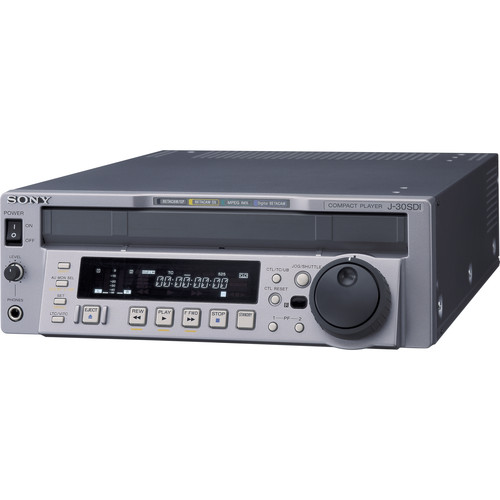
As I have gradually been teasing in a few recent articles, I am evaluating a pair of very interesting devices that capture classic interlaced analog, de-interlaces and upscales in realtime directly to 1080p60 to retain the original smoothness of motion. Some of the classic material I have been capturing-deinterlacing-recording to 60p and recording have been from Betacam SP, the leading component analog that officially lasted until 2001. Betacam SP was the successor of the original Betacam oxide format which had been released in 1982, and was replaced by SP (Superior Performance) in 1986. During its lifespan, I knew the Betacam SP line of recorders and features by heart: The BVW-60 player only, the BVW-65 player only (with dynamic tracking and broadcastable variable motion: still frame, slow and fast), the BVW-70 recorder/editor only, and the BVW-75 recorder/editor with dynamic tracking which initially cost about US$40,000 (for the NTSC version)… and the BVV-5 docking recorder with four XLR balanced mic inputs. All five mentioned Betacam SP models were either NTSC or PAL. Later, I discovered the lower-cost industrial PVW variants. None of these was multi-standard. After Betacam SP. I never became aware of the exact models of the subsequent Betacam SX, MPEG IMX and Digital Betacam models which superseded Betacam SP. Now, this article is about the wonderful Sony J-30SDI player-only I accidentally discovered in Memo Sauceda‘s possession after the 28 kg (62 pound) BVW-75 deck which was delivered to my door turned out to be non-functional (wouldn’t accept any cassette). The J-30SDI is not only multi-standard (NTSC/PAL), but can happily play original Betacam, Betacam SP, Betacam SX, MPEG IMX and even Digital Betacam. It weighs only about 8.2 kg (18 pounds! The J-30SDI deck that 3x Emmy Award Memo Sauceda had in his possession saved the day quite gracefully, aside from a surprising detail we discovered about his particular unit.
Official outputs on the J-30SDI deck

ABOVE: Photo courtesy of Sony’s official J-30SDI brochure.
- Video outputs: 2x SD-SDI (BNC), 1x Composite (BNC), 1x Composite (RCA), 1x S-Video (aka Y/C via 4-pin), 1x Component (Y/R-Y/B-Y).
- Audio outputs: 2x XLR (Balanced), 2x RCA (Unbalanced), 1x 1/4-inch Stereo Headphone jack.
- Digital/Data Outputs: 1x IEEE-1394 FireWire (i.LINK 6-pin).
- Control/Timecode: 1x Time Code (BNC), 1x RS-422A (9-pin), 1x RS-232C (9-pin).
Variant outputs on Memo’s J-30SDI
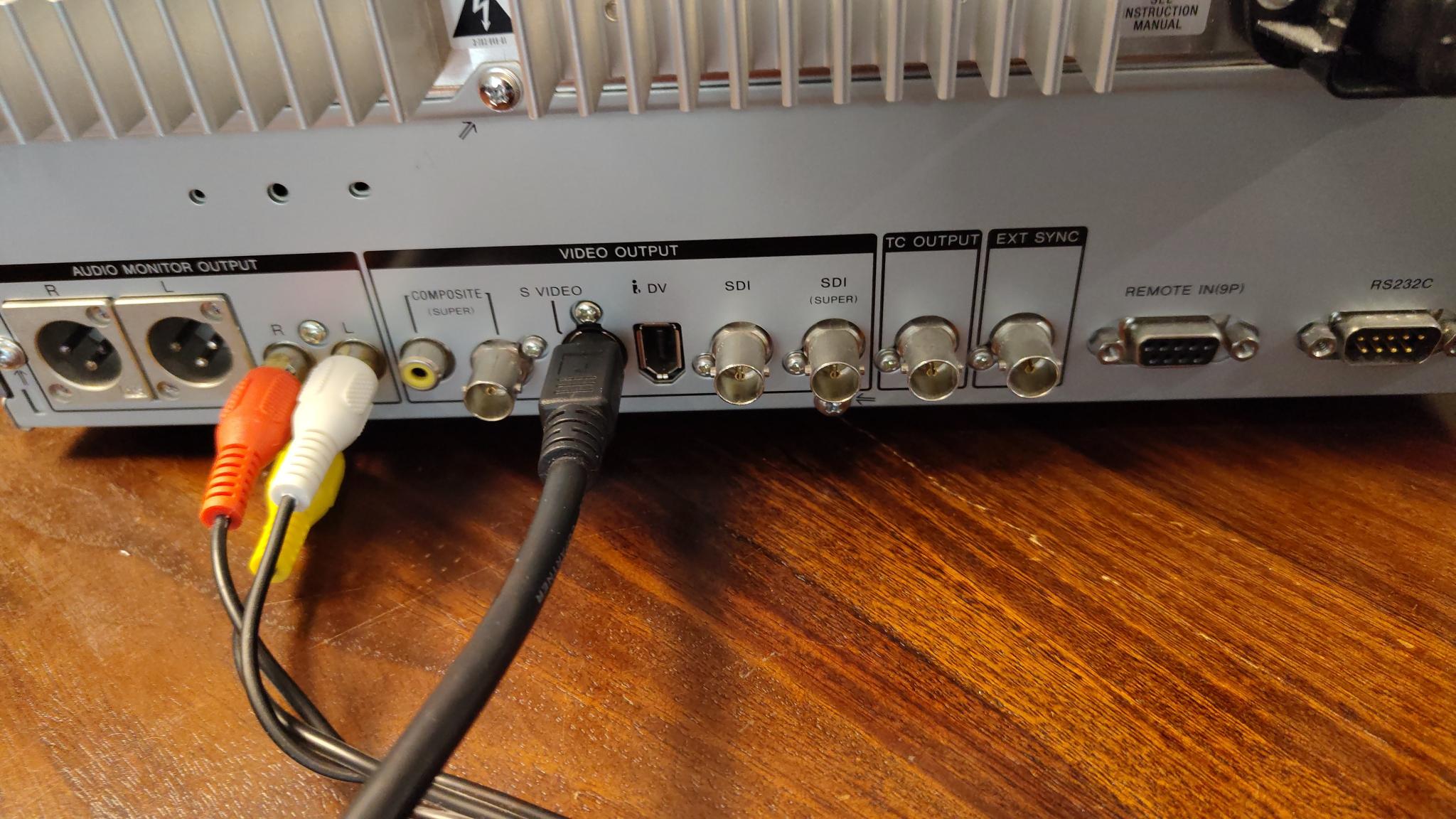
ABOVE: The surprising outputs on the back of Memo’s variant J30SDI.
We had planned to capture everything to the realtime device via component analog (Y/R-Y/B-Y) since it’s the best common output on the standard J30SDI and one of the two capture devices I am reviewing. To our great surprise, Memo’s J30SDI is either a variant or a modified version he had purchased several years ago via eBay. As a result, we ended up using a combination of composite (to test the quality of the 3D comb filter in the devices I am reviewing) and S-Video (Y/C).
The official Sony brochure further describes two versions a J30 (without the SDI suffix) and the J30SDI:
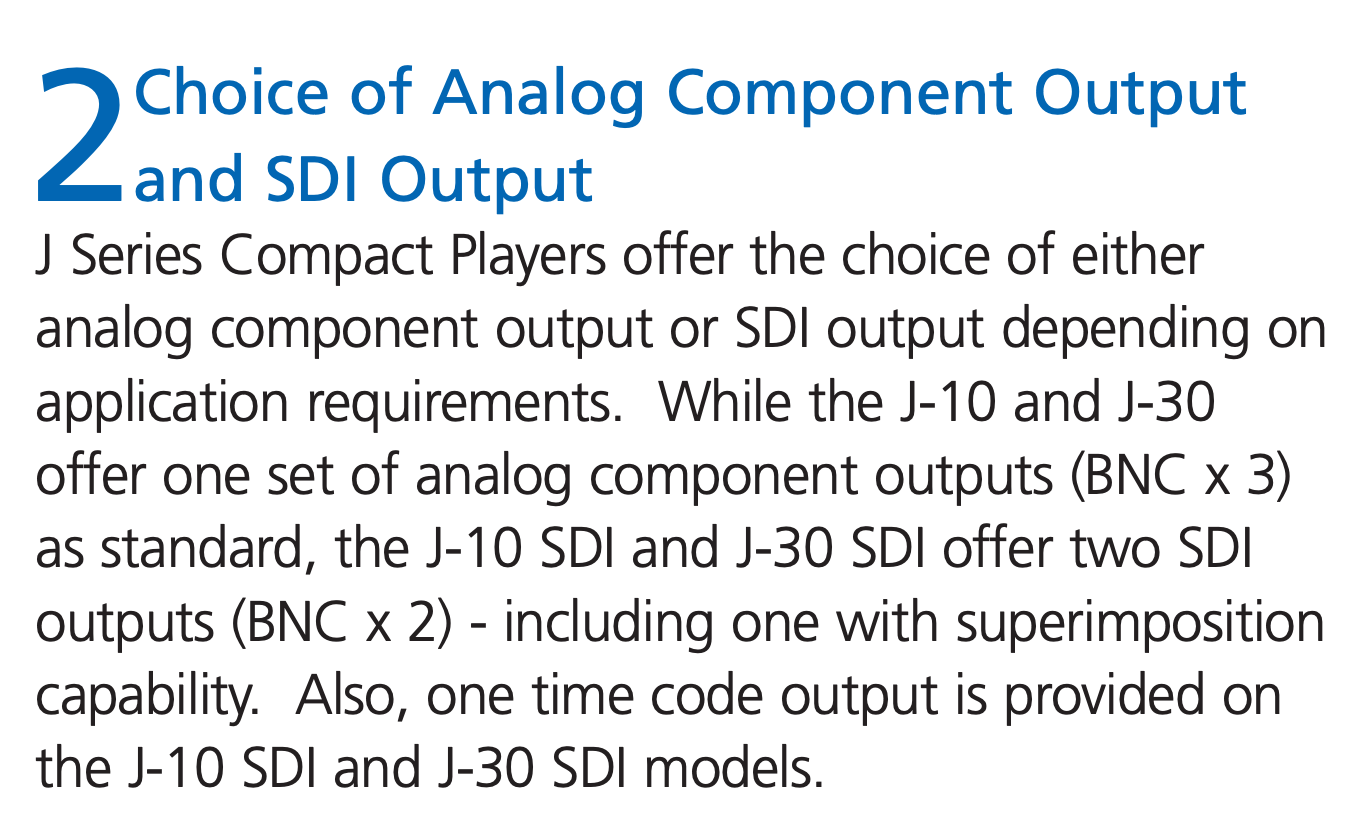
However, Memo’s device clearly states J30SDI on the front panel, so the original owner may have swapped a board in this unit at some point.
Important menus for playing NTSC tapes via an analog output of the J-30SDI
- Menu 713 (not to be confused with an area code originally assigned to Houston, Texas, US and parts of surrounding counties including Harris, Fort Bend, Montgomery, and Brazoria): Gives the option of having Setup (black level) of the analog composite output). The Sony manual says that the default is 0.0%. However the manual I found online may have been one published for Japan. The other option is 7.5%. This is a topic I have covered quite often over the decades, most recently in US video and TV: Reversing «necessary» evils from 1941 and 1953.
- Menu 718 (not to be confused with an area code originally assigned to New York City boroughs of Brooklyn, Queens, Staten Island, and the Bronx, along with Marble Hill in Manhattan): The manual simply says that it’s for adjusting the setup level (black level). Default value: 0H.
Acknowledgements
A great thanks to both RAMM Productions and Memo Sauceda for lending authentic NTSC Betacam SP material and decks for these articles and process. Fortunately, I see that there are still working J-30SDI units available on eBay, although often without the hyphen. They appear as: «J30SDI».
Lee este artículo en buen castellano…
J-30SDI de Sony: un reproductor Betacam casi universal que descubrí por accidente
(Re-)Subscribe for upcoming articles, reviews, radio shows, books and seminars/webinars
Stand by for upcoming articles, reviews, books and courses by subscribing to my bulletins.
In English:
- Email bulletins, bulletins.AllanTepper.com
- In Telegram, t.me/TecnoTurBulletins
- Twitter (bilingual), AllanLTepper
En castellano:
- Boletines por correo electrónico, boletines.AllanTepper.com
- En Telegram, t.me/boletinesdeAllan
- Twitter (bilingüe), AllanLTepper
Most of my current books are at books.AllanTepper.com, and also visit AllanTepper.com and radio.AllanTepper.com.
FTC disclosure
None of the listed individuals or companies mentioned above has paid for this article. Some of the manufacturers listed above have contracted Tépper and/or TecnoTur LLC to carry out consulting and/or translations/localizations/transcreations. So far, none of the manufacturers listed above is/are sponsors of the TecnoTur, BeyondPodcasting, CapicúaFM or TuSaludSecreta programs, although they are welcome to do so, and some are, may be (or may have been) sponsors of ProVideo Coalition magazine. Some links to third parties listed in this article and/or on this web page may indirectly benefit TecnoTur LLC via affiliate programs. Allan Tépper’s opinions are his own. Allan Tépper is not liable for misuse or misunderstanding of information he shares.