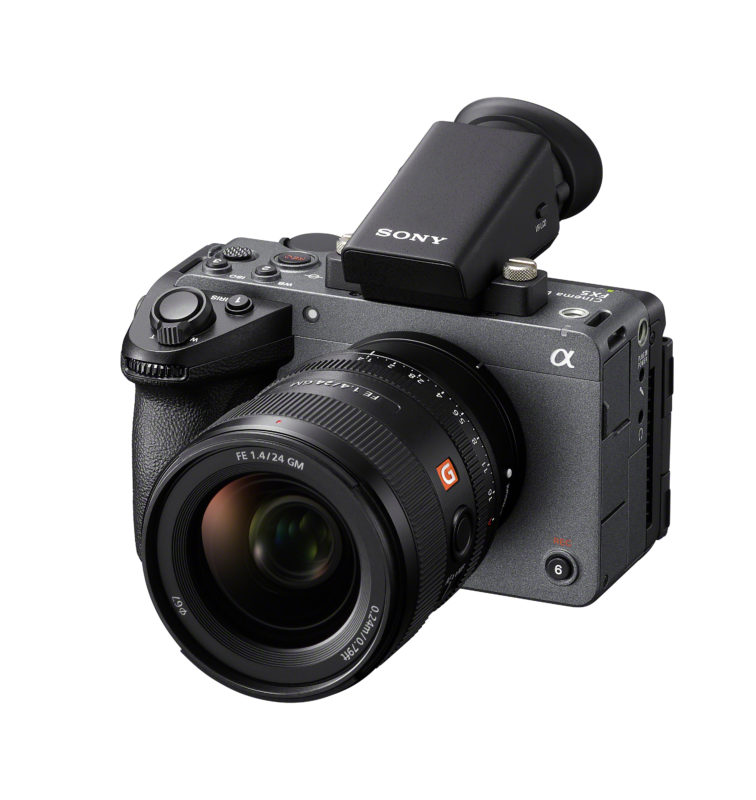



Sony has officially introduced the Sony FX5, a new addition to its Cinema Line that slots directly between the FX3 and FX6. Rather than replacing an existing model, the FX5 establishes a new tier in Sony’s lineup while bringing much of the imaging philosophy of the VENICE and BURANO into a smaller, more affordable body.
The company’s Cinema Line now follows a clear progression:
VENICE 2 → BURANO → FX6 → FX5 → FX3 → FX2 → FX30
According to Sony, the goal wasn’t simply to refresh the FX3 or FX6. Instead, engineers set out to push the technology forward while maintaining image consistency across the entire Cinema Line. One of the most significant examples of this philosophy is that productions can continue using the same LUTs across every camera in the lineup from VENICE 2 all the way down to the FX30, making color matching considerably easier on mixed-camera productions.
I’ve had the Sony FX5 for a few days now, and while I’m still in the process of reviewing the camera, I feel like I can write with some certainty that the Sony FX5 checks a whole lot of boxes for me. First and foremost is the inclusion of X-OCN raw recording capabilities, and second, that you can buy a dedicated tiltable EVF, which I’ve tested and it’s wonderful. Here are some other highlights.
Sony FX5 Highglights
- 16.6 MP full-frame stacked Exmor RS™ CMOS image sensor.
- New BIONZXR2™ processing engine with integrated AI processing.
- Internal 16-bit scene-linear X-OCN recording.
- Includes X-OCN LT, X-OCN C1 (new), and X-OCN C2 (new) recording options.
- 5K full-frame recording up to 60p.
- 5K 3:2 Open Gate recording in X-OCN
- 4K recording up to 120p.
- Full HD recording up to 240p.
- Three Base ISO settings: 800, 4000, and 12800.
- 15+ stops of native dynamic range.
- New Dual Gain mode provides 16+ stops of dynamic range (800 ISO)
- Updated Clear Image Zoom with simultaneous optical and digital zoom operation.
- De-squeeze display options: 1.3x, 1.5x, 1.6x, 1.8x, and 2.0x,
- New 3.5-inch 16:9 four-axis multi-angle LCD
- False Color, Waveform, & Vector scope monitoring.
- Dual CFexpress Type A memory-card slots.
- New NP-SA100 battery system.
- Approximately 130 minutes of 4K 60p recording.
- Compact body: approximately 132 × 79 × 87 mm.
- Approximate body weight: 1.62 Ibs / 734g
- Less than 5% weight increase compared with FX3-class body design.
- Positioned between FX3 and FX6 within the Cinema Line.
A New Sensor Designed for Cinema
At the heart of the Sony FX5 is an all-new 5K full-frame stacked Exmor RS CMOS sensor paired with Sony’s next-generation BIONZ XR2 image processor featuring an integrated AI processing unit.
The camera records:
- 5K up to 60 fps
- 4.5K up to 120 fps
- FHD up to 240 fps
Sony also confirmed that 4K 240 fps recording is planned as a firmware update after launch, currently targeted for 2027.
Sensor Details
- Full-Frame Stacked Exmor RS Sensor
- 16.6 MP effective resolution.
- Full-frame stacked CMOS architecture.
- 5K maximum sensor resolution.
- Faster sensor readout for high-frame-rate capture.
- 5K 60p recording.
- 4K 120p recording.
- Full HD 240p recording.
- 15+ stops of native dynamic range.
- Three Base ISO settings.
- Dual Gain readout mode.
- Open Gate 3:2 capture.
Open Gate Recording Arrives
For filmmakers shooting anamorphic or planning multiple delivery formats, the FX5 introduces full 3:2 Open Gate recording.
Maximum Open Gate resolution is: 4992 × 3328
The camera also supports anamorphic de-squeeze monitoring for: 1.3x, 1.5x, 1.8x, 2.0x. Additionally, Super 35 recording is available at 3264 × 1836 (16:9).
Three Native Base ISOs
Perhaps one of the most interesting additions is the implementation of three native base ISO settings: ISO 800, ISO 4000, ISO 12800.
Sony says the triple-base design delivers cleaner shadows, improved highlight retention, and wider exposure latitude across varying lighting conditions. Additionally, the idea of having three native base ISOs came from users asking for a third base ISO in the FX6 between that camera’s two base ISOs of 800 and 12800.
Users can also disable internal noise reduction, which is something many cinematographers have requested for workflows that rely on external denoising in post-production.
Dual Gain Processing
Sony’s new dual-gain implementation is designed to maximize dynamic range while minimizing shadow noise.
Rather than simply increasing sensitivity, the system captures multiple gain paths that preserve highlight information while lifting shadow detail. Sony claims this approach effectively delivers over 16 stops of usable latitude, particularly improving low-light performance without sacrificing highlight roll-off. Sony specifically stated that the Dual Gain feature reduces noise in darker image areas and is designed to provide greater post-production flexibility in X-OCN workflows.
X-OCN Comes to a Smaller Camera
The FX5 also introduces X-OCN (Extended tonal Original Camera Negative) recording. What does X-OCN mean for a camera like the Sony F5? Sony designed the X-OCN to deliver RAW flexibility at lower data rates than conventional uncompressed or lightly compressed RAW formats.
16-bit linear RAW recorded internally means
- Maintains flexibility for:
- Noise reduction
- White balance
- Exposure
- Highlight recovery
X-OCN Recording Options
- X-OCN LT, X-OCN C1, X-OCN C2.
- X-OCN C1 approximately 25% smaller than X-OCN LT; final rate TBA.
- X-OCN C2 provides a smaller-file workflow for higher frame rates; final rate TBA.
- X-OCN available in:
- Full-frame 5K 3:2, 17:9, 16:9
- Full-frame crop 3.8K 16:9
XAVC Recording is in the Sony FX5, but you can’t film 5K 3:2 open gate yet. That feature will be in a future update.
AI Expands Beyond Autofocus
Sony continues to integrate artificial intelligence deeper into camera operation.
The dedicated AI processor powers:
- AI-powered subject tracking.
- Improved low-light autofocus performance.
- Improved subject retention during movement.
- AI processing supports autofocus independently of conventional image-analysis data.
- Reduces the need for manual subject-selection changes in fast-moving environments.
Rather than simply recognizing faces, the system is designed to maintain tracking accuracy across more complex shooting scenarios.
Stabilization Gets a Significant Upgrade
Image stabilization also receives considerable attention for those interested in the Sony FX5. Sony says the FX5’s in-body stabilization significantly surpasses the FX3 with:
- Improved in-body image stabilization.
- Approximately 2x improved roll correction.
- Dynamic Active Mode.
- Gyro metadata support for post-stabilization workflows
- Suitable for handheld, gimbal, vehicle, and mobile shooting.
- Dynamic Active Mode prioritizes stronger correction for walking and moving-camera shots.
- Catalyst-based stabilization supported through recorded gyro information.
These improvements should make handheld documentary and gimbal shooting noticeably smoother.
Smarter Clear Image Zoom
Sony has also refined Clear Image Zoom. Instead of abruptly transitioning between optical and digital zoom, the system now blends both together, allowing users to perform smooth zoom pulls using the lens zoom ring while maintaining image quality.
- Updated Clear Image Zoom operation.
- Optical and digital zoom can operate simultaneously.
- Zoom-ring ctrl supported w/compatible lenses.
- Provides smoother transitions between optical and digital zoom ranges.
- Avoids the visible handoff associated with optical-first, digital-second operation.
- Designed for continuous zoom pulls.
- Preserves autofocus operation during supported zoom workflows.
A New Cinema Line Interface
Although physically similar in size to the FX3, the FX5 receives a substantial redesign. When one holds the Sony FX5 in hand, you can feel the difference. The camera is slightly deeper, and I think it feels a tad heavier than the FX3.
The camera measures approximately:
- 3.11 inches high
- 5.2 inches wide
- 3.43 inches deep
It weighs just 1.62 lbs.
The most immediately noticeable change is a new 3.5-inch 16:9 LCD monitor mounted on a four-axis articulating mechanism.
Sony has also adopted a display philosophy borrowed from VENICE and BURANO. Camera information now lives primarily in black information bars surrounding the image rather than overlaying the picture itself, allowing operators to monitor framing without menus obscuring the scene.
The overall user interface has also been redesigned to more closely resemble Sony’s higher-end cinema cameras, reducing the learning curve for crews moving between VENICE, BURANO and the FX5.
Physical controls have likewise been reorganized with buttons moved to the top and sides of the body, six assignable function buttons and a multi-function control dial inherited from the VENICE 2.
New Power System
Because of the camera’s increased processing requirements, Sony has introduced a new NPSA1000 battery. X-OCN needs power to process it, and I’m sure the EVF and/or Audio handle need a little bit more juice so the Sony FX5 can do all the things.
Sony estimates approximately 130 minutes of continuous runtime. Media remains familiar, with dual CFexpress Type A card slots.
- New NP-SA100 Battery
- Approximately 140 min of 4K 60p recording
- Increased operating time despite expanded processing and recording capability
- Designed for professional continuous recording.
- New power architecture supports the upgraded sensor, processor, cooling system, and display.
- USB power options available through USB Type-C connectivity.
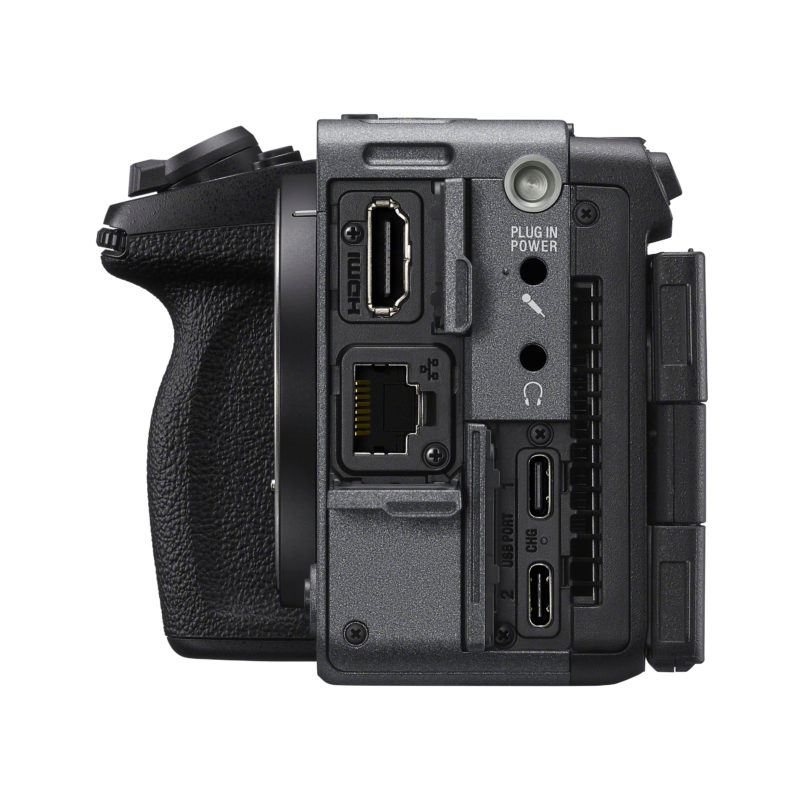

Sony FX5 Connectivity
The FX5 includes:
- HDMI Type A & Ethernet/LAN port.
- Two USB Type-C ports.
- 3.5 mm mic input / 3.5 mm headphone output.
- Multiple 1/4-20 UNC mounting holes.
- Tri-band Wi-Fi: , 2.4 GHz, 5 GHz, 6 GHz
- High-speed wired and wireless workflows.
- Built for multi-camera production.
- Designed for streaming and connected-set opp.
- Monitor & Control app support.
- Wireless smartphone monitoring & camera ctrl
- Supports integration into contemporary IP and network-based production.
- The addition of Ethernet expands options for studio operation, remote control and IP-based production workflows.
Optional Timecode Cable
This is for those who wish the Sony FX5 had a BNC output.
- USB-C-to-BNC configuration.
- Provides professional timecode connectivity.
- Supports synchronization in multi-camera production.
- Suitable for external timecode generators and production sound workflows.
- Compact alternative to a permanently integrated BNC terminal.
Optional XLR Handle Adds 32-Bit Float Recording.
Sony is also introducing a redesigned XLR handle. The new audio accessory supports 96 kHz / 32-bit float audio recording, eliminating many concerns about clipping during production. Sorry, this new handle is not backward compatible with the FX3. Now, here is the rub. The Sony FX5 can have either the new optional XLR handle attached or the new EVF, but not both at the same time. Bummer, I know.
- Removable XLR Handle Unit.
- Professional audio connectivity.
- 96 kHz/32-bit float audio recording.
- Increased audio headroom.
- Reduces risk of unrecoverable clipping.
- Designed as an optional configuration rather than a permanently bundled
Optional Electronic Viewfinder
A removable electronic viewfinder is also available for the FX5, and it is brilliant. I think the EVF, which is tiltable, and the X-OCN are my two favorite features.
Specifications include:
- Removable design.
- Tiltable viewing angle.
- 3.68 million-dot OLED.
- High-frame-rate display.
- Wide color gamut, High brightness.
- Approximately 2500 cd/m? stated brightness.
- Designed for bright exterior shooting.
- Suitable for handheld work.
Sony FX5 Pricing
Sony says the FX5 will be available in two configurations:
- Body only: $4,999
- With XLR Handle: expected between $5,499 and $5,699
Importantly, Sony emphasized that the FX5 is not an FX3 Mark II. The FX3 will continue to remain in the Cinema Line alongside the new model.
Sony FX5 First Impressions
Perhaps the biggest takeaway isn’t any individual specification, but Sony’s broader strategy.
The FX5 appears to be less of an incremental update and more of a new direction for the Cinema Line. By incorporating technologies previously reserved for the VENICE and BURANO, such as open gate recording, triple-base ISO, X-OCN recording, AI-assisted imaging, and a more production-oriented interface, Sony is narrowing the gap between its flagship cinema cameras and its compact production tools.
If real-world image quality lives up to Sony’s claims, the FX5 could become one of the most compelling cameras for documentary filmmakers, owner-operators, and commercial productions looking for VENICE-inspired color science and workflow in a body that remains small enough for gimbals, drones, and handheld production. I think the Sony FX5 will be a favorite camera for many.