

Filmtools
Filmmakers go-to destination for pre-production, production & post production equipment!
Shop NowWhat kind of acoustic foam is best for music production, audio engineering, or video game live-streaming?

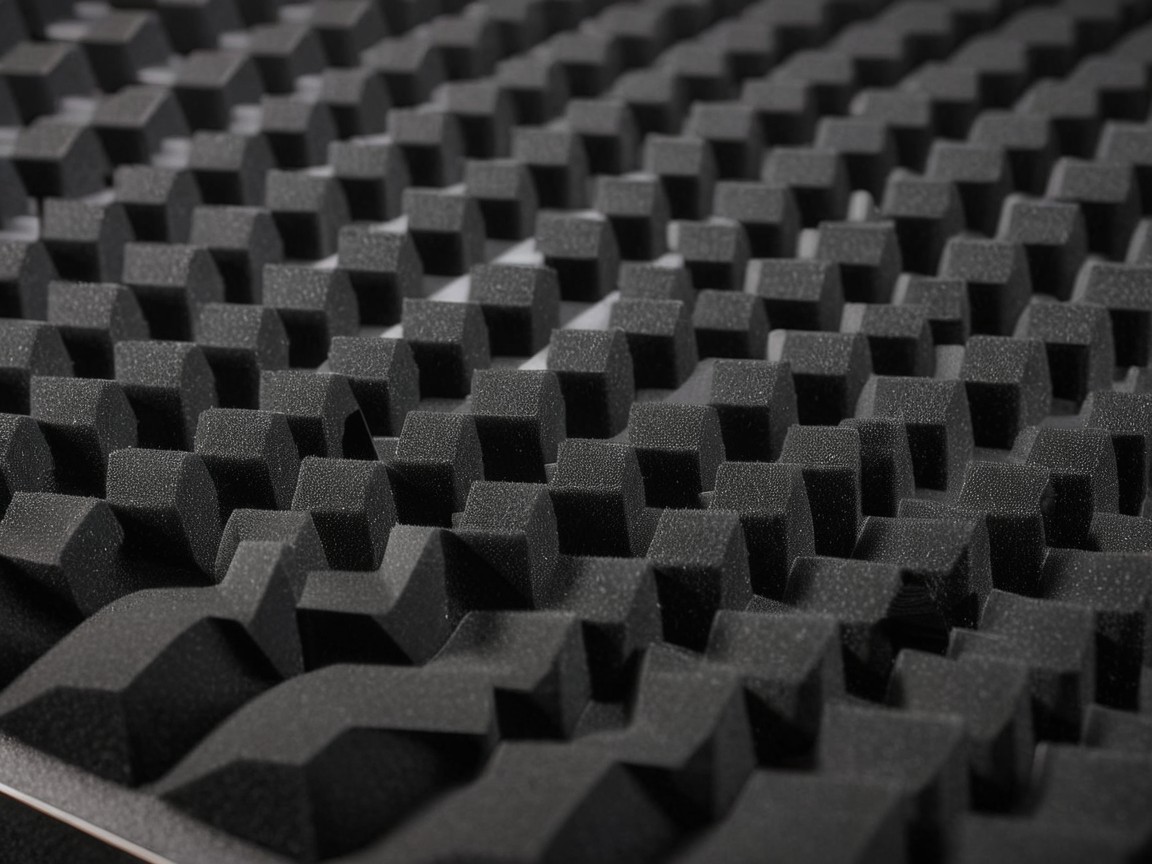
If your work involves recording live audio, acoustic foam is one of the simplest and most effective ways to improve your sound. An unfitted room cluttered with hard surfaces – walls, floors, desks, monitors, all manner of furniture – reflects sound waves. These reflections bounce around the space and interfere with your microphone, creating issues such as echo, reverb, and frequencies that are muddied or exaggerated.
The right acoustic foam helps control these issues by absorbing mid-to-high frequency reflections, ensuring your audio sounds crisp, clear, and professional. In an at-home setup, the presence of padded, upholstered furniture or carpet can, on paper, help reduce reverb; however, the difference between a DIY workaround and proper soundproof padding is significant. A good panel setup works in tandem with your audio equipment to deliver consistent, high-quality results.
That said, acoustic foams are not a “one-size-fits-all” solution to audio production. The foam – and the results they give – differ by the density and thickness of the material, as well as how it’s shaped.
Open-cell foams, which are flexible, spongy, and lightweight, absorb sound waves by trapping them within the material’s porous structure, thus reducing echo and reverberation. Closed-cell foams, by contrast, are dense and rigid, used to block sound and create a soundproof barrier. While closed-cell materials are useful for construction and industrial noise control, most recording environments rely on open-cell foam because the goal is not to completely block sound, but to control reflections within the room.
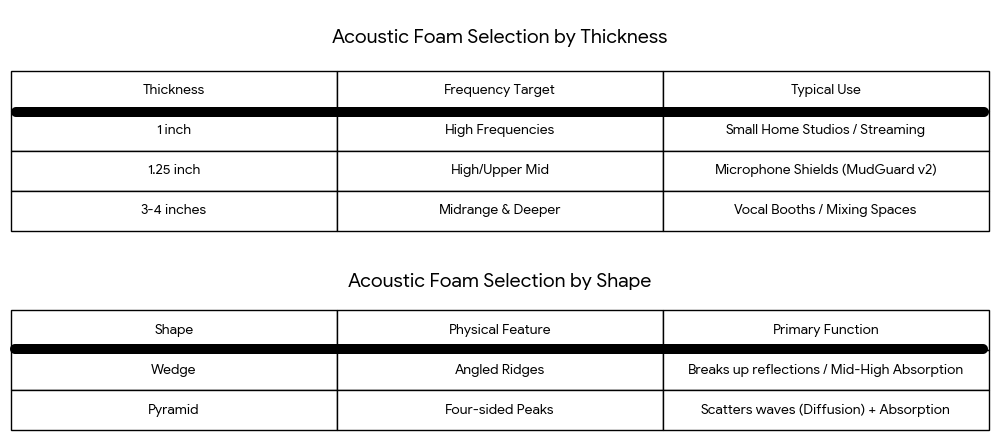
Thickness impacts frequency absorption. Thicker panels better absorb lower frequencies, while thinner foam affects higher frequencies. For small home studios or streaming setups, one-inch foam panels can reduce sharp, high-frequency reflections caused by bare walls and flat surfaces. The MudGuard v2 from Auralex Acoustics, for instance, is a microphone shield that wraps 1.25-inch foam around the mic. Its convex design helps divert internal reflections away from the microphone, reducing unwanted coloration and keeping recordings cleaner.
For more serious recording applications, such as vocal booths, podcast studios, or mixing spaces, three-to-four-inch foam panels provide deeper absorption and better control over midrange frequencies. These thicker panels help prevent the “boxy” or “roomy” sound that often occurs when microphones capture reflections bouncing between untreated walls. Products like Auralex’s LENRD Bass Traps are commonly used in corners alongside thicker wall panels to manage low-frequency buildup and create a more balanced listening environment.
The physical shape of the foam also affects how sound waves are dispersed and absorbed. Wedge panels are among the most common designs. Their angled ridges increase surface area and help break up reflections while providing reliable absorption across mid and high frequencies. Pyramid panels, meanwhile, serve a similar role but feature four-sided peaks that scatter sound waves in multiple directions, introducing a bit more diffusion while still offering solid absorption.
Egg-crate panels are often marketed as a budget-friendly option for entry-level setups. While they can reduce some echo, their shallow profile and softer contouring generally absorb a narrower range of frequencies compared to deeper wedge or pyramid designs. They can be a starting point, but in professional environments, the added control and consistency of sound wave reflections offered by more engineered foam shapes is typically worth the additional investment.
Ultimately, the best acoustic foam is the one that matches both the size of your space and the demands of your production. Are you recording vocals, streaming live, or building a room for mixing and engineering? Each scenario calls for a different balance of absorption and reflection control. Just as important as the foam itself is how it’s used. Experienced recordists think strategically about panel placement, focusing on key reflection points rather than trying to cover every possible surface until no wall remains. For vocal recording or live streaming, treating the areas directly behind and beside the microphone often provides the most noticeable improvement. Mixing environments, on the other hand, may require a broader approach that also considers first reflection points, corners, and overall room balance.
Acoustic treatment is ultimately a modular and iterative process. You can start small, listen to how your room responds, and build outward as your needs evolve. Quality materials can make that process easier and more predictable, which is why many studios turn to established manufacturers such as Auralex Acoustics, whose engineered foam products are designed to provide consistent, reliable absorption across a wider range of frequencies.