Filmtools
Filmmakers go-to destination for pre-production, production & post production equipment!
Shop Now
Even in a largely wireless world, creative teams can’t rely on the cloud for everything. More often than not, the proverbial concrete foundation for any media-adjacent production happens in the real world. It’s necessary to keep things physical with tangible equipment that’s unburdened by latency, connection disruptions, or – God forbid – a Cloudflare or AWS crash.
Patch cables are the plucky ragtags resisting an all-cloud future, with their origins traced all the way back to the telephone switch boards of the late nineteenth and early twentieth centuries. Over one hundred years later, these cables have not ceased their patching, and in fact, have become a pervasive facet of everyone’s day-to-day, even if the average consumer may not be familiar with “patch cables” as a moniker.
While patch cables are still synonymous with telecommunications in the modern era, their base definition and use cases have considerably broadened. Nowadays, a patch cable refers to a short electrical or optical cable used to connect various hardware together, such as network devices or AV equipment. As such, patch cables come in a variety of types specifically designed to carry out different functions.
Networking Staples: The Ethernet Patch Cable
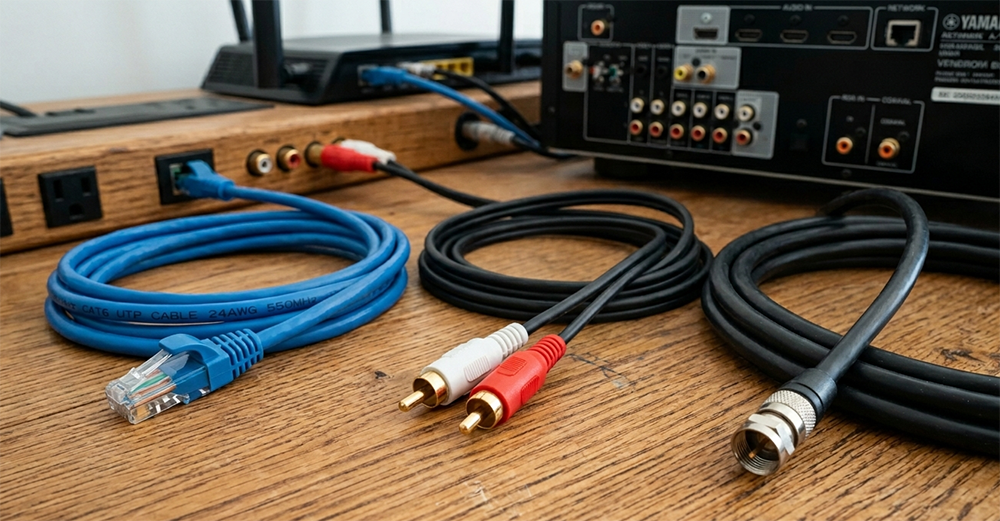
If there’s a single cable that best embodies the modern idea of a patch cable, it’s the humble Ethernet cord. Utilizing twisted-pair cabling in their modern designs, Ethernet patch cables are designed to shuttle data between devices on a local network. Think computers, switches, routers, and wall jacks, “patching” into the internet via a local, physical connector rather than relying a wireless signal.
What makes Ethernet cables particularly emblematic is their ubiquity. Offices run on them. Studios depend on them. Even in homes where Wi-Fi reigns supreme, there’s usually at least one Ethernet cable lurking behind a desk or TV stand, maintaining a fast and stable network connection for any dedicated device. In environments where milliseconds matter – live streaming, collaborative editing, network-attached storage, or even playing a multiplayer video game over the internet – Ethernet patch cables are a necessity, with many diehards swearing by their high speed and low latency.
Stepping back from the ubiquitous, Ethernet is just one expression of a broader idea: short-run cables designed to make systems flexible. “Patch” describes intent, not the signal itself. You’re linking Point A to Point B quickly, cleanly, and often temporarily. And once you start looking for that pattern, you see it everywhere.
Audio & Analog Connections: Flexibility on Demand
Take audio. Walk into any recording studio or live venue and you’ll likely find a patch bay: a grid of ports that turns a tangled mess of gear into something modular and controllable, not too dissimilar from its telephone switch board ancestors. Here, patch cables are typically short runs with 1/4-inch TS or TRS connectors, or sometimes XLR. Their job is simple: reroute signals on demand. Want to send a vocal mic through a different compressor? Patch it. Need to reconfigure an effects chain mid-session? Patch it. Need to simply connect your electric guitar to your amp on a Saturday night? Patch it.
Stereo cables, the kind you’ve probably used to connect a phone or laptop to speakers, are a more consumer-facing version of the same concept. Usually terminated with 3.5mm TRS connectors (that beloved headphone jack, though wired headphones are not considered patch cables), they carry left and right audio channels in a single, compact cable. They may not look as imposing as studio gear, but they serve the same fundamental purpose: bridging devices quickly and reliably.
Specialized Signal Transfer: Coaxial and Fiber Optics
Coaxial cables tell a slightly different story, favoring fidelity over flexibility. Built with a central conductor, insulating layer, shielding, and outer jacket, coax cables are designed to protect signals from interference over longer distances. You’ll find them carrying cable television into homes, linking modems to wall jacks, or handling RF signals in broadcast environments. As patch cables, coaxial lines are typically short jumpers: the piece that connects your modem to the wall plate, or a monitor to a distribution system. They’re less about constant reconfiguration and more about preserving signal integrity at the final step.
And then there’s fiber.
Fiber optic cables are the thoroughbreds of the patch world, befitting a post-internet society. They use pulses of light – which represents binary code – to transmit data, allowing for staggering bandwidth and minimal signal loss. In data centers and enterprise environments, fiber patch cables connect switches, servers, and storage systems at speeds that would make traditional Ethernet blush. They’re thin, lightweight, and incredibly fast. However, they are also delicate, often requiring careful handling and precise connectors.
The Magic of Modularity
What’s striking is how all of these cables – Ethernet, TRS, XLR, coax, fiber – serve wildly different technical roles while still falling under the same conceptual umbrella. The term “patch cable” doesn’t care what’s flowing through it. Audio, video, data, radio frequency, light, it’s all fair game. What matters is the job: making connections that are immediate, modular, and reversible.
That modularity is the real magic.
Permanence is the enemy of flexibility. Hardwiring every connection might make things neat, but it also makes them deceptively brittle. If something goes wrong, you’re forced to throw out the baby with the bathwater. Patch cables introduce a layer of abstraction between devices and infrastructure. Instead of rewiring an entire setup, you swap a cable. Instead of redesigning a signal chain, you reroute it. This is as true in a bedroom music setup as it is in a server rack handling millions of requests per second.