

Filmtools
Filmmakers go-to destination for pre-production, production & post production equipment!
Shop NowAvid brings Meida Composer into the Gen AI game with help from Google

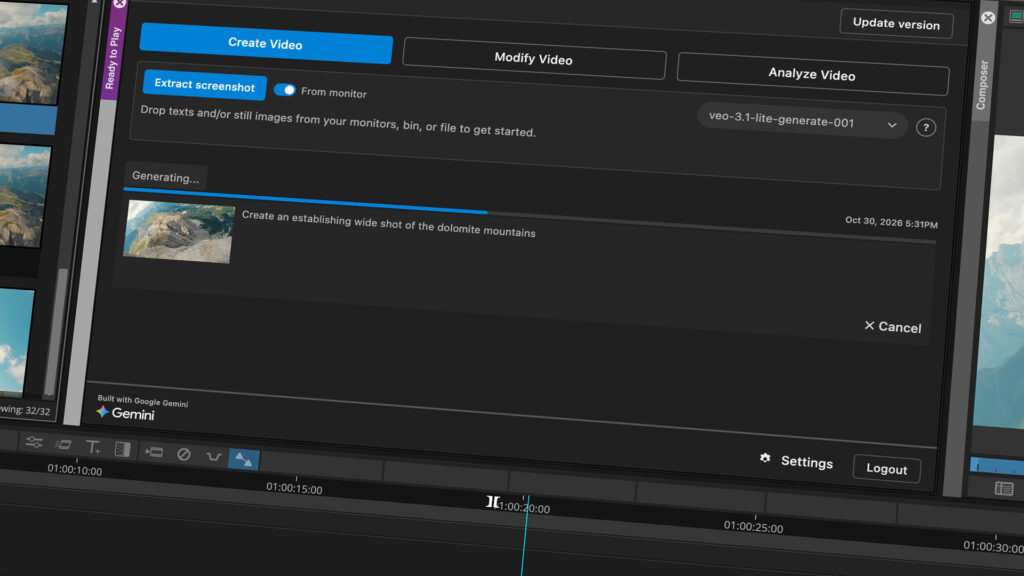
Avid has announced Ready to Play, a new AI-powered extension for Media Composer built in partnership with Google Cloud and powered by Google’s Gemini and Veo AI models. It’s available now for Media Composer Ultimate and Enterprise users at no additional charge from Avid, though access to Google’s AI models requires an eligible Google Cloud billing account. Editors will manage any AI usage costs directly with Google. We talked about this with Avid at NAB 2026, and now it’s out for the world to see.
The goal is to let editors work with AI without leaving the Media Composer environment they already know. That’s a significant detail as many AI tools right now live outside your editing application, which means you’re constantly switching between apps. For those that try to keep the editor in the NLE, the tools are more purpose-built and not necessarily as marketed around another company. Ready to Play is designed to bring generated and AI-analyzed content back into your bins and sequences without disrupting what’s already there.
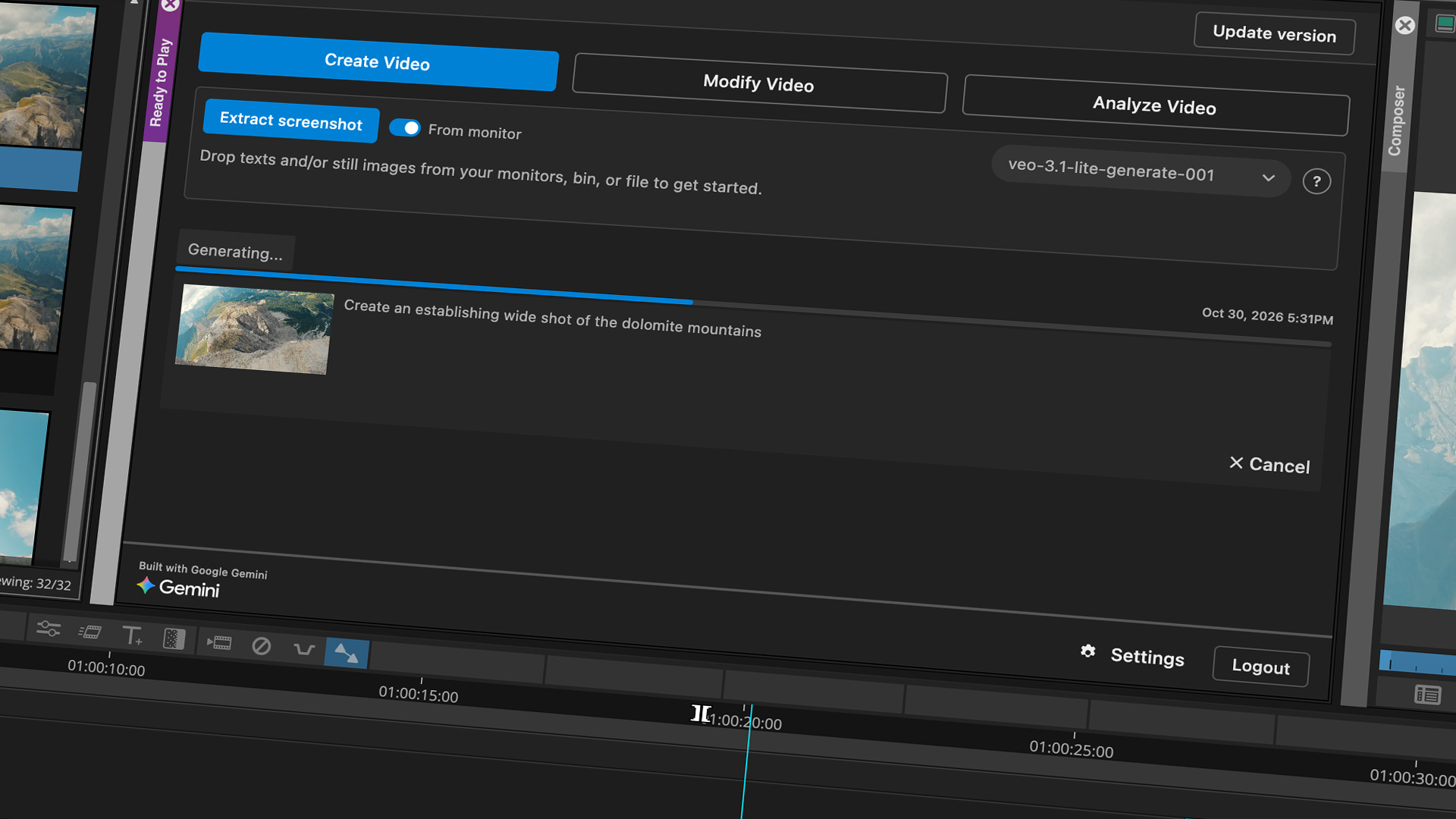
Three things it can do
Ready to Play launches with three features, and it’s helpful to understand what each one actually is.
Create Video lets you generate video clips from a text prompt or from a still image you pull directly from a clip or sequence already in your project. The result lands in a Media Composer bin. The obvious use case is temp B-roll – you need a shot of a coffee cup on a desk while the VO is running, you don’t have one, and you’d rather have something in the timeline while you’re editing than a black gap. It could also work for pre-visualization before a shoot, or as a placeholder while VFX or motion graphics are being finished.
Modify Video is probably the feature that will get editors thinking. You use a text prompt to explore visual changes to a clip – removing a boom mic from frame, for example, or changing the look of a background. Critically, it generates a separate output and preserves the original media. This matters: Avid is specifically not letting these tools overwrite your source material. The modified version is something you can review, use, or discard. These are Google’s AI models doing the heavy lifting, so the quality of results will depend on what Veo and Gemini can actually produce – but the integration into Media Composer is Avid’s contribution.
Analyze Video is the quieter, potentially very useful one. It analyzes footage and generates descriptive metadata you can add to clips. If you’ve ever inherited a drive full of unlogged media with no paperwork and no memory, the idea of AI generating clip descriptions that go directly into Media Composer metadata fields is appealing. The metadata it generates is customizable, and it doesn’t overwrite anything you’ve already entered.
Ready to Play is the first commercial product to come out of Avid’s expanded Google Cloud partnership. At IBC 2026, Avid showed off Avid Assist which was described as an orchestration and governance layer for AI agents, and gave a preview of Ready to Edit, the agentic tool focused on project prep and organization before editing starts. Ready to Play fits at the creative production stage; Ready to Edit would handle what comes before it. These seem to be building toward a broader AI layer across the editorial process rather than a single all-in-one feature.
Avid also surveyed 120 editors in partnership with American Cinema Editors (ACE). Among editors who use AI daily or weekly, 98% said AI is most valuable when it enhances creative intent rather than replaces it, and more than 80% said AI tools should be built into the applications they already use rather than accessed separately. Ready to Play is a direct response to that last point.
Editors will want to know what the Google Cloud usage costs actually look like in practice. Avid isn’t charging extra for the extension itself, but every generation and analysis task presumably draws from your Google Cloud account. That cost structure will matter a lot to freelancers and smaller shops evaluating whether this fits into how they work.