

Filmtools
Filmmakers go-to destination for pre-production, production & post production equipment!
Shop NowLens hunters need to dig deeper than ever in 2026

Continued from part one, in which we considered whether cheap glass from internet auction sites is really a cheap option at all.
Some people choose lenses by phoning the rental house and asking for the optical sommelier by name. Other people rely on applying advanced techniques to eBay’s search feature. This is the second instalment in a series for people who are aware that f/4 hides many sins, and any remaining sins are easily dispelled by a heartening story about 1970s East German optical workers riding to work on a bus of the people.
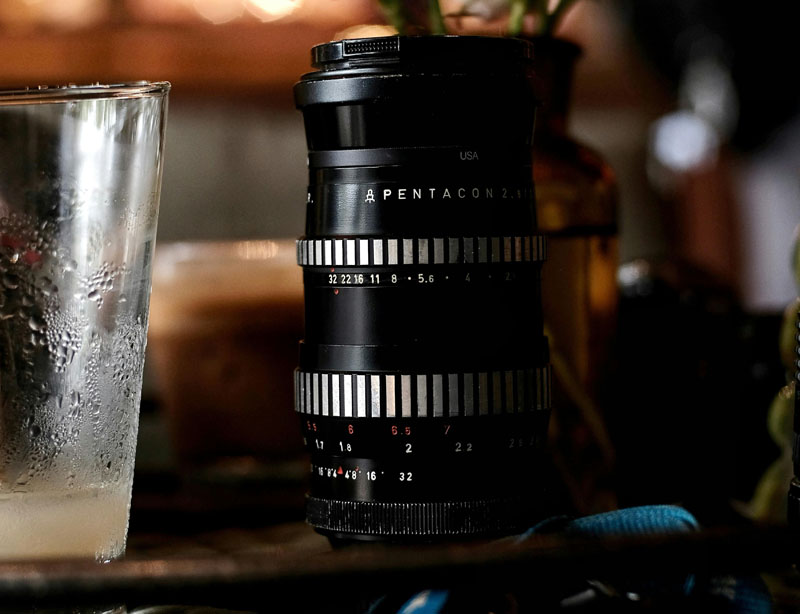
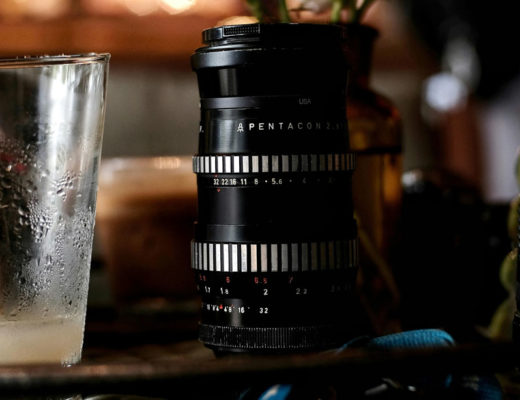
Last time, we discovered that the most popular lenses made by those people tend to be (entirely coincidentally, of course) the most visually striking members of the search results. We looked at zebra-striped barrel designs which have gathered enough social media chic to launch a flare-obscured career in YouTube equipment punditry. We even managed to conclude that the sanest response to this situation involved Pentacon-branded medium-format lenses with reducers. That gets us the fashionable industrial design and access to something between 50mm and 100m without feeling quite so financially chastised.
Still, some people might not like a lens economy which has made sixty year old products so expensive that a Kipon Baveyes focal reducer, which is still $500 at B&H, seems like a reasonable route to affordability.
Daddy’s lens company
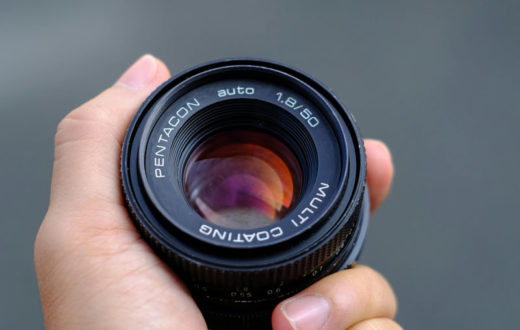
People with even higher standards for reasonableness might consider Pentacon’s prosumer products, especially in the understanding that prosumer 70s designs often contain more metal than today’s top of the range. As such, we can confidently plug in search terms such as “Pentacon Electric” or “Pentacon Auto” and be confident of getting a lens barrel that won’t collapse if a kitten falls asleep on it.
Even so, the results of that search might provoke a sneer. They lose the stripy, mid-century, precision-machined National Geographic gloss and gain a lot more knurled rubber. The manufacturer of these lenses was properly VEB Pentacon, which stands for “Volkseigener Betrieb” (“people-owned enterprise,”) although locals quietly scoffed that “Vatis ehemaliger Betrieb” (“dad’s former enterprise,”) was a fairer way to describe a group of companies which had been outright expropriated by the Socialist Unity Party. As a result, there is a distinct likelihood that lenses marked “Pentacon Electric” or “Pentacon Auto” contains exactly the same pieces of glass as a similarly-specified Meyer Domiplan, Oreston or Orestor of ten years previosly.
Still, right now, a Pentacon Electric 50mm f/1.8 goes for something like half the price of a Meyer Oreston 50mm f/1.8.
Cold-war intrigue
The lack of fast wides persists. The glass from Meyer’s 29mm f/2.8 was sold in a Pentacon barrel, but the tempting Pentacon 24mm f/2.8 is, surprisingly, a Sigma import, and less likely to produce a look compatible with other, similarly-styled barrels. There are also at least two distinct generations of Pentacons, one of which comes in a 70s-looking barrel with engraved text and one in an almost 1980s design with a silk-screened front ring. There are coating differences between the two; differentiating them reliably is tricky, but look for either a yellowish (generally older) or blue-purple-green (generally newer) reflection.
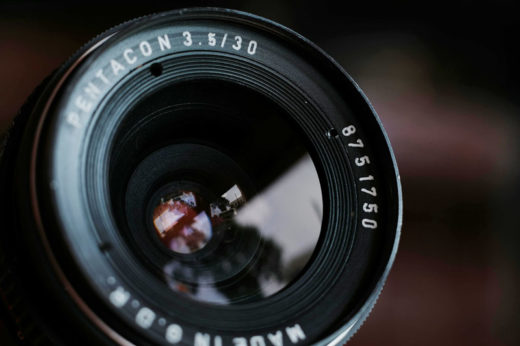
Happily, politics has created us a few other relevant search terms for the same thing. The name Prinzflex was used by Dixons in the UK to retail East German lenses while dodging the political association, while Foto-Quelle in West Germany did the same with the Revuenon brand. The difference is that these lenses attract near-zero cachet and are often found lurking under a thick layer of dust on the shelves of charity-owned retail establishments which price them like bric-a-brac.
That’s an attractive price for a stirring tale of cold-war intrigue, especially when it affords access to such a broad range of what a modern manufacturer might promote as optical personality. Putting together anything like a matching set is likely to involve a bit of trial and error, given the tendency for Meyer, Pentacon, Prinzflex and Revuenon brands to appear on a confusingly similar range of focal length and aperture specifications, but at least that’s a fairly affordable process.
Options from Japan
Despite it all, that Pentacon-branded 24mm Sigma remains a tempting purchase for anyone who’s looking to complete the short end of a set and is willing to keep buying and trying to create a set which matches. It’s inexpensive – under $50, for imperfect examples which are probably still better than their Eastern Bloc contemporaries in terms of optical performance. It’s at this point that sensible onlookers will notice that our unhealthy fascination with the artfully imperfect has led us to talk things down on the basis they’re… good?
In reality, the boundaries are – appropriately – blurred. Even the intermediate era of Pentacon lenses was marked “Multi-Coating” and boasted at least some of the technology that Japanese manufacturers were using at the time. That’s not to say they would match, but they might be about as good in different ways. Even so, craftier thinkers will ponder whether anything else under the Prinzflex and Revuenon names was perhaps also made by Sigma, or if there’s some other lesser-known route to a set of Japanese lenses.
The answer is a resounding maybe, but the good news is that there are certainly options that avoid the most famous Asahi and Nikon-branded options which have mostly raced out of the financial reach of the people who need them most, which we’ll consider next time.