Filmtools
Filmmakers go-to destination for pre-production, production & post production equipment!
Shop Now…and that’s not great, because while media may last, machinery has a finite life.

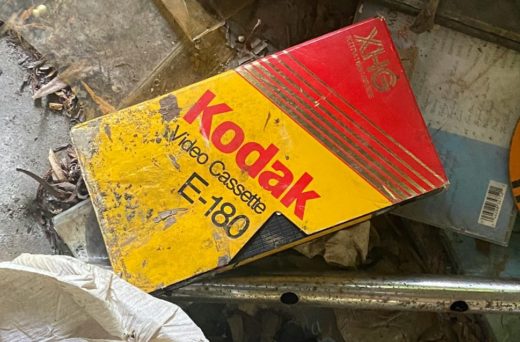
Every so often, the BBC proudly puts out a press release that it has found a long-lost episode of Doctor Who on a dusty Betamax in someone’s attic and returned it to the archive. Those of us with a penchant for monochrome tube-camera images of wobbly sets and monsters made of carefully-painted doormats will rejoice, but there’s still a problem: no matter how many tapes we find, we might have them… and not have them, at the same time.
There are, to all practical purposes, three magnetic tape formats left. One of those is the compact cassette, which is enjoying an unexpected renaissance among the sort of people who buy a lens on the basis it’s silver and take it backpacking, then fill Instagram with cellphone pictures of themselves holding the lens. The other two are the IBM 3592 series data tape system, which barely exists outside the world of enormous server farms owned by enormous conglomerates, and LTO, which is used everywhere by everyone for everything.
More or less every tape format which has ever existed has now been out of production for long enough that the machines which read them are old. That’s a problem for 8-track, but it’s an even bigger problem for formats using helical scan, which means all video tapes and most data tapes. The archival longevity of tape is talked about a lot, but that’s only one problem. Despite the favourite prejudices of chin-stroking advocates of photochemical storage, tape can also last decades if properly stored, and film doesn’t always.
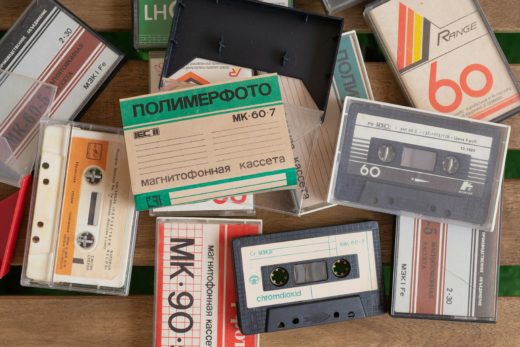
The truth is that even if the tapes lasted forever, and even if we had them all neatly indexed in the archive, we could never possibly play them all back. There are only so many tape decks in the world, and only so many total head hours, and it’s a safe bet that there are fewer head hours than there are recorded hours of tape to play.
If we have ten thousand hours of tape and only a thousand hours of head life, the only choice we have is to decide which nine thousand hours of heirloom material to throw in a skip. Considering the breathe-into-a-paper-bag reaction we get from losing a few episodes of the BBC’s most charmingly cost-effective sci-fi, we should probably be concerned by the prospect of losing what might end up being a vast amount of media history.
Refurbishing archive machines
Some types of video tape head can be refurbished using essentially a polishing technique to buff out the dents, although that works less well on high-end formats which rely on incredible precision. The technology to make heads from scratch is non-trivial and the human experience required to do it well is increasingly lost to history. The last VCR manufacturer shut down more than ten years ago, citing exactly this problem. Refurb and rebuild is done in individual quantities, to order, by specialist companies, at vast expense. Not all formats are covered. Absent massive funding, and unless technologies such as 3D printing become staggeringly more advanced, this is likely to get worse, not better.
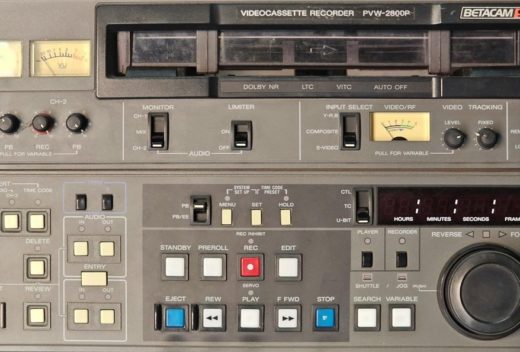
As such, the worst problems affect primarily the sort of formats which were used in professional acquisition. Nobody’s mourning millions of hours of duplicated VHS feature films. There’s plenty of decks, tolerances are comparatively generous and heads can be refurbished. All of that is far less true for, say, D-1 through D-3, which were rare thoroughbreds even when new and are now very old, long since unsupported and yet were used almost exclusively for high value material.
It’s a stark realisation that in 2026, even the youngest VTRs in the world are ready to go to middle school. Betacam SP was manufactured from 1982 to 2001, an amazing run, but the most recent machines are now 25 years old. All of this has led to what’s sometimes been called the magnetic media crisis, sometimes citing 2025 as a deadline after which just playing things back ceases to be a mainstream, pushbutton activity, and becomes an almost forensic process for archive specialists.
Workarounds?
An open source project called VHS Decode (which now supports a lot more than VHS) uses inexpensive software-defined radio techniques to capture signals directly from tape heads, bypassing the sometimes-dubious electronics of inexpensive decks. Software can then do slow, careful, sophisticated correction of timebase, dropouts and noise, and ancillary data can be captured in full. It is an excellent archival approach, and it can allow – for instance – certain VHS mechanisms to capture S-VHS tapes. Similar things might become possible with other formats which have geometry and tape formulation in common.
That potentially stretches machine life, but it still needs heads with enough performance left to capture a clear signal, and a mechanism to scan them past the tape with adequate precision. It could work on digital formats, too, but the reverse-engineering effort for that is larger and the mechanics more exacting.
It’s traditional to end articles like this with encouraging references to potential solutions, but in this case there really isn’t one. So, if you have any valuable archive on Betacam SP, or much worse, one of the early, rare, expensive D-series formats, make no mistake: you are in a race to recover it before the last head hours tick down, the sand timer empties, and helically-scanned video tape becomes a vault locked behind a seven-figure engineering effort.