
Fun fact: an instant ice pack can go past airport security as a solid, not a liquid.
The day I trekked to Adobe MAX, I awesomely rolled my ankle while running (pun intended) an errand. Before trekking to the airport, I snagged a few instant ice packs that transition into a cold and frigid tool when you pop the inside container. Despite the fact that shaking causes the ice pack to become more of a liquid than a solid, I brought it right on through security. 15 minutes later, I could soon be found icing my ankle and eating snacks right at the gate.
At the tail end of Day 2, when we may have wanted to ice our feet after MAX bash, and we continued to find the snacks, we bounced around different states of matter, amplified by energy (in this case, Girl Scout cookies) and moderated by shifts.
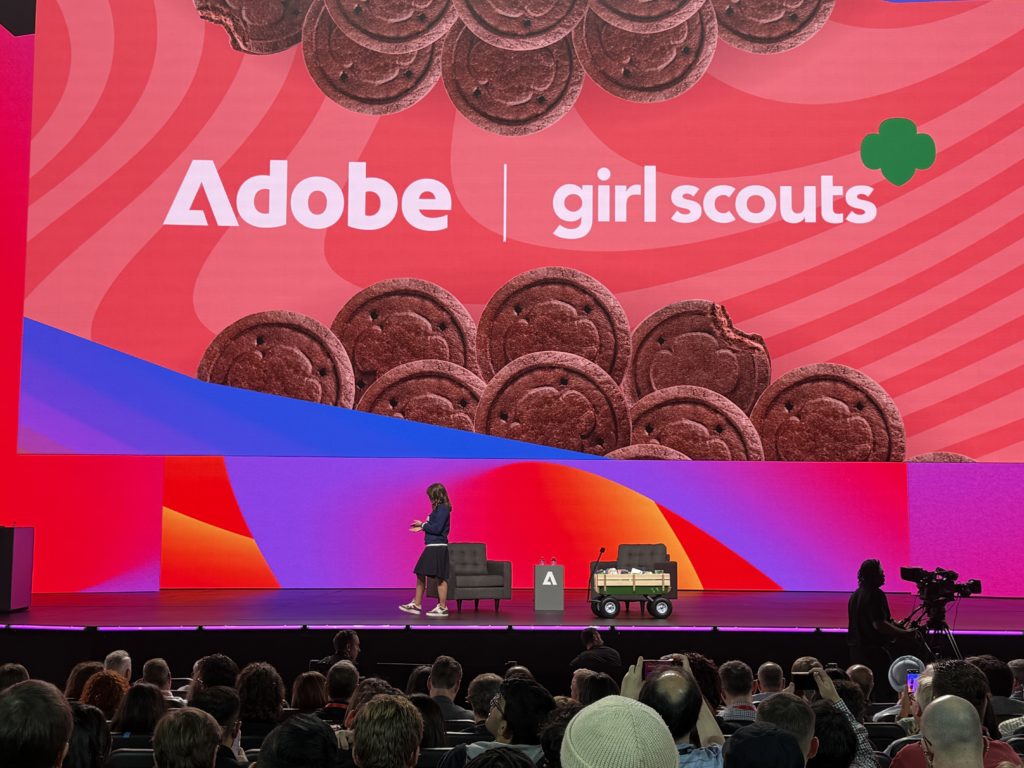

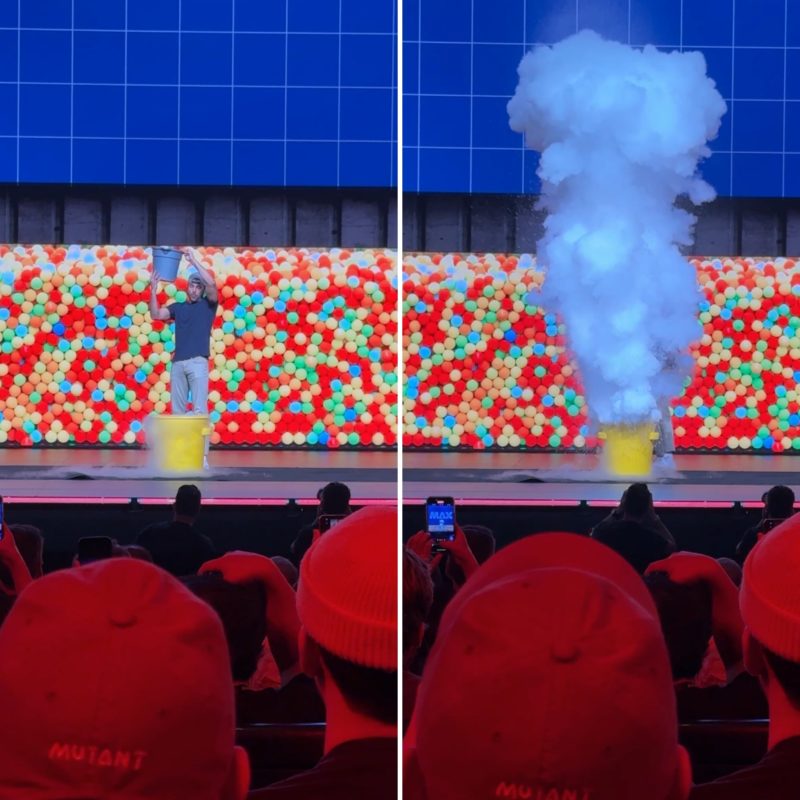
As we jump in, a reminder from my earlier days of science class: the three main states of matter are solid, liquid, and gas. To shift states of matter, we add or remove energy. And no matter where you looked at Adobe MAX there were changes in phases aided by creative energy… and of course, Girl Scout cookies. From clouds forming live on stage courtesy of Mark Rober, to the possible transition into plasma, Adobe MAX encapsulates physics and harkens back to our personal early days of creating.

We have the introductory phase, as shared by Brandon Baum, Content Creator & CEO, StudioB. The rudimentary setup is relatable and meaningful: an old school split screen video with a locked down tripod and a green screen provided the catalyst for Baum’s early creative work, “made from my bedroom.” With Adobe Firefly in his workflow, he is now an AI-powered creator.
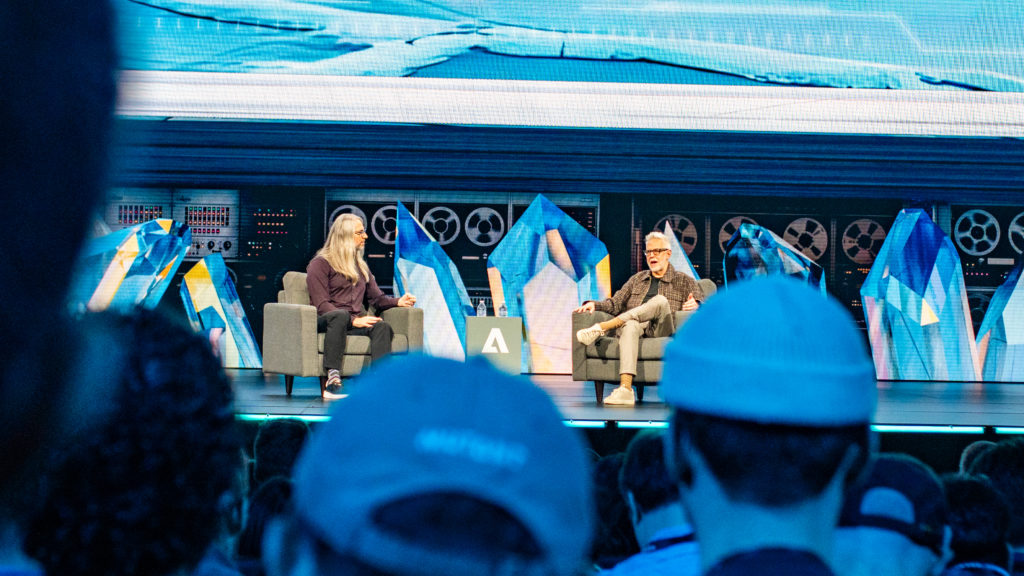
We have the “discovery phase,” as shared by indusy legend James Gunn during his sit-down with Jason Levine. “The thing is to create shit,” he reminded us. We need to go through the phase of trying things out, as Gunn did, an exploration of “finding out what I was really good at and what I enjoyed.”
We have the vulnerability phase, shared by Meagan Keane, Director of Product Marketing, Adobe Pro Video, during the Video Super session. As we “move into new disciplines,” such as sound and motion and visual, we also try new things, such as vertical storytelling on a mobile device. If we capture the process, it’s possible that “creativity comes alive in new exciting ways.” But only if we’re willing for projects to be “seen before being perfect”
We have the current state of mobile, also clarified by Keane, with the recent launch of Premiere for iPhone. You may have noticed that Rush and Project Violet can no longer be downloaded in the App store: Rush will continue to work, but is no longer in the store and Violet turned out to be the Beta for Premiere for iPhone. Rush set the staging ground for the new mobile app. “One of the biggest learnings that we had from Rush into Premiere on Mobile is that mobile editing is complex, and people want a certain level of complexity that is approachable,” Keane shared. The real core focus for Premiere on Mobile was [the] unlimited timeline, smooth performance, really making sure the editing experience was top notch…So the growing from Rush was more, we needed to be a professional-level tool made for a mobile device.”
We also can’t ignore the current state of video editors. The traditional model of progressing through the video world, from assistant onward, feels tenous alongside the current rate of production and the reality of chat-based video editing and AI-assisted video production. I posited the curiosity, and the general unease, of where AI might be headed within the video editing environment to Keane: “For Premiere Desktop, we are very cognizant of, like, how and when and what we are bringing in from an AI perspective, and as part of that, we are very tight with the video community in terms of what is most useful. Where do you actually want AI, and where are you feeling the human or the creative element is something that you really want to retain? And so when you look at things like Media Intelligence, or Generative Extend, these are places where editors are wasting way too much time not being able to actually be creative, being taken out of their creative flow. And those are the things where we’re really focusing on.”
We have states like chapters, highlighted by Kait Schoeck, Principal Designer at Microsoft AI+Cloud, on the Discovery Stage. Designing requires chapters such as “primitive, complicated, and simple.” Key moments may live in between those stages, or in a cycle.
We have brand new states that happen right in front of us, not just in the formation of a cloud, but as a transition from intern to an employee: Oinfrila Saha, current state Research Scientist/Engineer Intern at Adobe promoted on stage to a full-time position by Paul Trani during her presentation at Sneaks based on the success of her project, Project Scene It.
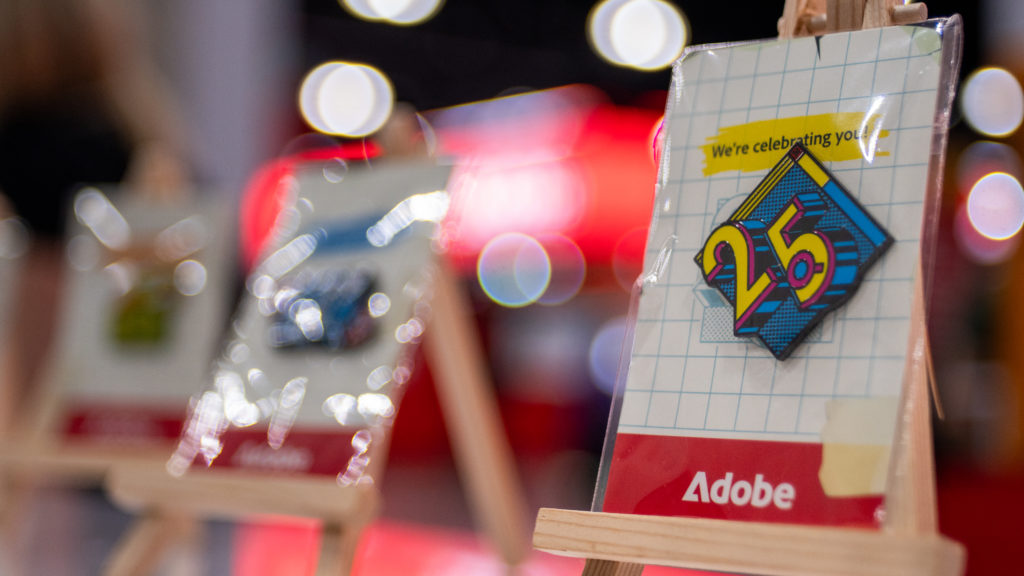
We have the state of the ocean, courtesy of the pool-theme Adobe MAX Sneaks stage. Sneaks host Jessica Williams referred to Sneaks as a “magic show for millennials.” And certainly the jokes in that realm were there: Project Motion Map inspired a “Flash is BACK!” yell from a nearby attendee. FYI that if you, like me, used Flash, Congrats: you have used Adobe products for 25 years.
Now, speaking of Flash: when I was in school, we learned the three main states of matter, but not the fourth fundamental state: plasma.
According to the Princeton Plasma Physica Laboratory, “When a neutral gas is heated such that some of the electrons are freed from the atoms or molecules, it changes state and becomes a plasma. Lightning is one example of plasma. And there was definitely a strike on stage: Project Clean Take, or as I called is, Project whaaaaatttt. With separation technology to isolate sounds, and the ability to regenerate words and shift emotion in video, this brought all of our phases front and center.
In Boston now, we are in fall, a moment of transition where the leaves change to a vibrant state. Los Angeles is not privvy to these seasons, not exactly. It was 90 degrees in October.
But perhaps, just maybe, these little atom changes will start to add up to a shift for you. And maybe, just maybe, MAX is a state change as well.