

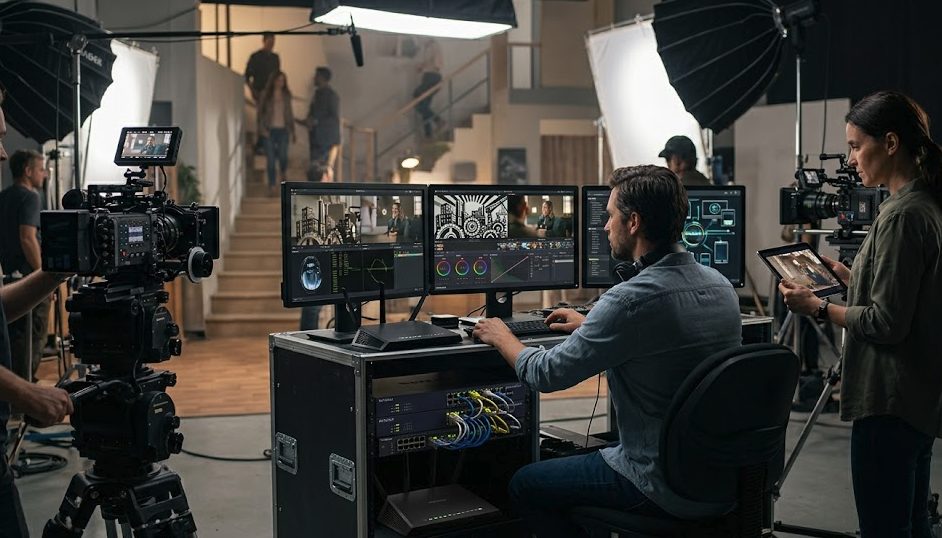

Filmmakers and creatives have always prioritized what’s on screen, but are especially aware that you can’t get what you need without the right gear. It’s why we obsess over the glass on the lens, the ratio of the key light, and the perfect color grade. Things like signal distribution and latency as well as video cords and cabling aren’t always top of mind, but we’ve detailed the gaps that can occur when they’re not prioritized. It’s similar to view networking hardware and on-set connectivity as an afterthought. But that mindset can create similar problems on set and in post.
It’s easy to understand why that’s the case, because the modern set is entirely data-driven. When you fail to treat on-set connectivity as a core production asset, you’re not just risking bad Wi-Fi, you’re actively draining your production budget. Leaving networking to chance creates a domino effect of technical friction that directly translates into expensive delays.
The Real Price of a Dropped Signal
When a cheap consumer router or an unmanaged switch bottlenecks on a busy stage, production grinds to a halt. Consider a director trying to review real-time footage on a tablet, a sound recordist attempting to sync timecode over a congested local network, and an assistant camera operator trying to use a wireless focus control app. If the wireless network drops or stutters under the data load, the camera crew cannot pull focus, the director loses their video village feed, and the talent stands around waiting.
On a union set, every single minute of downtime costs hundreds of dollars in crew labor. If a poor connection delays shooting by just thirty minutes a day over a two-week shoot, thousands of dollars of your budget vanish into thin air. You are essentially paying top-tier creative talent to watch a loading spinner.
Additionally, data bottlenecks destroy post-production schedules. Waiting hours on set for massive digital video assets to transfer over an inadequate connection delays your Digital Imaging Technician from backing up footage and pushing proxy files to the edit bay. When the crew works past their scheduled wrap time just waiting for data bars to finish filling, you face steep overtime expenses. No matter the size of the production or budget, there are numerous products that can provide the connectivity needed to ensure that doesn’t happen.
Next-Gen Video over IP: Netgear AV Line Managed Switches
As Hollywood shifts toward decentralized sets and live broadcast workflows, AV-over-IP (Audio/Video over Internet Protocol) has become a necessity. Netgear’s specialized line of switches—such as the Netgear M4250 AV Line Managed Switches—bridges the gap between traditional video engineering and modern IT systems.
Options like the compact Netgear M4250-9G1F-PoE+ AV Line Switch offer critical advantages for localized mobile carts. Unlike standard IT switches that require intense manual coding, the Netgear AV line comes pre-configured with a dedicated user interface tailored entirely for broadcast and pro-AV environments. Operators can easily assign color-based profiles for Dante audio, Q-SYS, AES67, or video systems directly to specific ports without being an IT specialist. Additionally, Power over Ethernet (PoE+) allows digital imaging technicians and video engineers to power complex video rigs, PTZ cameras, and production monitors using a single network cable, cleaning up clutter across the video village.
Eliminating Dead Zones: WiFi 6 Infrastructure and Mesh Extenders
Large studio stages, dense practical locations, and sprawling backlots present massive physical barriers to wireless signals. Specialized broadcast inventory introduces key Netgear wireless access points and extenders to maintain uninterrupted signal across massive distances.
Operating with concurrent dual-band speeds up to 1.8 Gbps, deployment-ready access points like the Netgear WAX202 and WAX214 integrate high-performance 802.11ax technology into small footprint production kits. These units support cutting-edge WPA3 encryption, isolating sensitive telemetry or camera control traffic from the rest of the crew’s devices. When a video village needs to be set up far from the physical stage or video cart, the Netgear EAX20 WiFi 6 Range Extender transforms an existing network into a localized mesh system, extending the range under a single network name so tablet operators can roam the set fluidly without dropping connections. For sets utilizing local internet drops or cellular bonding arrays, incorporating an ultra-high speed gateway like the Netgear Nighthawk CM2000 2.5Gbps DOCSIS 3.1 Modem guarantees a massive pipeline back to the production office or remote editors, delivering multi-gigabit speeds directly to your master router.
Navigating the Pro AV and Broadcast Landscape
Securing enterprise-grade infrastructure through professional production channels provides distinct commercial advantages. Suppliers like Filmtools and PacRad understand how IT hardware interacts directly with filmmaking gear like Teradek transmitters and professional wireless follow-focus rigs.
To help production companies scale their inventory without draining immediate cash flow, these platforms offer flexible purchasing programs like Affirm alongside dedicated business accounts to streamline commercial quoting. Because production schedules are unpredictable, having access to global delivery across more than 190 countries and live engineering support ensures you can troubleshoot network emergencies directly from location shoots, keeping your budget intact and your cameras rolling.