




When I needed to produce a dramatic audio scene on CapicúaFM, featuring the VPs of International Wire Transfers from two different fictitious banks located in two different countries, I went to the max to achieve realism: I came up with the two fictitious bank names (one in Colombia, the other in the United States). I had logos made for each, and even purchased domain names for each of the two fictitious banks. Then I chose the ideal character names and each voice actor and actress, to have a very recognizable accent. (Details ahead about the accents chosen for each character in this episode.) Of course, I also wrote a very believable script of our «live coverage of the first ever billion dollar wire transfer» between the United States and Colombia. I played the role of myself, as I introduced each bank executive. Both sounded and expressed how excited they were to have this «historic event» be covered «live on the Internet» on CapicúaFM, as they initiated the «billion dollar wire transfer». Their character names were: Fernando Villanueva, VP of International Wire Transfers at the Potomac Bank in the US, and Sandra Restrepo Betancourt with the same exact role in Banco Chibcha of Colombia.
Above, you can hear the entire episode, in Castilian (castellano), commonly but inaccurately called «Spanish» (español).
The tragedy of the scene is right after the Potamac Bank sends an amount which is dramatically less than the amount expected at the other end, due to a colossal misunderstanding about the word billón and the word billion in their current definitions in the respective languages and countries.
The whole purpose of this episode (in addition to entertaining the audience) was to:
- Educate the audience about the problem with the English word billion and its meaning in the US (and even in the UK, starting in 1974), contrasted with the closest sounding word in Castilian (billón) and its value. Unfortunately, many otherwise educated bilingual people end up inadvertently adding or subtracting three zeros in their blundered translations or interpretations. In Castilian, a billón has twelve zeros, as it officially did in UK English until December 20, 1974, when the then UK Prime Minister Harold Wilson announced the country’s decision to match the US billion definition, with only nine zeros.
- To satirize and ridicule the Spanish Royal Academy Castilian Dictionary‘s unfathomable decision to make the word billón officially refer to either of the amounts: 1,000,000,000,000 or just 1,000,000,000 depending upon the location of the Castilian speaker in the world.
That’s why Sandra Restrepo Betancourt from the Banco Chibcha went from happy to extremely concerned, saying that there was a problem. Then Fernando Villanueva of the Potomac Bank asked her in Castilian: «What’s wrong? You didn’t get the transfer?»
Sandra responded: «We received it, but it’s not the agreed amount.»
Then Fernando Villanueva tried to defend himself, saying that he sent a numeral 1 followed by nine zeros. Sandra Restrepo Betancourt then clarified that that is wrong, since the worldwide consensus of the billón definition in any Castilian-speaking country is with twelve zeros, not nine.
At that point, we had a «surprise»: Dulcinea, the Royal Academy’s public relations spokesperson, somehow crashed our live call without having been invited, and told them both: «Not to worry. You are both correct according to our latest Dictionary!»
Sandra Restrepo Betancourt then becomes furious with the situation and with Dulcinea, stating that it is complete chaos for the Academy to have made such an unacceptable decision about a numeric word which absolutely must be an international standard among all Castilian speakers worldwide. Sandra Restrepo Betancourt insisted that since the Academy was absolutely culpable for this unnacctable situation, she demanded to have the Academy immediately wire her bank the difference of US$999,000,000,000 to compensate for its colossal blunder in stating in is latest Dictionary that both amounts were equally correct. Dulcinea becomes flustered and embarrassed, pretends that the call is failing and disconnects.
Then I clarified to the audience that we had been presenting a simulation, explained the purpose and thanked the real-world Nathalia Morales Arévalo for her 2022 article in the Colombian newspaper La República, where she explained how certain Colombian banks had begun to offer accounts in US dollars for the very first time. I also invited the real-world Nathalia Morales Arévalo to be interviewed on CapicúaFM in a future episode.
How I chose each accent for each role in the dramatic scene
Considering that CapicúaFM has a worldwide audience of Castilian speakers since 2014, with over 515,239 unique plays in 161+ countries according to Podtrac, I wanted to make ideal selections, as indicated below:
- For the character of Fernando Villanueva of the Potomac Bank in the US, I chose a voice that sounded native Hispanic but generic for most listeners. That’s why I chose a Costa Rican voice over actor, since the majority of my Castilian-speaking friends (who are not Costa Rican) are not familiar with that accent and it sounds generic to them.
- Most of my Castilian-speaking friends have never been in Colombia and are unaware that there are many regional accents within the country, just as there are within the United States in English, and within other countries too. Among Castilian-speaking friends I know who have never visited Colombia or haven’t yet had close Colombian friends from multiple regions (I fortunatelly have), there is only one regional Colombian accent that they all recognize as «Colombian»: the paisa accent, so that’s what I wanted and chose for the character of Sandra Restrepo Betancourt. (The last names Restrepo and Betancourt are also quite common in Colombia.)
- Considering that the character Dulcinea needed to be from Spain and be recognizable as such, I chose a voice actress who speaks not only with a Spaniard accent and tone, but also one who distinguishes the soft C and Z sounds from the S sound.
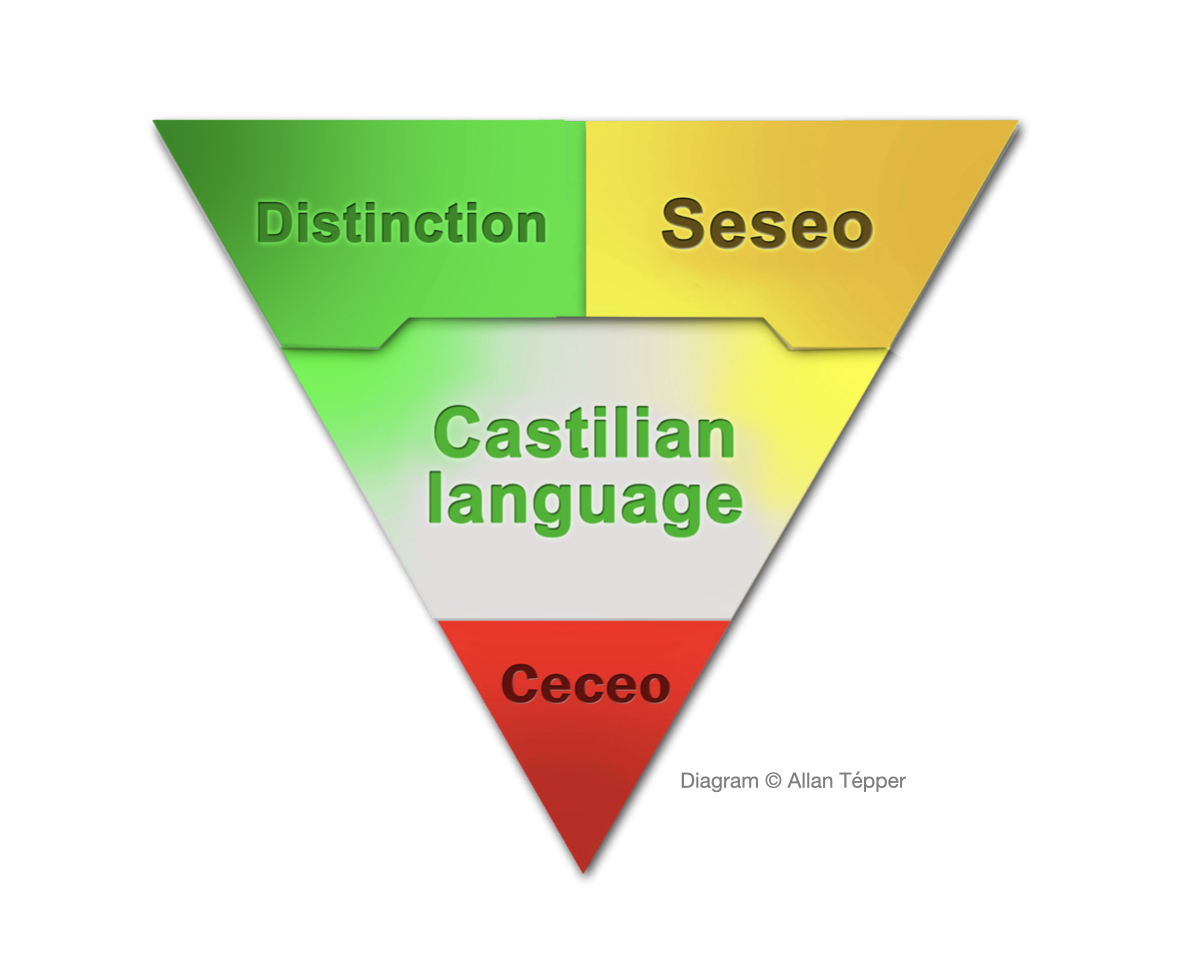

I am very aware that there are some regions in Spain that speak with the seseo, where the soft C and Z are pronounced like the S (as with the majority of Castilian-speakers in the Americas), that is not what I needed for this character. I covered the issue (seseo versus distinction versus ceceo) as illustrated above in the first episode of Speak Castilian, called Castilian lisp? Think again!
Click the play button above to hear this episode in English.
Upcoming dramatic scenes in CapicúaFM
Be sure to be on one of my mailing lists below for upcoming dramatic scenes in CapicúaFM.
Lee este artículo en buen castellano
(Re-)Subscribe for upcoming articles, reviews, radio shows, books and seminars/webinars
Stand by for upcoming articles, reviews, books and courses by subscribing to my bulletins.
In English:
- Email bulletins, bulletins.AllanTepper.com
- In Telegram, t.me/TecnoTurBulletins
- Twitter (bilingual), AllanLTepper
En castellano:
- Boletines por correo electrónico, boletines.AllanTepper.com
- En Telegram, t.me/boletinesdeAllan
- Twitter (bilingüe), AllanLTepper
Most of my current books are at books.AllanTepper.com, and also visit AllanTepper.com and radio.AllanTepper.com.
FTC disclosure
None of the listed individuals or companies mentioned above has paid for this article. Some of the manufacturers listed above have contracted Tépper and/or TecnoTur LLC to carry out consulting and/or translations/localizations/transcreations. So far, none of the manufacturers listed above is/are sponsors of the TecnoTur, BeyondPodcasting, CapicúaFM or TuSaludSecreta programs, although they are welcome to do so, and some are, may be (or may have been) sponsors of ProVideo Coalition magazine. Some links to third parties listed in this article and/or on this web page may indirectly benefit TecnoTur LLC via affiliate programs. Allan Tépper’s opinions are his own. Allan Tépper is not liable for misuse or misunderstanding of information he shares.