


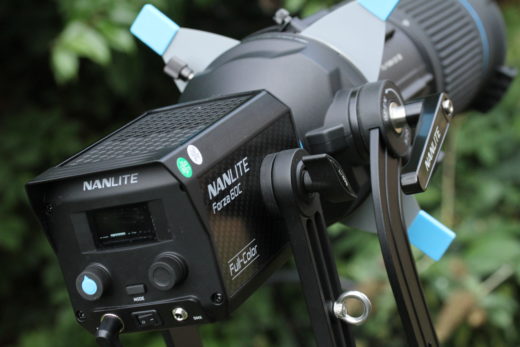
Mention the idea that the film industry did not invent interchangeable modifiers, and someone will immediately mention K5600’s stalwart Jo-Leko, a projection attachment which predates the widespread adoption of flash-shaped LEDs with snap-on options. Still, while we’re calling it a Bowens mount, we should probably accept that we owe some of the conveniences of modern lighting to the world of stills.
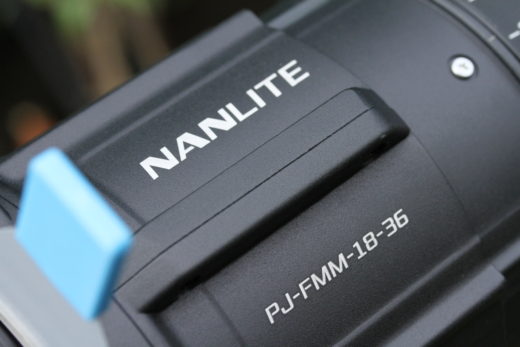
This discussion is prompted by Nanlite’s new 25 to 45-degree projection attachment, which the company intends for Bowens-mount lights such as the FC-500C. For comparison, we also see the 18-36 degree attachment for lights with the company’s smaller FM mount. This sort of lens tube has improved enormously during the age of LED; the optics used in most modern designs are often considerably better than those of a decade ago, reducing aberration in a way that helps things look less like a projected effect and more like an actual shadow and without the light loss of traditional workarounds.
Compatibility issues
The company suggests that the Bowens-mount design should be compatible with lights from other manufacturers, which sounds straightforward: a Bowens mount is a Bowens mount, surely? Well, there’s a reason Arri developed a custom mount for Orbiter, and it’s not just because it wanted electrical contacts. Historically, the Bowens design specified the one-third-turn latching arrangement, but not much else – particularly, there is vagueness on how far the emitting surface protrudes through the latching ring, and how large that emitting surface is.
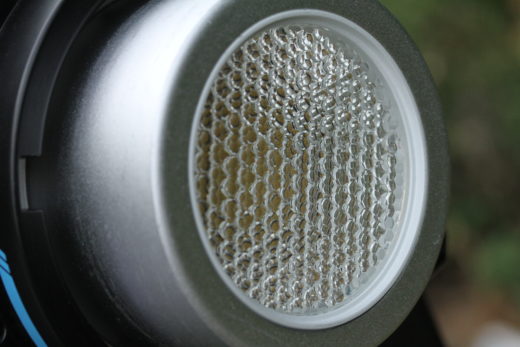
That uncertainty makes cross-compatibility tricky. There are ways to mitigate the issue, particularly using a large (therefore expensive) condenser element at the back of the lens tube. In practice, trying the 25-45 lens tube on Brand X seems to work fine – either it is a clever design, the compatibility issues are exaggerated, or luck intervened. Because of that third possibility it’s still a little risky to make high-stakes assumptions, but on available info, compatibility seems good. Certainly, projection attachments from Brand X have been shown not to work well on lights from Brands Y and Z in the past. Looking good so far.
The diminutive Forza 60C light is compatible with the 18 to 36-degree lens tube. Projection lens arrangements such as these are inevitably somewhat inefficient, though the comparatively large diameter of the lens tube ensures a reasonably healthy f-number (yes, f-stops go both ways). The 60C is a modestly-powered light and the result is naturally not the sort of searchlight beam produced by a 500W LED. More crucially, the field is not quite as flat – the beam hotspots slightly. Still, projected patterns seem clear and sharp.
Colour quality
While we have these lights on the bench, let’s take the opportunity to assess colour quality, which is an interesting question given the differing technology underlying it all. FC-500C is an RGB plus white device, though metering suggests the white is very warm. Forza 60C is an RGBACL design. Comparing colour quality, we discover that both do well – especially given the larger light’s simpler colour engine. Its red and blue channels seem to include two different species of LED, broadening their spectrum, and the result is a light which minimises the drawbacks of other four-channel designs.
The Forza 60C naturally measures very differently, with a spectrum that is rather more continuous – albeit lacking in super-deep reds and blues as most LEDs do. The choice between RGBW and RGBACL is largely one of, respectively, power over spectral quality.
One pleasant surprise is that both match fairly well when asked for the same thing. Measurements were taken at 100%, 50% and 5% output and at a selection of colour temperatures. The RGBACL design is capable of anything from 1,800K to 20,000K (so wide that UPRTek CV600 meter refused to consider it a white light at the minimum). CCT accuracy is superb across the entire range on both lights, though the RGBW design offers a reduced range of 2,700K to 7,500K.
Technological differences
The RGBACL design seems to offer more consistent R9 and R12 responses – not higher than the RGBW option, but less changeable across different intensities and colour temperatures. The 60C achieves a minimum of 86 R9 and 67 R12 at the difficult 20,000K setting; otherwise, numbers are in the high 70s and around 90 respectively. TLCI is generally better on the 60C, as we might expect. The FC-500C maintains a minimum of 80.8 and that only at the difficult 5% output; TLCI is otherwise at least 90. The 500W light maintains a minimum of 63 R12 and 82 R9, measured at 7500K and 4200K respectively.
Both of these lights default to a maximum-output strategy, so midrange colour temperatures are brighter. Naturally, the lens tubes increase point intensity. Without the projection attachments, and with reflectors, at one metre, the FC-500C approaches 48,000lx and the 60C 11,500lx (its reflector is much, much narrower).
In the end, it is difficult to be objective about how well the company’s high-compatibility lens tube design maintains performance across different LED lights, because lights have variances in performance anyway. Suffice to say that it is considerably more cross-compatible than many designs, and general clarity and build quality is good. Perhaps one day someone will manage to establish a better specification for modifier mounts, but until then, engineering designed to desensitise technology from compatibility issues can only be a good thing.