


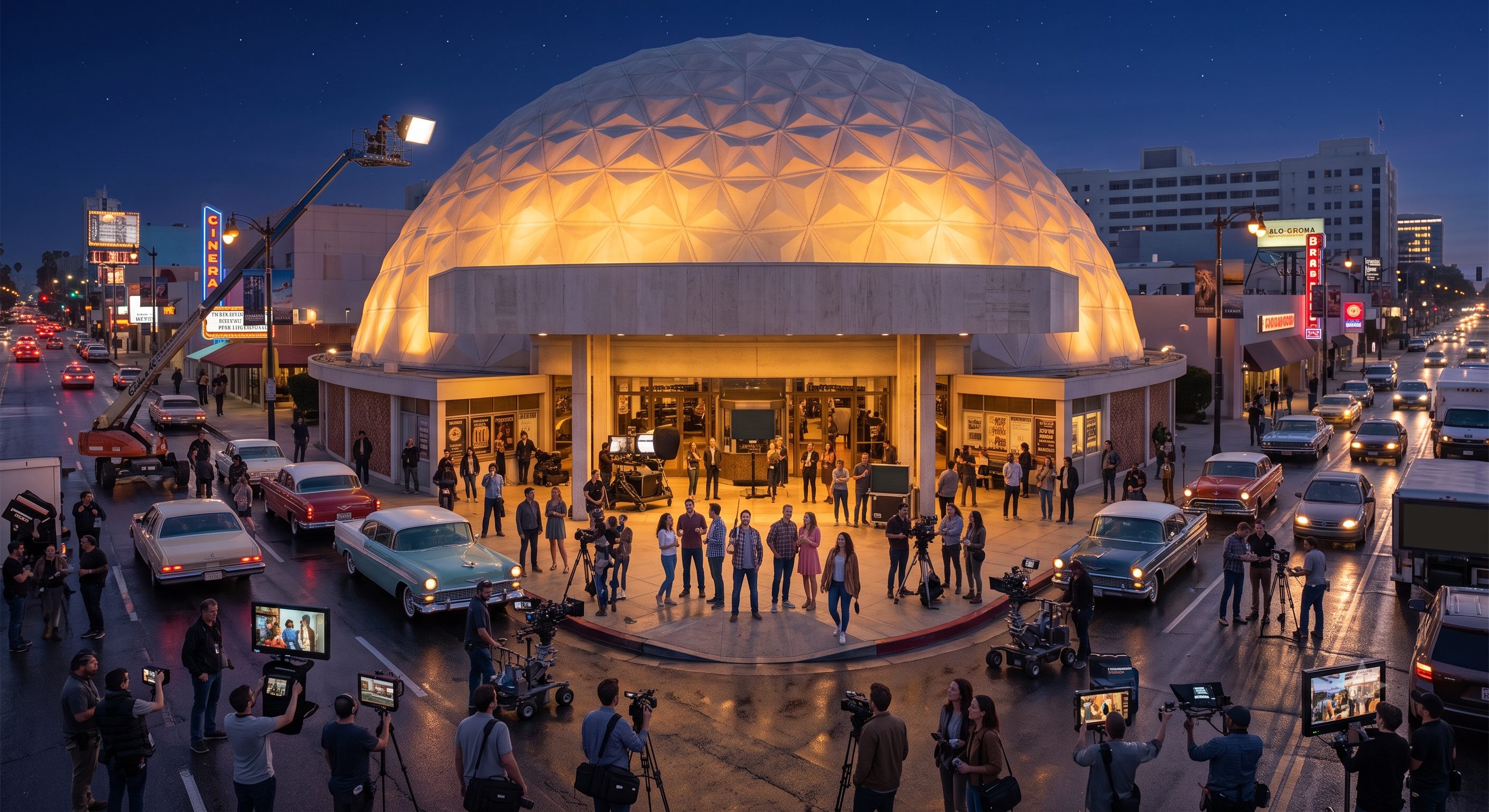
In recent years, the industry narrative surrounding Los Angeles has often sounded like an extended eulogy. Between production tax credit debates, runaway shoots to out-of-state hubs, and shuttered physical spaces, it’s easy for filmmakers working in production and post to wonder if L.A. is slowly relinquishing its soul as the center of cinema.
This week’s announcement that Sony Pictures Entertainment and Alamo Drafthouse Cinema are officially restoring and reopening the iconic Cinerama Dome proved that filmmaking spirit and community is alive and well. It’s tangible proof of Los Angeles still being the spiritual and physical capital of filmmaking and a place for filmmakers of all eras.
A Church for Film and Filmmakers
When Pacific Theatres closed its doors in 2021 during the aftermath of the pandemic, the dark marquee on Sunset Boulevard stood as a painful monument to what felt like an industry pulling back from its roots. For decades, the ArcLight Hollywood and the Dome weren’t just where Angelenos went to watch blockbusters on a Friday night. They were where crews went to see their work rendered in crisp 70mm, where directors hosted premiere Q&As, and where the line between content creator and audience completely dissolved.
Sony’s plan preserves the exact elements that made the venue a holy site for picture and sound purists. While Alamo Drafthouse is famous for its food-and-drink service, the Dome itself will remain a pure, traditional cinematic experience with no in-theater dining or server interruptions during screenings. The historic mid-century architecture and the signature 86-foot curved screen will undergo a full restoration, alongside support for pristine 35mm and 70mm large-format projection.
Meanwhile, the adjoining 14-screen multiplex will become the new Alamo Drafthouse Hollywood, featuring state-of-the-art 4K laser projection, immersive audio, and dedicated programming for archival film, filmmaker retrospectives, and Q&As in early 2028.
Why This Matters for the L.A. Production Ecosystem
Productions may no longer shoot exclusively on local soundstages, but the directors, cinematographers, colorists, and post-production craftspeople living and working in Southern California remain the backbone of the global industry. Having a venue engineered for proper screen brightness, precise color fidelity, calibrated sound, and zero ambient light interference honors that technical labor. It bridges the gap between cinematic legacy and modern technical excellence, ensuring art created here is experienced exactly as intended.
Having a major studio like Sony acquire Alamo Drafthouse and reinvest directly into a historic Hollywood landmark sends a strong signal about the enduring value of the theatrical experience. As Sony Motion Picture Group Chairman Tom Rothman noted, the team believes in moviegoing down to its soul, and few venues symbolize that commitment like the Dome.
Renovation work begins next month, with the full complex set to light up Sunset Boulevard in early 2028. Ultimately, the revival of the Dome proves that cinema hasn’t left Los Angeles, but is instead doing what it’s always done, which is to evolve alongside the surroundings that created it.