


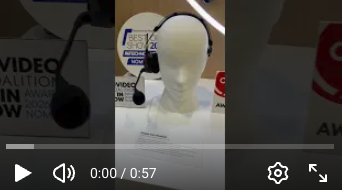
At NAB 2026, Saramonic isn’t just releasing products—it’s building out a full-spectrum audio ecosystem that spans from solo creators to large-scale production teams. Getting hands-on with the Air SE, WiTalk9X, and the new Base station, the throughline is clear: simplify audio workflows without sacrificing capability.

Starting at the smallest end of that spectrum, the Air SE feels like a direct response to the explosion of mobile-first content creation. The pitch is straightforward—professional audio, stripped of complexity—and in practice, it delivers on that idea with surprising confidence.
The system is built around ultra-miniature transmitters—roughly 5 grams each—that are designed to disappear on camera. Despite the size, it captures 48kHz/24-bit audio, with built-in AI-driven noise reduction that can intelligently suppress background noise without flattening the voice. Range extends up to around 200 meters line-of-sight, and setup is essentially plug-and-play via USB-C or mobile integration.
What stands out in use is how frictionless it feels. There’s no real “setup phase”—you plug it in, clip it on, and start recording. For creators working quickly—whether that’s social content, interviews, or run-and-gun shooting—that immediacy matters. This is clearly designed to compete not on raw specs, but on accessibility and speed.
At the other end of the spectrum, the WiTalk9X system shifts the conversation entirely.
Designed for multi-person communication, WiTalk9X builds on Saramonic’s intercom platform with a full-duplex, hands-free workflow that allows entire crews to stay connected without the need for push-to-talk or centralized hubs. In demo environments, communication is continuous and natural—more like a conversation than a comms system. It can support large teams while maintaining clear, full-duplex communication, even in loud environments like concerts or live events. It can also integrate with intercom systems from other brands, making it easy to drop into existing workflows without starting from scratch.
Range is substantial—up to roughly 500 meters line-of-sight—with dual-antenna transmission designed to maintain stability even in RF-heavy environments. The system supports up to nine users out of the box and can scale significantly higher through cascading setups, making it viable for everything from small film crews to larger broadcast or live event teams.
What’s particularly notable is the clarity. Saramonic’s ClearTalk noise-canceling system uses a multi-mic array and processing to isolate voices even in loud environments, which is exactly where most intercom systems tend to struggle. In practice, that translates into cleaner communication and fewer repeated calls—something any AD or director will immediately appreciate.
Then there’s the Base station—arguably the most important piece in terms of where this system is heading.
While earlier WiTalk systems emphasized decentralized, hub-free operation, the addition of a Base unit introduces a more traditional infrastructure layer for larger or more complex productions. It allows for expanded routing, integration with external communication systems, and connectivity beyond a single local network—bridging on-set communication with remote teams, production offices, or even cloud-based workflows.
This is where the ecosystem thinking becomes clear.
Air SE handles capture at the smallest scale—fast, simple, and mobile. WiTalk9X manages communication across active production environments. And the Base station ties everything together when those environments grow beyond a single location or team.
What Saramonic seems to be doing here is addressing a gap that’s been quietly growing in the industry. As productions become more distributed—smaller crews, remote collaboration, hybrid workflows—the need for scalable, interconnected audio tools has increased. Traditionally, that’s meant mixing and matching systems from different manufacturers.
Here, it’s all part of the same ecosystem.
If there’s a takeaway from seeing these tools at NAB this year, it’s that audio is no longer just about capture—it’s about communication and coordination across an entire production pipeline.
And with the Air SE, WiTalk9X, and Base working together, Saramonic is positioning itself not just as a microphone company, but as a workflow company.
After going hands-on, that shift feels both intentional—and well-timed.