


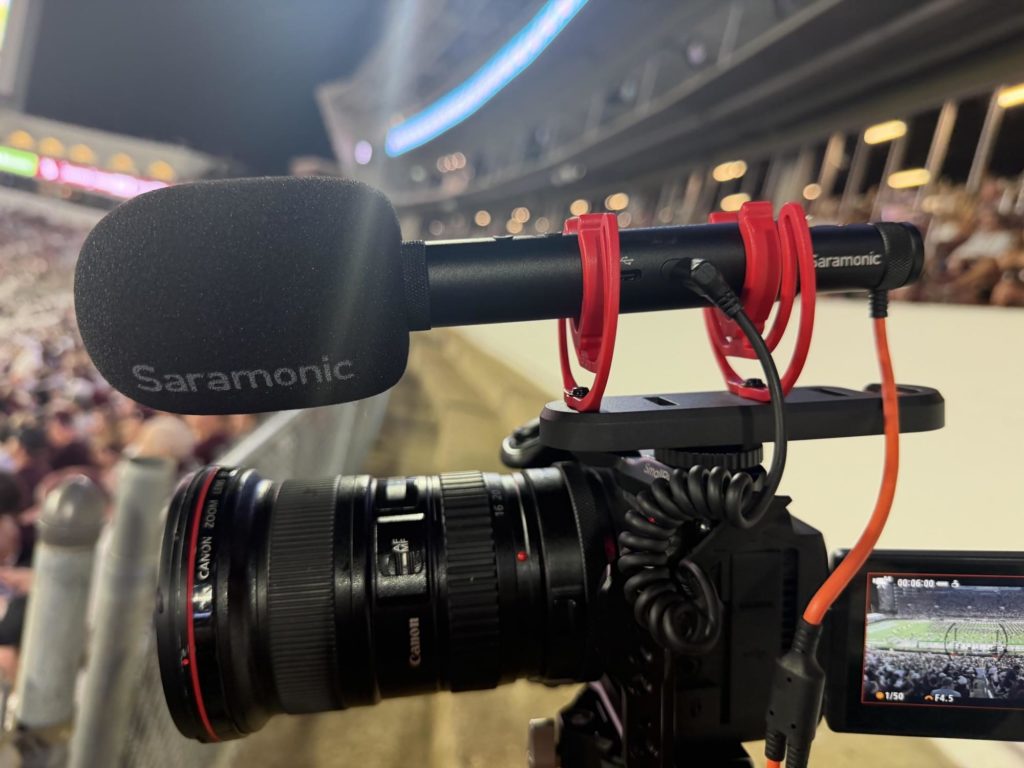
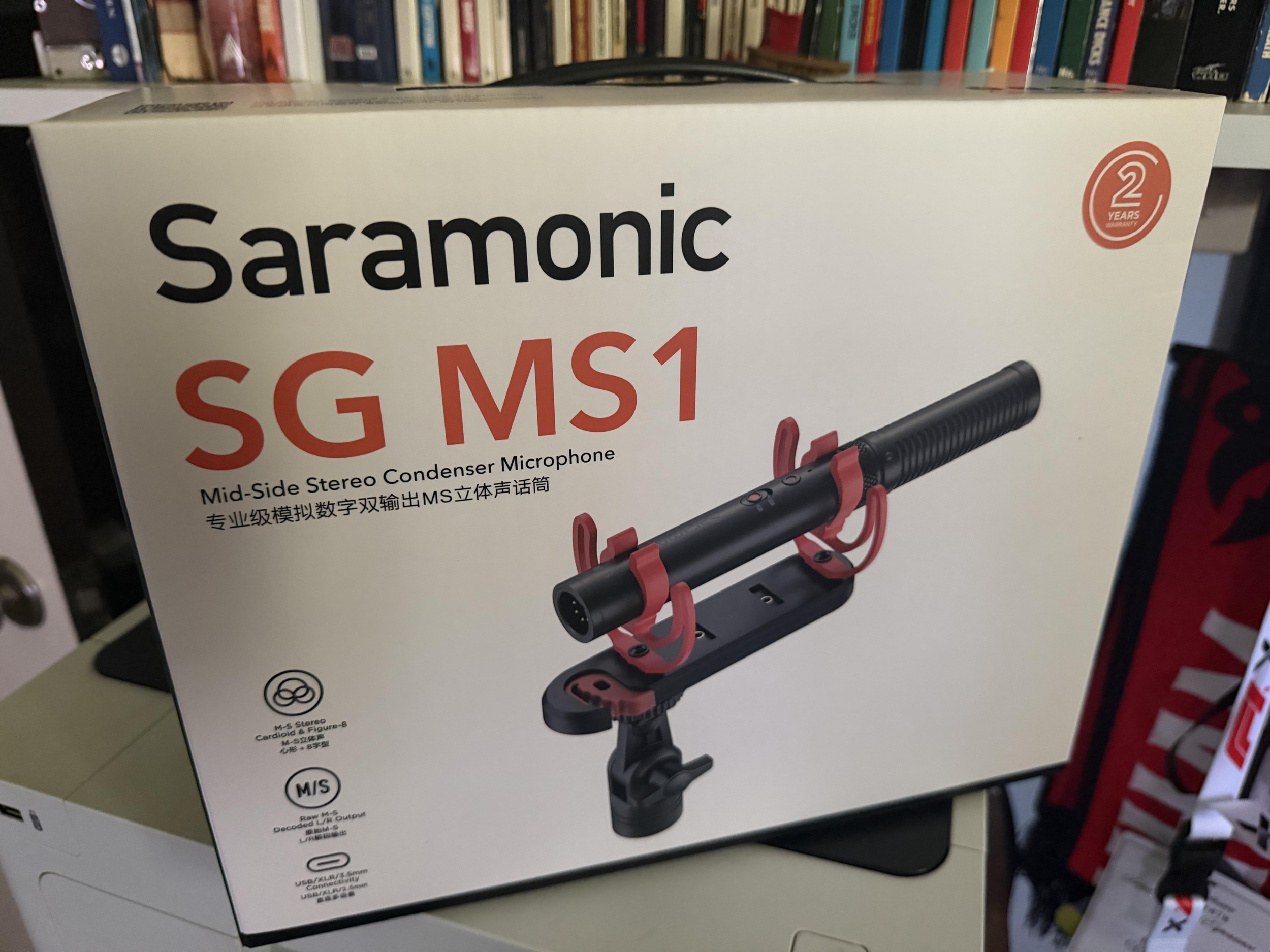
Saramonic continues to add useful products for the solo creator or small production shop to its line. The new Saramonic SG-MS1 Shotgun Microphone is one of those additions: a mid-side stereo mic that doubles as a cardioid on-camera mic.
Saramonic sent me this mic to test and review, which is great because I had a couple of specific scenarios to put it into.

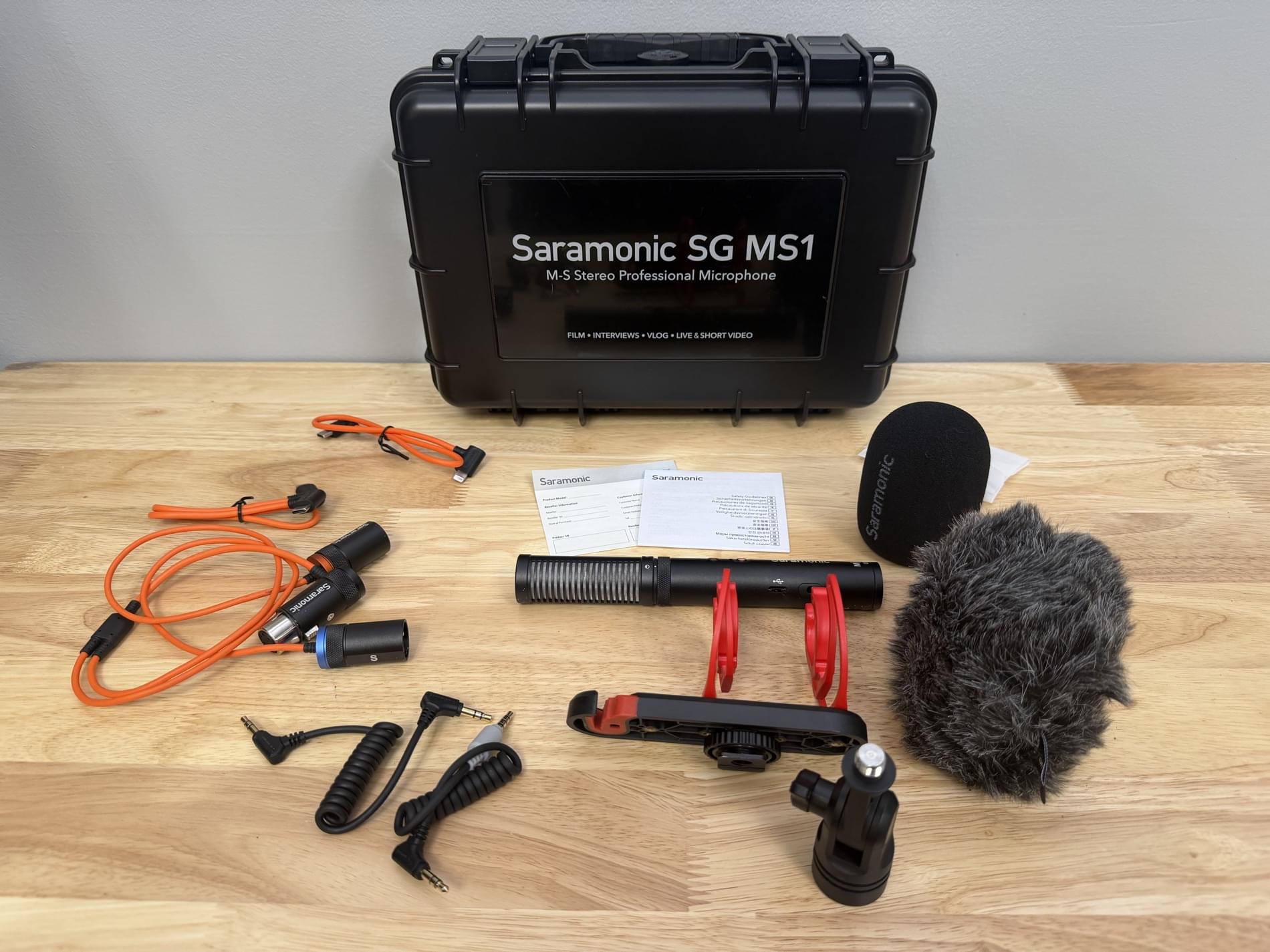
So, what all comes in the box?
The SG-MS1 is an all-metal build that weighs just 90g (3.17 oz), and it comes in a hard case along with:
- Foam windscreen and a more rugged dead cat-style wind protector
- Shock mount with cold-shoe mount
- 5/8″ stand mount adapter with 3/8″ and 1/4-20″ adapters
- Five-pin XLR to dual XLR cable
- USB-C charging and output cable
- USB-C to Lightning output cable
- 3.5mm TRS and TRRS output cables

One of the things I found really cool about this mic is its built-in rechargeable battery, rated for up to 5 hours, so you don’t need phantom power, though it does support 48V phantom if you have it.
Under the hood, the SG-MS1 has two capsules: a forward-facing cardioid (the “mid”) and a figure-8 (the “side”) that picks up from the left and right. A dial on the body lets you choose how those two capsules get combined across three output modes. Decoded L/R does the decoding inside the mic and gives you a standard left/right stereo feed that’s ready to use right out of the box. Raw M-S sends the mid and side signals separately, so you can decode in post and set your stereo width after the fact, or even collapse it down to mono. And M/S Mono puts each capsule on its own XLR channel, so you can use the cardioid mid by itself as a short shotgun-style mic.
The XLR jack on the mic is a little different in order to accommodate the various outputs. It is a 5-pin connector instead of the standard 3-pin jack. Saramonic provides a custom cable that splits the 5-pin into two standard XLRs for stereo or M/S recording. The USB-C port can be used to charge or as an audio out, and there’s also a 3.5mm TRS output.
And yes, you can output over the XLR cable and the TRS at the same time. That was a very cool addition. In testing, I ran the TRS output into a camera’s 1/8-inch mic jack and took the XLR outs into a small outboard recorder. The mic provided those outputs hot at all times, so I can record a scratch safety track on camera while recording much higher quality audio to an outboard recorder.
The mic can be controlled via USB with the free Saramonic System App for iOS and Android. I tested the iOS version.

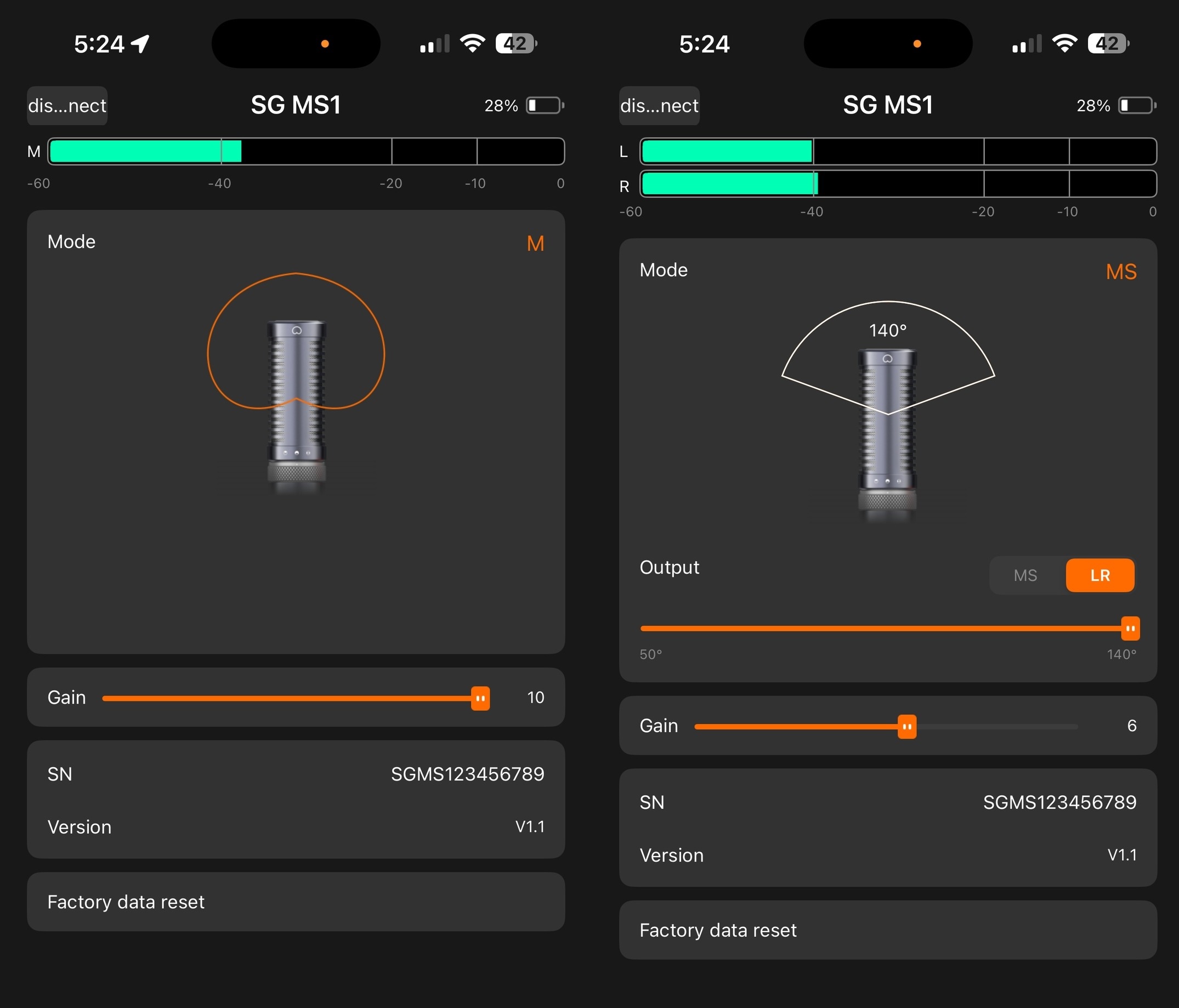
The app gives you deeper control than the dial on the body. From the app you can switch between output modes (Decoded L/R, Raw M-S, or M/S Mono), adjust the gain, and dial in the stereo width, which is really handy when you want to tighten or open up the stereo image depending on the venue. The app also shows real-time audio levels, so you can see what you’re getting while you make adjustments, and it lets you keep an eye on battery life. It is a pretty handy addition, but it must be connected via a wired USB-C cable.
Now let’s jump into a couple of real production use cases.
Scenario 1: The Famous Maroon Band
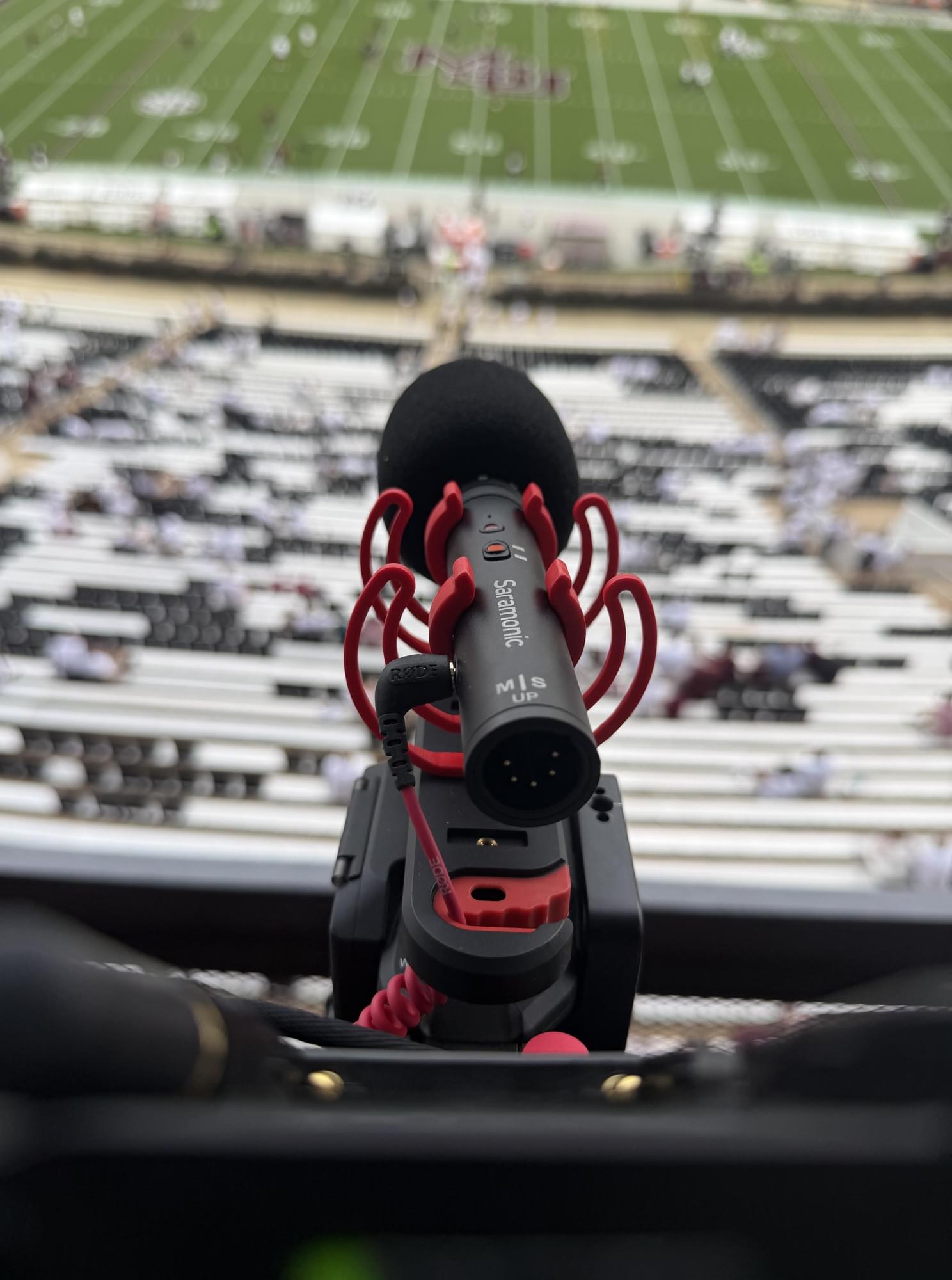
Every year I shoot the pregame and halftime shows for the Mississippi State University Famous Maroon Band. I’m usually on a photo deck a hundred feet in the air at the 50-yard line in Davis Wade Stadium. The band is 400+ members and puts out a pretty large wall of sound.
I shoot the pregame with a camera on the west side of the stadium. For halftime, I keep that shot and add an east side high shot for when the band turns halfway through the show and performs to the east side of the stadium.

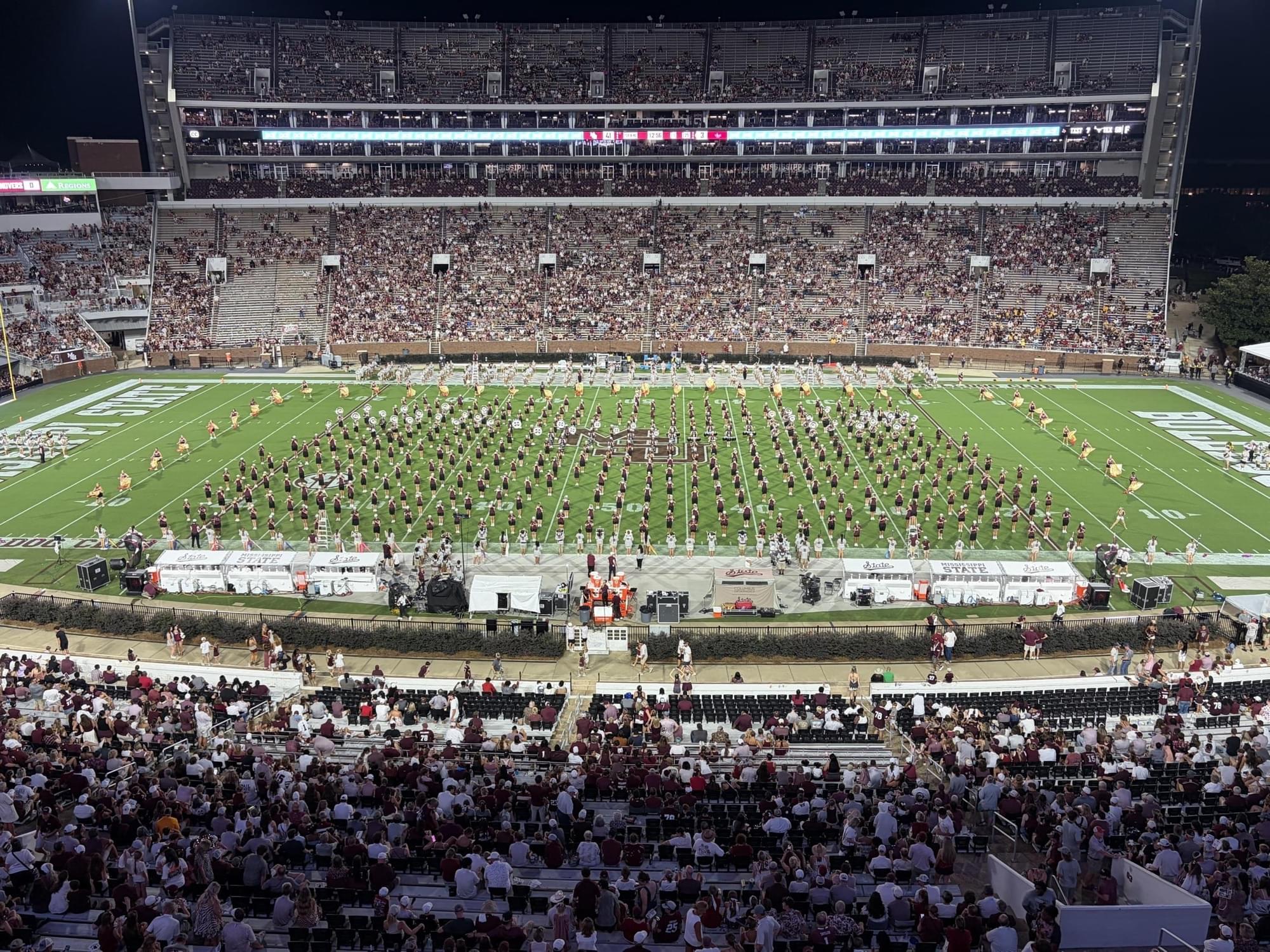
One of the challenges I’ve had is isolating stadium noise from the band while getting a true stereo image of the band. I have used short shotguns from other manufacturers in the past. The SG-MS1 piqued my interest because of its flexible outputs. I contacted Saramonic and asked for a demo unit to see if I could improve my audio quality.

This is the pregame shot from west side with the SG-MS1 in Decoded L/R mode. Cowbells and all.
For the first game in early September, I ran the mic in left/right so I would get the entire stereo field. I was pretty impressed, and I thought it sounded better than a traditional shotgun in a mono configuration. I could hear the full stereo image of the band, and it placed the drumline and other sections like brass in the mix as they moved across the field.
What I didn’t account for was the increase in stadium ambient sound.

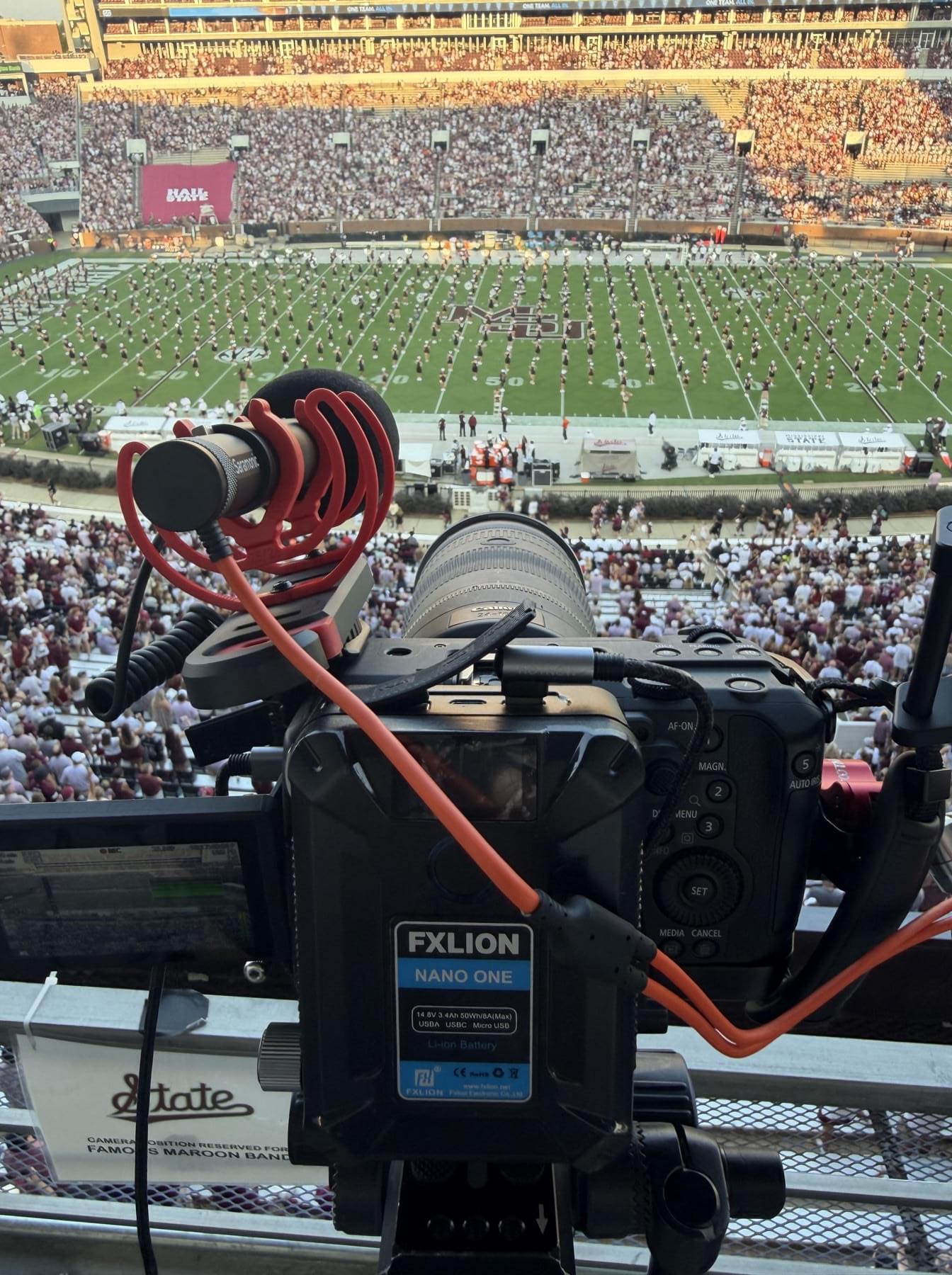
Mississippi State is known for its cowbells. The tradition dates back over a hundred years and is part of the university’s culture. Fans are given cowbells at an early age, bring them to football games and other sporting events, and ring them (mostly) nonstop. Christopher Walken immortalized the cowbell in his famous Saturday Night Live skit with Will Ferrell. (MORE COWBELL!)
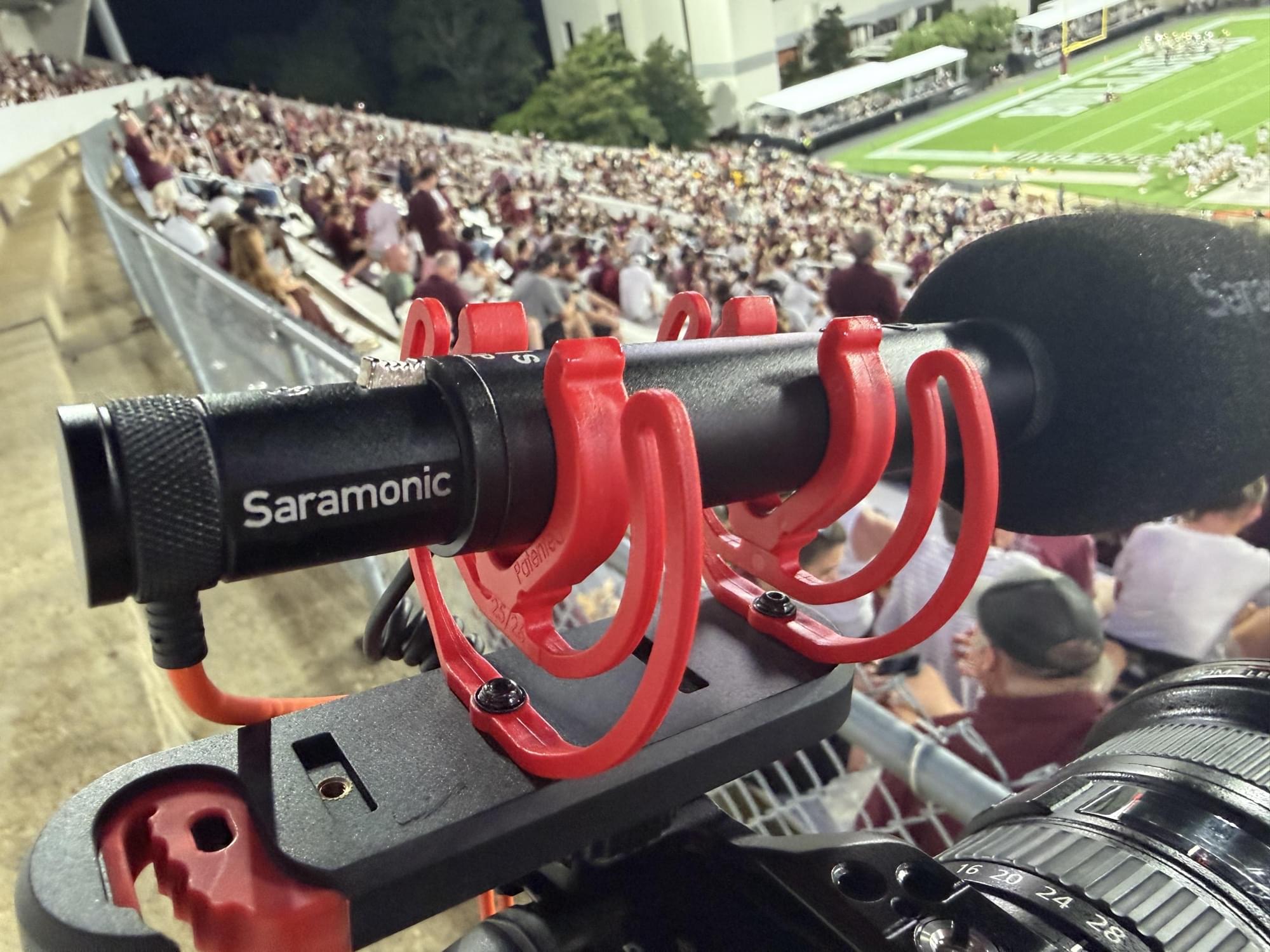
So imagine 60,000 cowbells ringing as the Famous Maroon Band marches out to take the field and perform the national anthem. Yeah, I didn’t think about that either as far as a stereo image was concerned. So not only did the Saramonic pick up a stereo image, it gave me a lot of “more cowbell.”
(For the next game, I switched to M mode so I concentrate on the band a little more.)

This halftime show started on the east side with the SG-MS1 in Decoded L/R mode. Mid way we change cameras to the west side where the audio is from the Audio Technica AT875R short shotgun. You can hear the difference between pickup patterns and clarity.
I was really pleased with the quality of sound and the pickup pattern, especially for a sub-$400 microphone.
Scenario 2: Secondary interview mic
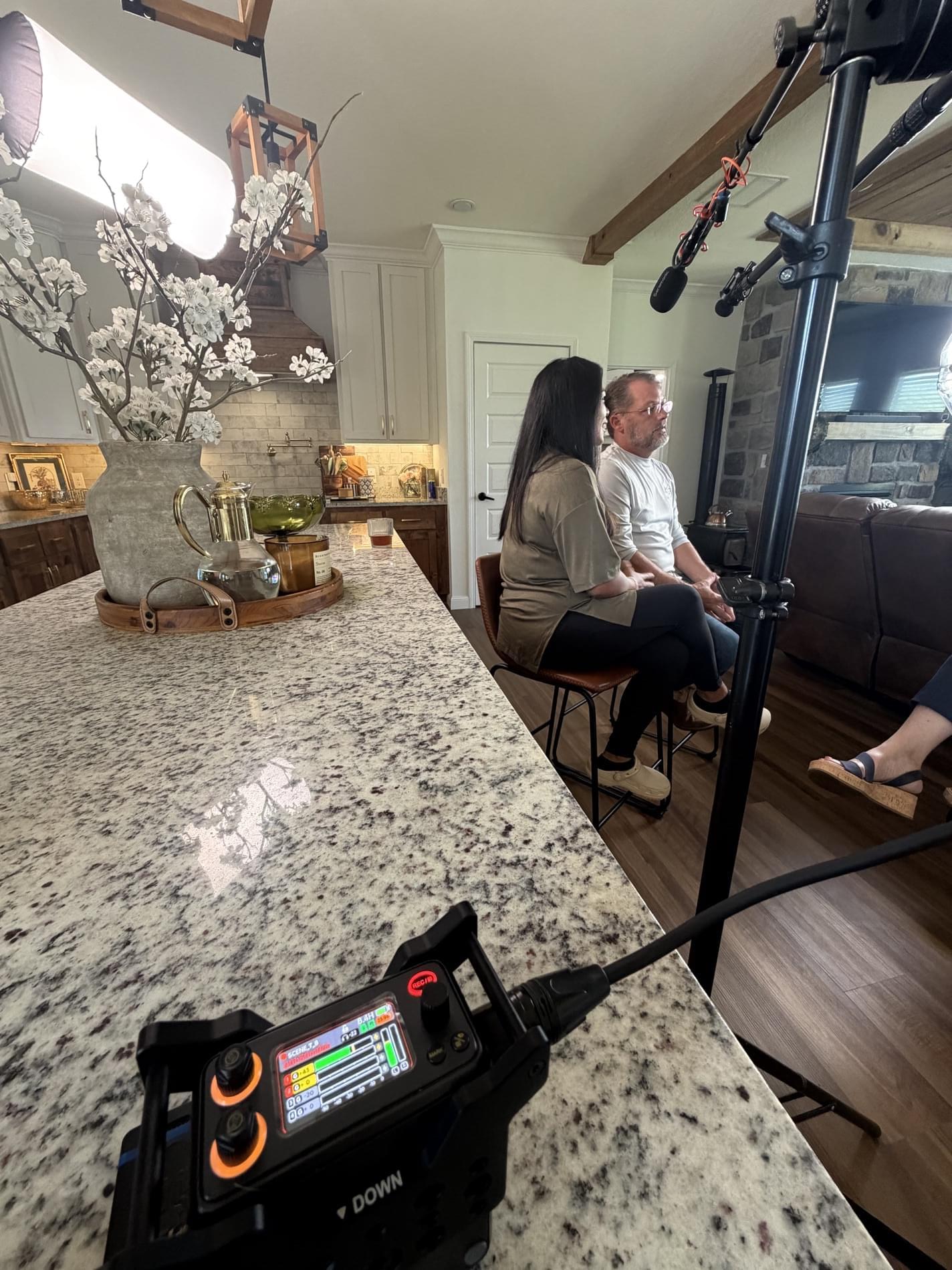
We were filming couples’ interviews for a client. These are couples who have purchased a manufactured home and are giving testimonials to the affordability, customization, and build quality. Typically, one of the homeowners speaks the majority of the time.

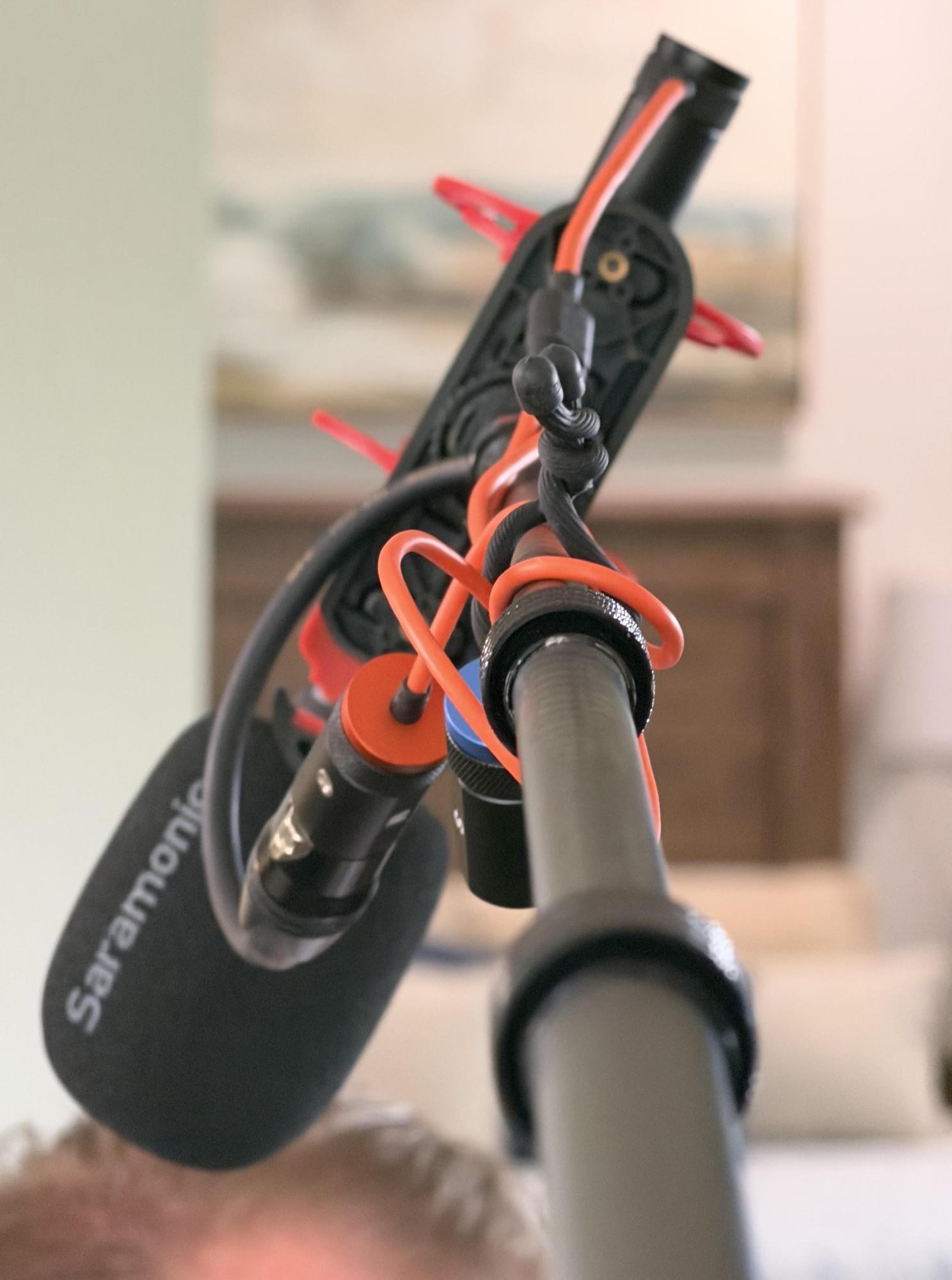
We boomed a Sennheiser MKH 8040 compact cardioid on the primary interview, then put the Saramonic into M/S Mono mode and flew it in from the other side of the set for the secondary interview. And I have to say, it sounded really, really good.
Is it a $1,600 Sennheiser? No, it’s not. But for the price point, as a secondary mic, it was impressive. We were able to EQ it to a fairly good match with the 8040. Was it identical? Absolutely not. Did it work for our use case? It was great, and probably better than putting a lav on the secondary interview.

The SG-MS1 performed well in two very different scenarios. It is pretty versatile for a mic in its price range.
PROS
- Onboard rechargeable battery eliminates the need for disposable batteries or camera-based phantom power.
- Multiple pickup patterns that you can select with a physical dial.
- Both TRS and XLR outputs are hot at the same time.
CONS
- The included hard case is nice, but I would prefer a soft-sided one to make packing easier.
- I understand why there is a 5-pin XLR cable, but I would like to see a shorter 5-pin to 3-pin cable for use in M/S Mono mode.
- It’s easy to block an output on the side of the mic with the shock mount.
CAUTIONS
- The app only works via USB-C, so make sure you have the appropriate cables handy.
- Be careful with the mode selection dial. The icons showing the pickup pattern are almost too small for my eyes.
- The 5-pin XLR decode cable is a little long, so make sure you have Bongo ties to secure the excess so it doesn’t wiggle and cause mic noise.
The Verdict
To my ear, this mic is as good as, if not better than, the lower-end offerings from RØDE and competes with the NT4. It’s aggressively priced at $350 and would be a perfect addition for any content creator or one-man band who needs a high-quality on-camera mic with a variety of outputs.
It has proven to be my top pick for on-camera mic uses with a small kit, and it will be a strong contender as a secondary boom. I would not hesitate to use it as my primary boom mic if I was flying light. I have no doubt that it will work as a mic for dialogue recording in almost any scenario.
Disclaimer: Saramonic sent me a demo unit of this mic to use. They have not seen this review at any point prior to publication. And I probably would have bought this mic with my own money.