


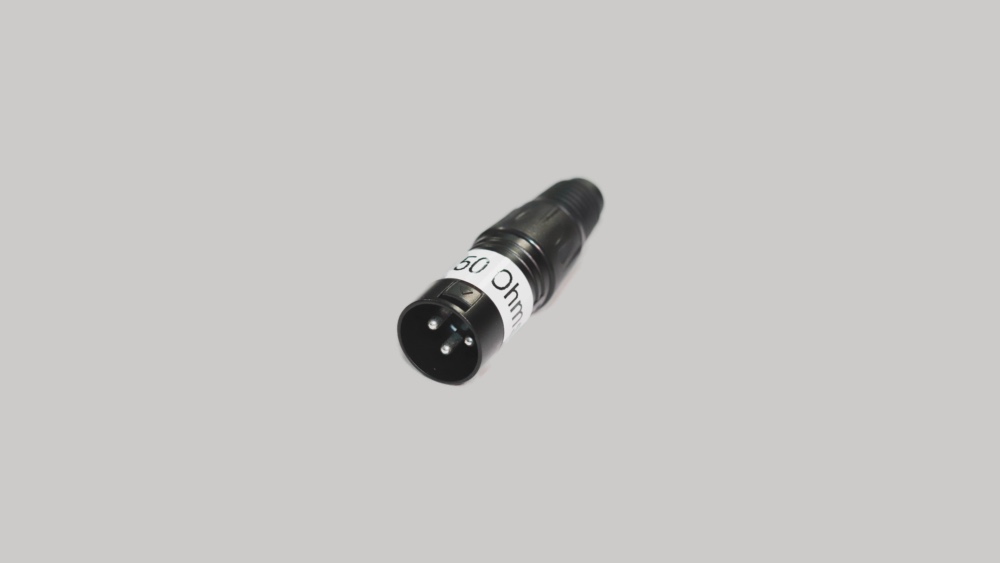


It has been known for many years (or decades) that one of the the best tools to determine how clean or noisy an audio preamp we plan to use with a dynamic microphone is with the use of a 150 ohm resistor. That’s because when using a dynamic microphone, the noisiest source in a recording situation (beyond the room or ambient noise) is nearly always the preamplifier, not the microphone. (The opposite tends to be the case with condenser or electret-condenser microphones, where the microphone is usually notably noisier than any connected preamp.) Using the 150 ohm resistor connected to the preamp input (instead of a dynamic microphone) allows us to test the preamp’s cleanliness or noise at any giving gain setting without adding the distraction of the room or ambient noise. To my knowledge, the first of my colleague’s to popularize the use of a 150 ohm dummy plug was Julian Krause in this video. Later, my other colleague Ray Ortega produced a related great video showing how to acquire the required components and then solder them together. Soldering electronic components was something I used to do during my youth, but nowadays I prefer to acquire such a device already available on the market at a reasonable price. After years of searching, I finally found it with Lisafiles and ordered one. The XLR 150 Ohm Preamp Interface Noise Tester, Black Dummy Plug currently costs US$20 pre-tax and pre-shipping.
According to Lisafiles:
«All of these dummy plugs are hand-soldered and tested to make sure they’re all working properly!»
Why reading the noise specs from devices is often not enough?
Even if we are to trust audio manufacturers with their published noise specs, either with Signal-to Noise or EIN (Equivalent Input Noise), there are three reasons why those official specs are often useless for us to compare directly:
- Different audio manufacturers often measure them at a different gain setting. For example, manufacturer will measure at +60 dB and another at +70 dB to show off its best-case scenario.
- Different audio manufacturers often measure EIN (Equivalent Input Noise) using two different measurements: some with dBV and others with dBu.
- When a device (like the Zoom PodTrak P4next multitrack portable recorder/interface I just purchased and will soon be reviewing) has special features, like a built-in switchable Limiter, switchable Tone (at least with the current firmware, a single EQ preset) or even switchable realtime AI noise reduction, it is very likely that the published noise specs were measured by the manufacturer at the best case situation, not the worst one.
Although it is indeed possible to perform a complex mathematical calculation to bring the specs indicated in examples 1 and 2 above into common ground, no such calculation will take care of the variances covered with number 3 as defined above. When I do my upcoming tests with the Zoom PodTrak P4next multitrack portable recorder/interface I just purchased, you can be assured I’ll be testing it with and without all of those options active and inactive one-by-one: built-in switchable Limiter, switchable Tone (at least with the current firmware, a single EQ preset) or even switchable realtime AI noise reduction. In any case, I am so glad that Zoom listed to our plea and improved it to work exclusively at 48 kHz and 24-bit.
Conclusions about the 150 ohm XLR dummy plug from Lisafiles
I am so glad that Lisafiles is now offering its 150 ohm XLR dummy plug for anyone who would prefer to let someone else be in charge of the soldering.
Lee este artículo en buen castellano
Reseña: Conector XLR de 150 ohmios para probar el ruido o la limpieza de preamplificadores de audio
(Re-)Subscribe for upcoming articles, reviews, radio shows, books and seminars/webinars
Stand by for upcoming articles, reviews, books and courses by subscribing to my bulletins.
In English:
- Email bulletins, bulletins.AllanTepper.com
- In Telegram, t.me/TecnoTurBulletins
- Twitter (bilingual), AllanLTepper
En castellano:
- Boletines por correo electrónico, boletines.AllanTepper.com
- En Telegram, t.me/boletinesdeAllan
- Twitter (bilingüe), AllanLTepper
Most of my current books are at books.AllanTepper.com, and also visit AllanTepper.com and radio.AllanTepper.com.
FTC disclosure
None of the listed individuals or companies mentioned above has paid for this article. Some of the manufacturers listed above have contracted Tépper and/or TecnoTur LLC to carry out consulting and/or translations/localizations/transcreations. So far, none of the manufacturers listed above is/are sponsors of the TecnoTur, BeyondPodcasting, CapicúaFM or TuSaludSecreta programs, although they are welcome to do so, and some are, may be (or may have been) sponsors of ProVideo Coalition magazine. Some links to third parties listed in this article and/or on this web page may indirectly benefit TecnoTur LLC via affiliate programs. Allan Tépper’s opinions are his own. Allan Tépper is not liable for misuse or misunderstanding of information he shares.