


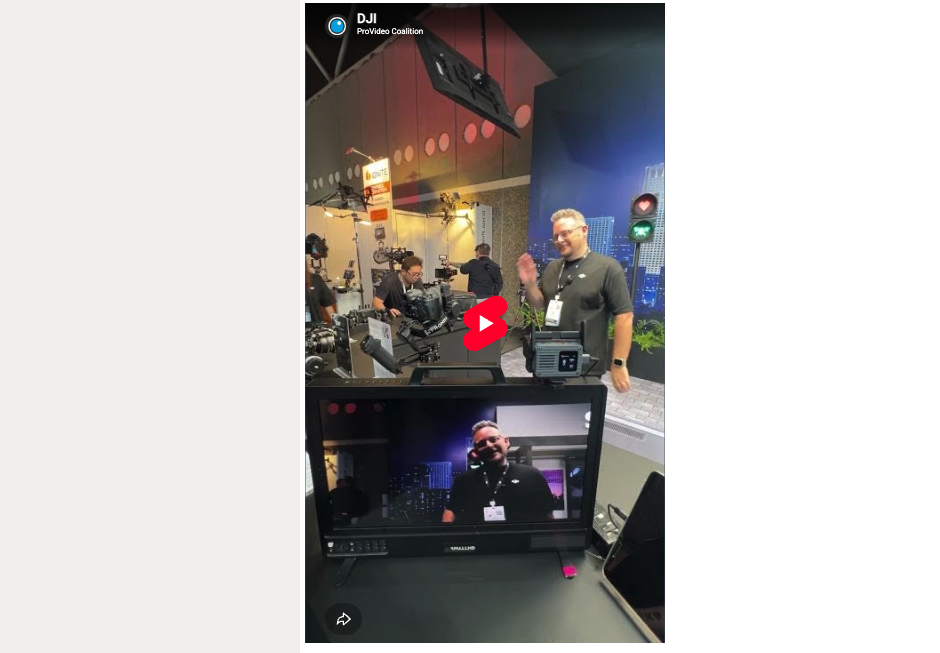
DJI, best known for their fleet of arial camera drones and other related accessories, have shown off a wholly new ecosystem of products at IBC 2026, putting its expansive professional content-creation portfolio front and center. Interconnectivity takes center stage at their booth, which showcases an ecosystem of new cameras, gimbals, microphones, and wireless transmission gear. This seamless integration was recently proven in the field at the 83rd Venice Film Festival, where the DJI Osmo Pocket 4P truly shined.
ProVideo Coalition got to take a close look at these products at IBC, one by one.

DJI SDR Transmission 2
DJI’s SDR Transmission was a wireless video transmission system that uses Software-Defined Radio (SDR) technology to give filmmakers stable, low-latency monitoring feeds on set, and its successor makes its international debut at IBC 2026.
This second-generation system has been built on DJI’s existing SDR transmission technology, with the company highlighting improvements in stability, interference resistance and signal penetration compared with the first generation. That positioning is significant. Wireless video transmission has become an increasingly important part of modern production, particularly as crews look to get camera feeds to directors, operators and other members of the team without the restrictions of physical cabling.
DJI is deliberately putting SDR Transmission 2 alongside its Ronin stabilization products and cameras at IBC, suggesting that the company sees transmission not as an isolated accessory but as part of a broader camera-to-monitor workflow.
There is, however, more to come. DJI says full product details and global availability for SDR Transmission 2 will be announced by September 1.
DJI Osmo 360 II
The next iteration of DJI’s 360 camera hardware pushes the company further into immersive image capture.
Launched earlier this month, the Osmo 360 II is DJI’s second-generation 360-degree camera and is built around an unusual square HDR image sensor designed specifically for panoramic capture. DJI says the sensor increases sensor utilization by 25 percent while helping reduce power consumption.
The camera touts up to 8K/60fps 360-degree video, with the dynamic range having been increased to 14.5 stops, doubling the brightness range. DJI has also introduced SuperNight 2.0, a noise-reduction algorithm designed to maintain image quality in low-light environments, making the Osmo 360 II ideal for nighttime shooting.
The Osmo 360 II also includes 105GB of built-in storage and uses replaceable lenses with an ultra-hard optical coating. The battery life can hold for up to 100 minutes of continuous 8K/30fps recording, and can reach 80 percent charge in 22 minutes.
It also touts NFC capabilities with NFC Quick Connection, allowing users to seamlessly transfer footage and connect to DJI’s Mimo mobile app.
DJI Mic Mini 2S
DJI touts the Mic Mini 2S as their first mini wireless mic with internal recording capabilities, a feature that was only possible with the company’s larger portable microphones. The first DJI Mic Mini made up for its limitations in square footage, being roughly the size of a mere postage stamp.
Yes, it is that small. It puts lavaliers to shame.
The Mic Mini 2S continues the legacy of “tiny,” now having its recording capabilities built into its ultra-compact frame.
The headline feature is 32-bit float internal recording, which gives users considerably more latitude when recovering problematic levels in post-production, bolstered by two levels of AI-powered noise cancellation. The transmitter also includes approximately 14.5GB of internal storage, enough for up to 28 hours of loop recording, providing a local backup when wireless transmission is compromised.
DJI has also designed the system for larger crews. A single receiver can handle up to four transmitters simultaneously, with cross-generation compatibility extending to Mic Mini and Mic Mini 2 transmitters.
DJI Osmo Pocket 4P
The Osmo Pocket 4P is a dual-lens pocket gimbal camera designed to meet the needs of all content creators and filmmakers, regardless of industry or career level. DJI asks a simple question: how much equipment and bulk can a single filmmaker carry before the cumulative weight becomes a creative obstacle?
And in the same breath, they come to a just-as-simple solution: cut the fat and keep it all to a single piece of hardware.
At its core, the Pocket 4P is a dual-camera system. The primary wide-angle camera, coming in at 20mm, uses a 1-inch CMOS sensor, while a second 60mm-equivalent medium-telephoto lens provides a different perspective without needing to swap lenses. The combination of a 20mm wide-angle view and 60mm medium-telephoto perspective gives the Pocket 4P considerably more compositional flexibility than the traditional single-lens pocket gimbal camera. The longer lens is particularly suited to portraits and close-up work, while the wide lens can handle environmental shots and general-purpose coverage.
The primary camera is capable of up to 17 stops of dynamic range, enabled by LOFIC technology, while also supporting up to 4K/240fps slow motion. It also introduces 10-bit D-Log 2 recording, giving filmmakers greater flexibility for color grading.
As for the gimbal, the hardware keeps steady thanks to three-axis mechanical stabilization. ActiveTrack 8.0, DJI’s dedicated subject-tracking technology, works in tandem with the mechanical gimbal to help keep subjects within the frame.
Despite this long list of impressive features, the Pocket 4P remains impressively small at approximately 230 grams. Roughly half a pound. That is light for the functionality you are wrangling out of a 4K-capable camera.
DJI RS 5
The DJI RS 5 is a lightweight commercial gimbal that emphasizes flexibility, combining the familiar three-axis gimbal concept with a greater focus on automated operation and physical fine-tuning. Its optional Enhanced Intelligent Tracking Module allows operators to select and track a subject directly from the gimbal’s touchscreen.
DJI has also introduced an electronic briefcase handle that puts gimbal and camera controls directly into a single-handed shooting configuration, helping make low-angle, underslung and other unconventional camera positions easier to execute without reaching back to the camera itself.
Balancing has received attention as well. Fine-tuning knobs on the axis arms and Teflon-enhanced interfaces are designed to make precise balancing easier, particularly with heavier camera configurations. The system also gets second-generation automated axis locks, which lock the gimbal when powered down and release when it is turned back on.
Power management has been improved too. DJI says the RS 5 can fully charge in one hour, a 60 percent improvement in charging speed, while its standard battery provides approximately 14 hours of standby time.