


AJA Video Systems has brought its FS8 hybrid SDI/IP media processor to IBC 2026, offering broadcasters and live-production teams a flexible way to bridge established SDI infrastructure with SMPTE ST 2110 workflows.
AJA gave ProVideo Coalition the rundown of the FS8’s technical specs and features, demonstrating its capabilities as a broadcast workhorse, both in proficiency and reliability.

The FS8 is a broadcast solution designed for portability, optimized for production trucks, flyspecks, live venues, and other remote production environments. Within a single 1RU chassis, the hardware is capable of multi-channel frame synchronization, format and frame-rate conversion, HDR/WCG processing, color management, audio processing and SDI-to-IP gateway functionality. Regardless of location or workflow complexity, the FS8 aims to ensure that every downstream device receives a standards-compliant broadcast signal.
The platform supports up to eight HD processing channels or four UHD/4K channels, with the ability to mix processing modes across its eight video processors. Customizability is an offered feature, allowing users to mix and match up to eight processing channels in total, with the minimum requirement for UHD processing being two. As for connectivity, the FS8 supports a variety of video and audio networking formats, including 12G-SDI, SMPTE ST 2110, Dante and MADI, with further support for SDI over coax, or fiber and IP over SFP.
Each processor can provide frame synchronization, up/down/cross conversion, frame-rate conversion, scaling, and HDR/SDR transformations. Configurable video delay reaches up to 60 frames in HD and 30 frames in UHD, while an ultra-low-latency mode can deliver processing in less than half a video frame.
FS8 also provides color and HDR management, including 3D LUT-based workflows and integrated HDR/WCG conversion and look management. Audio capabilities span embedded SDI audio, Dante, MADI and SMPTE ST 2110 audio, consolidating video and audio processing within the same platform.
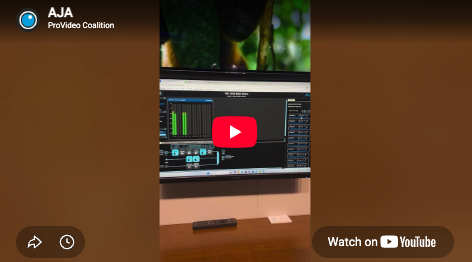
Control is handled through a node-based web interface, while REST API support enables integration with third-party control systems and customized applications. For IP environments, FS8 supports NMOS IS-04 and IS-05, along with EMBER+, an open-standard TCP/IP control protocol, for discovery, registration and control. A redundant power supply setup helps ensure an always-operational workflow during mission-critical applications.