

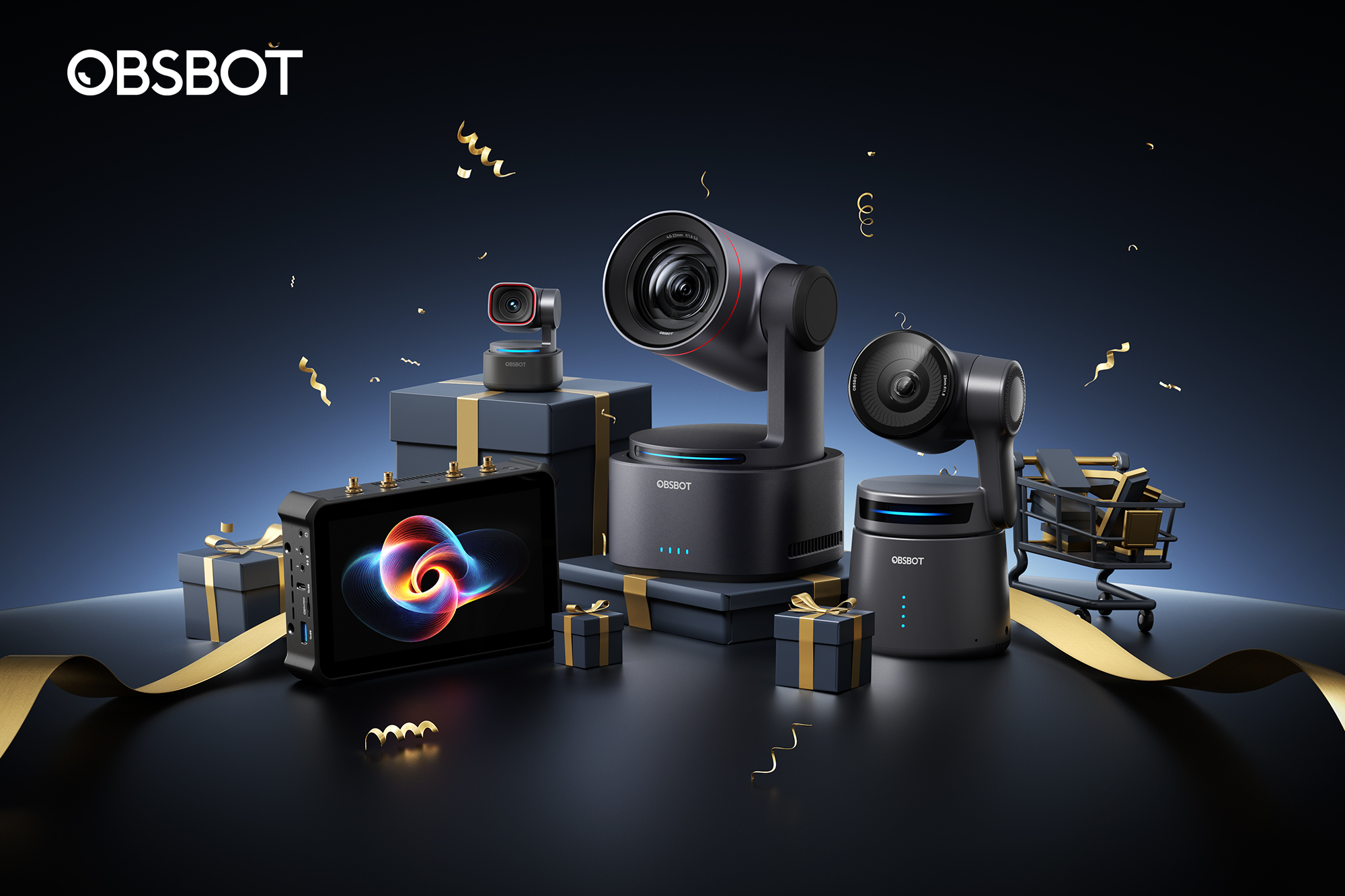

Today, we are going to describe OBSBOT’s Tail 2 cameras and Talent 2 switcher/streamer/recorder for multicam live productions.
OBSBOT’s Tail 2 cameras are often used in multicam situations, and have the appropriate connections and protocols for that, in addition to their powerful optical zoom, astounding low-light performance and PTZR or Pan, Tilt, Zoom, and Rotate (sometimes referring to roll) capabilities. Meanwhile, Talent 2 brings multiple camera feeds together for switching, recording and streaming, making the combination particularly useful for live events, panel discussions and small studio productions. For setups that need an additional angle, the more compact Tail Air can also serve as a supporting camera, such as providing a wide shot of the stage or panel.
With Black Friday approaching, OBSBOT is also offering discounts on both devices from November 19–30, 2026. The Tail 2 Standard Edition is reduced from US$1,199 to US$999 (16.7% OFF), while the NDI Activated version drops from US$1.298 to US$1,088 (16.2% OFF). The Talent 2 is also available for US$1,889 down from US$2,099 (10% OFF). These offers make it a timely opportunity for production teams looking to build or upgrade their multicamera setups.

Tail 2 features and specs
Size and Weight
- Working state: 97.5×103.5x155mm (38.4 x 4.07 x 6.1 inches)
- Off state: 97.5*103.5*172mm (38.4 x 4.07 x 6.8 inches)
Weight: 1.066 kg (2.35 pounds)
Sensor, camera, optical information
- Image Sensor: 1/1.5” CMOS (See upcoming section: Understanding and appreciating the 1/1.5” CMOS sensor size)
- Pixel Size: 2.0μm*2.0μm
- Effective Pixels: 50 million
- Effective Pixel Resolution: 8192×6144
- Lens System: 12x optical Lenses
- Zoom Range: 5x optical Zoom + 12x hybrid zoom
- Aperture: ƒ/1.8-ƒ/3.0
- Focus: Auto and Manual
- Effective Focal Length: 4.6mm-23mm
- Equivalent Focal Length: 22mm-110mm
- Field of View: W (1x) : FOV (D): 89°; FOV (H): 81°
T (5x) : FOV (D): 21°; FOV (H): 18°
- ISO Range:100-6400
- Exposure Value: ±3EV
- Electronic Shutter Speed: 1/8000 s to the limit of frames per second
- White Balance: 2000K-10000K
- Gyroscope: 6-axis Gyroscope
- Photo Resolution: 4K UHD, 1080P, 720P
- Framerates, outputs and protocols (See upcoming sections)
Understanding and appreciating the 1/1.5” CMOS sensor size
Understanding our camera sensor sizes can be confusing. This measurement was inherited from the past-century vacuum tubes like Newvicon, Plumicon, Saticon, Trinicon, Vidicon and more. In my youth, I even used cameras with those tubes! The Tail 2’s large 1/1.5-inch sensor gathers more light per pixel, improving low light performance and dynamic range. Combined with the Tail 2’s 2.0μm pixel size and Dual Native ISO technology, this helps the camera handle challenging lighting conditions.
For production teams working in dimly lit venues, conference rooms or indoor events, these imaging capabilities can be particularly useful.
PTZR design and AI Tracking 2.0
Beyond its imaging capabilities, one of the Tail 2’s key features is its PTZR design. In addition to conventional pan, tilt and zoom functionality, the camera supports 90° lens rotation for native vertical shooting, allowing operators to switch between horizontal and vertical compositions.
AI Tracking 2.0 adds another layer of flexibility. The camera can automatically track selected subjects, helping maintain framing as a presenter moves across a stage or within a production space. Features such as Auto Zoom and Group Tracking offer additional control over composition without requiring constant manual camera adjustments.
Tail 2 available framerates per special resolution and output
For professional production, supported framerates and video outputs are just as important as image quality. Broadcasters may need region-specific television rates, including integer 25/50 framerates and integer ones such as 59.94fps and 29.97fps, while Internet streaming workflows commonly use 30fps or 60fps.
The Tail 2 supports a range of these formats across its internal recording and external output options.
Understanding and appreciating NDI, RTSP and SRT
Alongside its physical video connections, Tail 2 supports several protocols used in professional IP video workflows.
NDI (Network Device Interface)
Enables compatible video devices and production systems to exchange video over IP networks. I’ve been covering NDI since its introduction in 2015, and it has since become an important part of many professional production environments.
RTSP, a summary
RTSP(Real-Time Streaming Protocol) is used to establish and control streaming media sessions between networked devices.SRT(Secure Reliable Transport) is an open-source video transport protocol that utilizes the UDP transport protocol.
All three of these are very sought out, industry standard protocols. I’m glad that OBSBOT chose to include all three to make Tail 2 compatible with so many scenarios.
Tail 2 interfaces
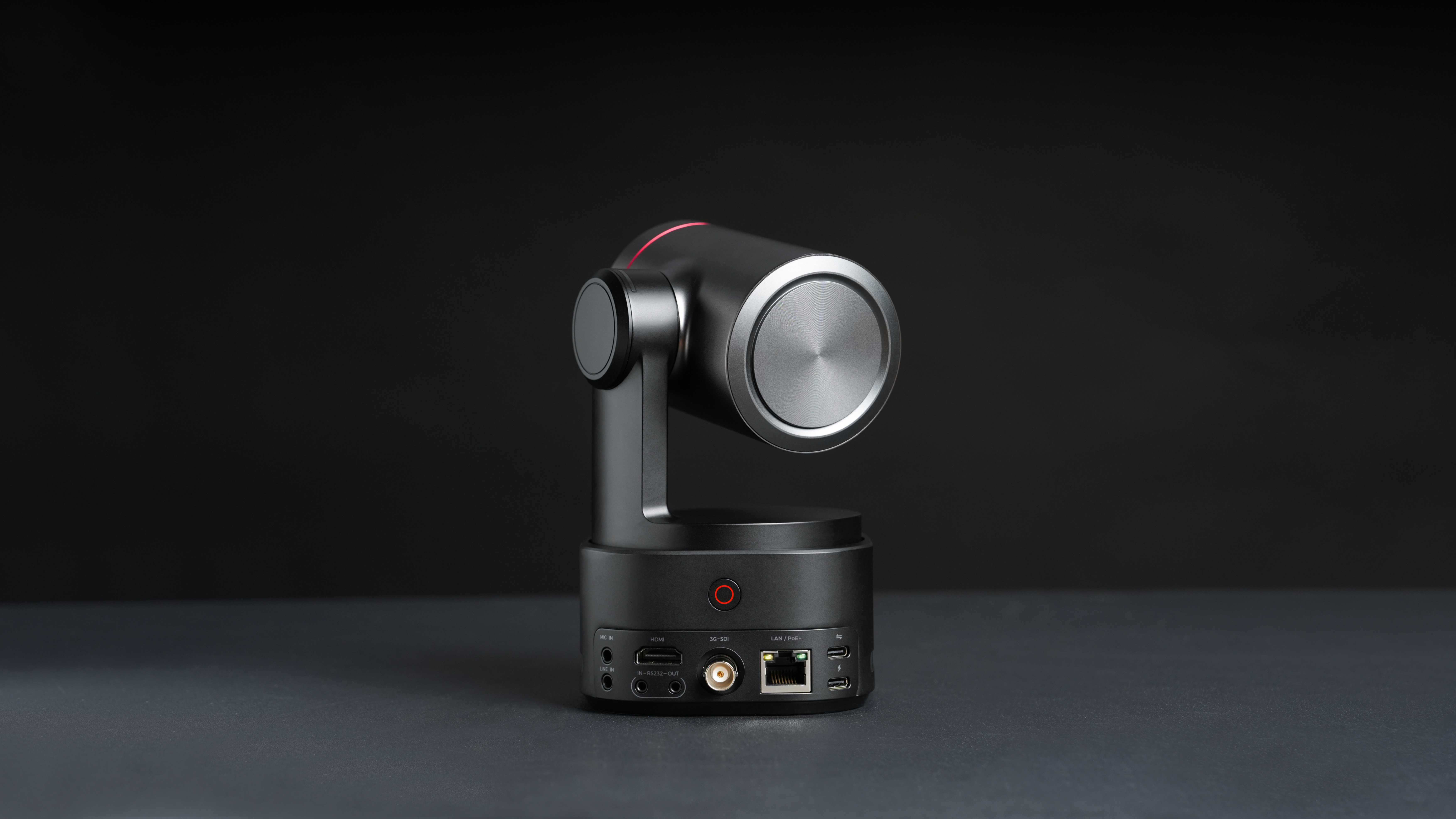

The Tail 2 cameras include:
- HDMI 2.0 output
- 3G-SDI output
- Bluetooth (BLE 5.4)
- USB-C power, with USB PD fast charging
- Video outputs: HDMI 2.0, 3G-SDI, USB-C 3.0
- RJ45 for Ethernet 10/100/1000Mbps with PoE+ (Power over Ethernet Plus)
- Mic input: 3.5mm TRS
- Line audio input: 3.5mm TRS (aux)
- 2.5mm RS232 control, with VISCA / Pelco-D / Pelco-P protocols
- MicroSD
- Wi-Fi 6(2.4GHz/5.8GHz)
These connections allow Tail 2 to work with a range of production equipment, from direct HDMI connections to network-based IP video systems.
The Ethernet port’s PoE+ support is particularly useful for permanent installations, allowing compatible network equipment to deliver power and connectivity over a single cable.
Tail 2 battery/charging
For portable productions, Tail 2 also includes a built-in rechargeable battery.
- Battery Type: Lithium Polymer(Li-po)
- Battery Capacity: 5000mA
- Battery Energy: 38Wh
- Battery Voltage: 7.6V
- Operating time: 217 minutes at 1080p/30fps; 207 minutes at 4K/60fps.
- Charging time: 211 minutes (when powered off)
Actual operating time may vary depending on settings and usage conditions.
With its combination of imaging capabilities, AI tracking, professional interfaces and flexible power options, Tail 2 is well suited to production environments where cameras need to be both capable and adaptable.
OBSBOT Talent 2 switcher/streamer/recorder
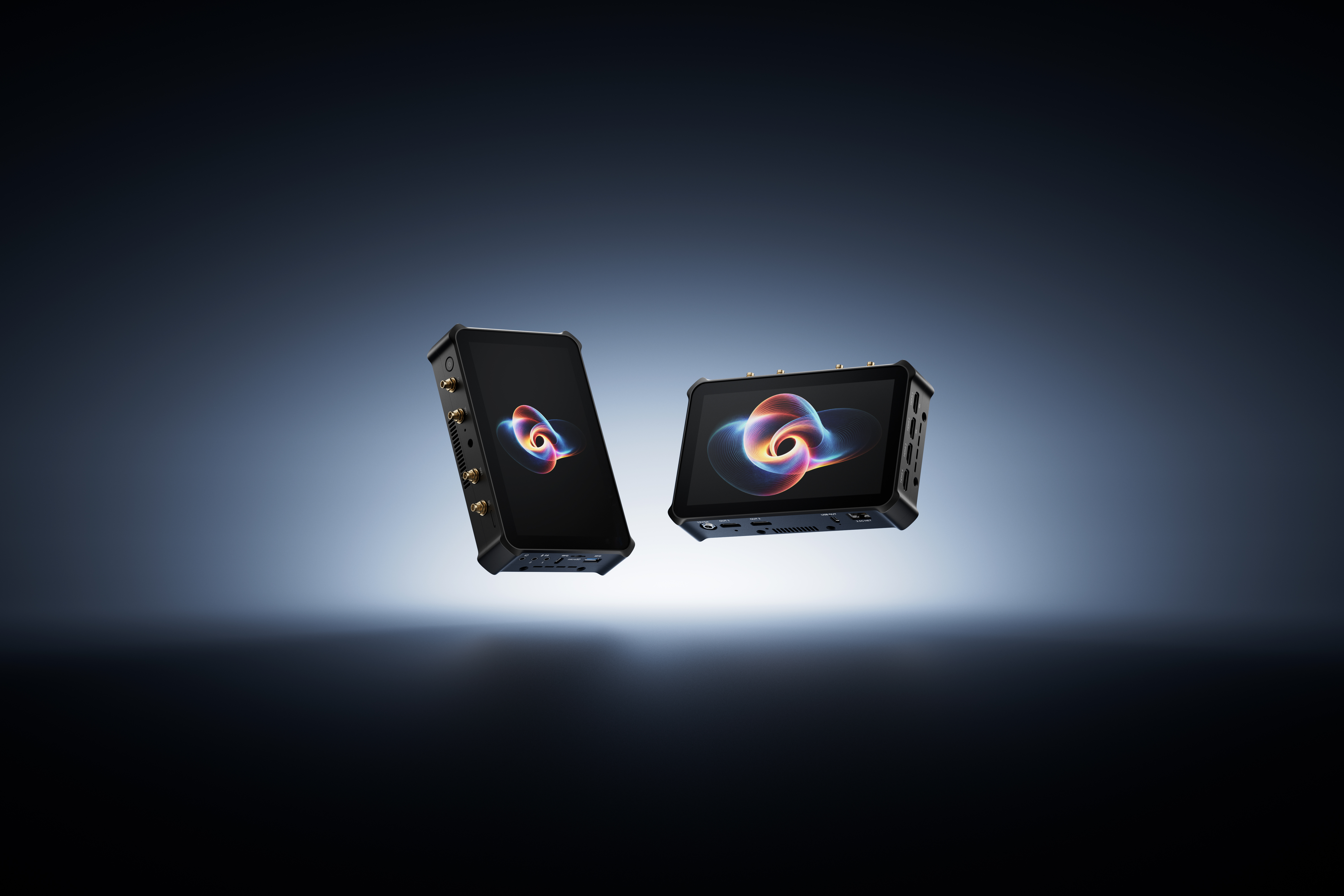

While Tail 2 handles image capture and framing, Talent 2 brings the camera feeds together into a complete live production workflow.
Designed as an all-in-one multicamera live streaming and production studio, Talent 2 combines source monitoring, video switching, recording, graphics, audio management and streaming in a single portable device.
Overview:
- Broadcast live or pre-record
- 4-channel ISO recording
- Up to 16 video sources
- 4 HDMI video inputs
- 2 USB video inputs
- 10 IP video sources
- In addition to OBSBOT and/or other cameras, also accepts smartphones as cameras via NDI
- Built-in streaming Apps for seamless workflow
- True 4K streaming experience
- Bright 7” AMOLED touchscreen—800 nits and 100,000:1 contrast ratio
- Smart auto switching including Video-Follow-Audio
- RJ45 10/100/1000Mbps Ethernet port with PoE+ (Power over Ethernet Plus)
- Robust Network Performance with 5G and Wi‑Fi 6 antennas
- Supports wired USB tethering from your hotspot or your mobile phone
- Custom graphic overlays
- Dual hot-swappable battery slots
- Streaming and Recording códecs H.264, H.265
- Spatial resolutions available: 2160p, 1440p, 1080p, 720p, 540p, 360p (360p only via NDI)
- Progressive framerates: 60/59.94/50/30/29.97/25/24/23.976 (23.98 in OBSBOT menu)/15 fps
- Supports saving recording files in MP4 or MOV format to local storage, SD card, or USB SSD
- On SD card or USB, FAT32, exFAT and NTFS formatting are supported. (My preferred one is exFAT for multiple reasons.)
- Accepts USB keyboard for shortcuts
How Tail 2 and Talent 2 work together in a multicamera production
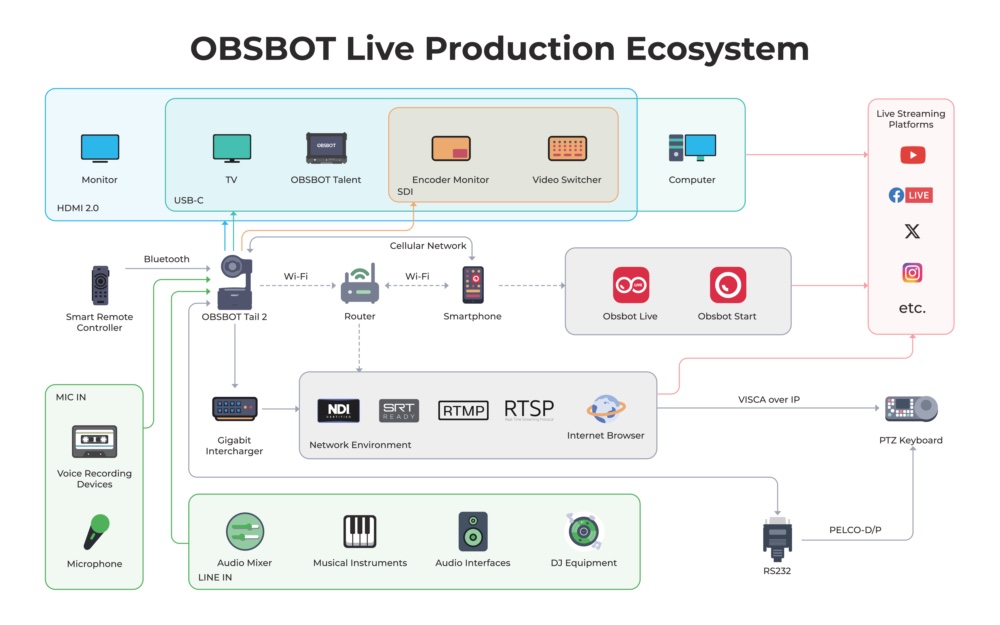

For a live panel discussion with a presenter and two guests, one Tail 2 could track the presenter using AI Tracking 2.0, while a second provides tighter shots of the guests using its 5× optical zoom. A Tail Air could serve as a fixed wide-angle camera, providing a continuous safety shot.
The camera feeds can be routed to Talent 2 via HDMI or IP, including NDI where activated. The operator can monitor and switch between sources on the 7-inch touchscreen, add lower-thirds for speaker identification, and use Video-Follow-Audio for automated switching when the audio sources are properly configured.
Talent 2 can stream the program output at up to 4K and record up to four isolated video feeds for post-production. This setup provides a practical workflow for a small crew handling multicamera acquisition, live switching and program delivery.
Image credits
All images in this article are courtesy of OBSBOT.
Conclusions
As you must have surmised, saying that the combination of a few Tail 2 cameras with Talent 2 switcher/streamer/recorder really do become a dream team, be it for the Internet or for traditional over-the-air television broadcast, regardless of your location in the world. Tail Air can also provide an additional angle or a continuous safety shot when needed.
OBSBOT Tail 2 pricing and Black Friday offers
Original price: US$1298 (NDI Activated)
Black Friday price: US$1088, 16.2% OFF | November 19-30
Original Price: US$$1199 (Standard Edition, without NDI)
Black Friday price: US$999, 16.7% OFF | November 19-30
Talent 2 pricing and Black Friday offers
Original Price: US$2099
Black Friday Price: US$1889, 10% OFF | Nov 19-30
Tair Air pricing and Black Friday Offers
Original Price: US$499 (Standard Edition)
Black Friday Price: US$429, 14% OFF | Nov 19-30
Original Price: US$598 (NDI Edition)
Black Friday Price: US$508, 15% OFF | Nov 19-30
FTC Disclosure
OBSBOT is a sponsor of ProVideo Coalition and paid for this content. Allan Tépper’s opinions are his own. Allan Tépper is not liable for misuse or misunderstanding of information he shares.