


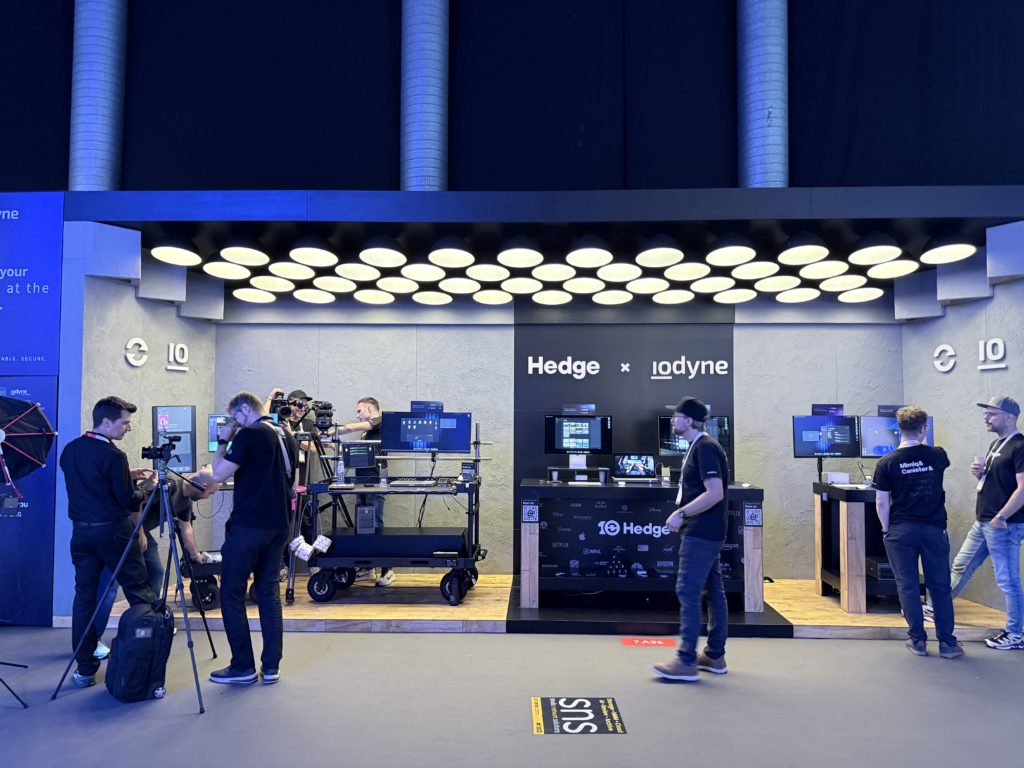
Every production relies on storage, but most portable drives remain surprisingly passive. They hold files, collect handwritten labels, and leave the crew to track who has them and whether a transfer finished. At IBC 2026, iodyne presented a more ambitious alternative: storage that can protect itself, report its status, and remain manageable as it moves between sets, editors, and facilities.

The centerpiece was the Pro Mini, shown publicly in Europe for the first time. Available in 4TB and 8TB capacities, the bus-powered drive connects through a 40Gbps USB4/Thunderbolt USB-C port and works across macOS, Windows, Linux, phones, cameras, and tablets. Its machined aluminum body weighs just over eight ounces, but inside is a notably different architecture from the single consumer M.2 drive found in many portable SSDs.
Pro Mini uses transactional RAID-6, checksums, self-healing, and automatic fault management to protect footage, even if an internal NAND component fails. XTS-AES-256 encryption is always active, with its keys secured inside a hardware Secure Enclave. Users can create individual passkeys and tap an iPhone against the drive’s NFC reader to unlock it when connected to another workstation or camera.
The other immediately visible feature is a customizable 2.1-inch e-paper display. Instead of another strip of camera tape, productions can show a project name, camera number, contact information, QR code, capacity, or connection speed directly on the drive. Because it is e-paper, the label remains visible when Pro Mini is disconnected and can persist for years without power.
iodyne also addresses a familiar weakness of compact SSDs: thermal throttling during sustained transfers. Dual solid-state AirJet cooling modules move heat without a conventional fan. The company says this allows Pro Mini to maintain performance through demanding ingest and offload workflows while encryption and RAID protection remain enabled.
At IBC, however, iodyne’s larger story was how this hardware connects to the company’s expanding software platform. The iOS app lets users see their assigned projects and devices, unlock Pro Minis, and access workflow metadata. A new Watchlist function can monitor an ingest or transcode in real time, allowing a crew member to step away from the cart and receive confirmation when the process finishes.
iodyne Cloud extends those controls from one drive to an entire fleet. Administrators can organize devices and personnel by project, determine who is authorized to access specific media, configure labels and storage containers, and follow activity through audit trails. Productions can also attach NFC tags to third-party drives or equipment, bringing existing assets into the same inventory system. Find My support through Apple and Google networks adds another safeguard for media traveling between locations.
The system is designed to address both production convenience and increasingly demanding studio security policies. Features such as remote management, tracking, secure erasure, and certificates of destruction can help satisfy IT and information-security requirements without forcing every camera assistant, DIT, or editor to become a storage administrator.
Pro Mini is now shipping through select resellers. For smaller crews, its appeal is reduced friction at the cart; for larger organizations, the same device becomes a trackable, policy-aware endpoint within a broader storage fleet.
iodyne demonstrated Pro Mini alongside Hedge workflow tools and in Adobe and RED booths, highlighting applications from ingest and editorial through visual effects, 8K workflows, and archival handoff. That interoperability supports the company’s central IBC message: creators should be able to own and secure their data at the edge without allowing storage management to interrupt the creative work.