


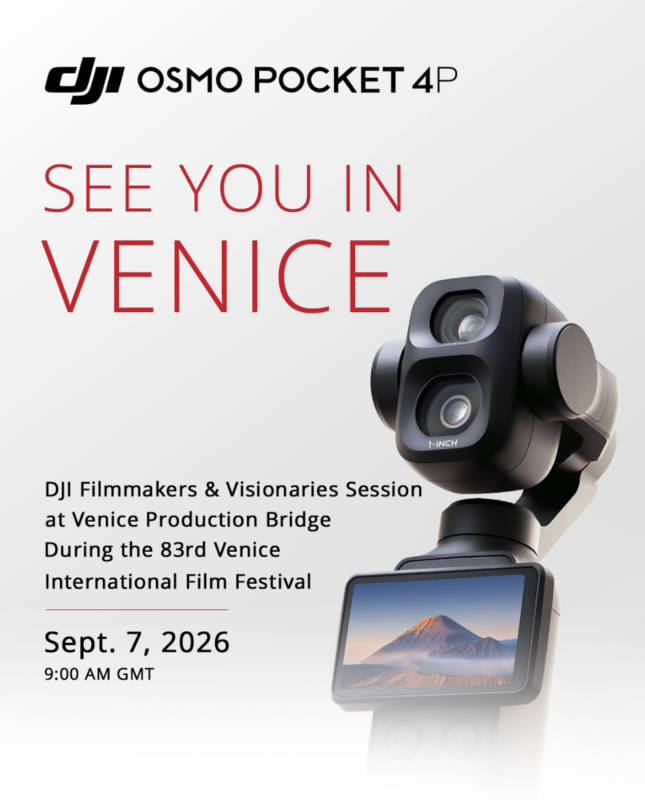
During the 83rd edition of the festival, DJI hosted its “New Generation, New Cinematic Language” event as part of the Venice Production Bridge. The morning began at the Biennale Match Point Arena on the Lido, beside a historic tennis court where an actual match was unfolding. DJI built the event around a deceptively simple question: What happens to cinematic language when a professional camera becomes small enough to fit in your pocket?

Instead of answering with a list of specifications, the company put the Osmo Pocket 4P into the hands of four emerging filmmakers and let their work make the argument. Gabriele Mencaroni, Alessandro Tempestini, Liu Yadi and Zhou Chengzhou each created a short film using the new camera. The resulting projects explored different subjects, environments and visual styles, but they shared one quality: each contained images that would have been extraordinarily complicated to achieve with a larger camera system. All four shorts were impressive, and each revealed a different advantage of the Pocket 4P:
Mencaroni’s Hide and Seek short was gorgeously shot. Floating movements that felt almost impossible to capture. The movement was controlled and tasteful, serving the emotion and perspective of the story rather than simply showing off what the camera could do. The images also carried a wonderfully textured, almost analog quality. That combination, modern mobility paired with an organic visual character, made the film feel cinematic rather than technological.
Yadi’s Chasing the Unknown pushed the camera into the tight confines of a car. Anyone who has photographed a scene inside a vehicle knows how quickly space disappears. A conventional production may require mounts, specialized support, or a process trailer simply to give the camera somewhere to live. Here, the filmmakers placed the Pocket 4P in positions that would otherwise be extremely difficult or physically impossible. Those placements created a more immediate relationship between the audience, performers, and moving vehicle.
The short film can be seen here:

Chenzhou’s A Girl’s Fantastic Journey contained one of the event’s most memorable sequences: a fluid movement up a spiral staircase. With a traditional cinema package, the narrow geometry would dictate the movement, crew footprint and rigging options. With the Pocket 4P, the camera moved naturally through the architecture. The building was no longer an obstacle; it became part of the choreography.
Tempestini’s Folds of Time delivered awe-inspiring motorcycle footage. Rigged close to the action, the camera produced images that felt fast, visceral, and remarkably smooth. Mounting a larger cinema camera to a motorcycle raises concerns about weight, vibration, safety and stabilization. A compact gimbal camera changes that equation, becoming a specialized tool for shots that might otherwise demand far more equipment and preparation.
The short film can be seen here:

Following the screenings, cinematographers Valentin Vignet, Cristiano Di Nicola and Michele D’Attanasio joined the filmmakers for a discussion of the work. Their presence gave the event real weight. These were established cinematographers evaluating the images from the perspective of people accustomed to demanding professional productions.
All three had experimented with the Pocket 4P and came away enthusiastic. They praised the shorts’ visual quality and the creativity the camera enabled. Most tellingly, panelists discussed plans to use it on upcoming feature films. They saw it not merely as a consumer or behind-the-scenes camera, but as something that could live alongside traditional cinema cameras and solve specific problems on professional sets.
That distinction became my main takeaway from the event. The Osmo Pocket 4P does not need to replace a full-size cinema camera to be significant. Its value is that it can capture perspectives a larger system cannot reach, or can reach only with considerable time, money, and infrastructure. Its small size is not simply a matter of convenience; it is a creative feature.
The DJI Osmo Pocket 4P packs a surprising amount of cinema-grade imaging into a camera that fits in your pocket, unlocking shots that would be much harder, or require much more gear, to capture with a traditional cinema camera. With the Osmo Pocket 4P, DJI is giving filmmakers a legitimate cinematic tool that can go almost anywhere. It proves that capturing professional images doesn’t always require a massive camera build or a full production crew.
Large rigs inevitably announce themselves. They affect how actors move, how crews arrange a room, and how quickly a production can respond. A camera this small becomes less of an obstacle and more of an observer, getting close to a performer or traveling through a confined environment before the energy of the moment disappears.
After the panel, the event moved to the Terrazza dei Fiori on the rooftop of the Hotel Excelsior. If the morning demonstrated the creative potential of the Pocket 4P, the afternoon captured everything special about attending a festival like Venice. The Excelsior sits at the heart of the festival, and its rooftop offered a spectacular backdrop for conversations with filmmakers, journalists and some of the leading creators working in the camera and production space. For me, connecting with so many thoughtful people from across the international filmmaking community made the reception a genuine highlight of the festival.
More on the Osmo Pocket 4P:
The Osmo Pocket 4P delivers a dual-lens system that allows shooters to capture sweeping wide-angle shots with the 20mm primary lens, then instantly punch into a cinematic tight frame using the 60mm f/1.8 telephoto lens with 3x optical and 6x lossless zoom. Featuring 17 stops of dynamic range via LOFIC technology and 10-bit DLOG 2 color grading, it preserves vital highlight and shadow detail in high-contrast scenes, providing colorists with the latitude required for high-end post-production.
Beyond creative range, the hardware is built to eliminate friction on set. Upgraded ActiveTrack 8.0 paired with 3-axis mechanical stabilization keeps subject tracking locked and sharp while 4K recording at 240fps offers high-frame-rate ultra-slow motion. With 103 GB of built-in internal storage and a fast-charging battery that reaches 80% power in roughly 18 minutes, filmmakers spend far less time managing gear and media, and more time focused on storytelling.