

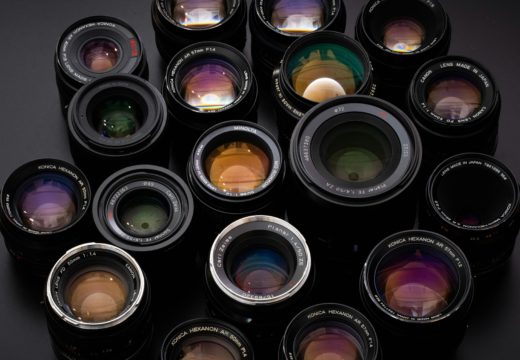

About fifteen years ago, the world suddenly realised that large-sensor movie cameras had become affordable, while large-sensor movie lenses hadn’t. Thus began a process which led to the limitless PL-mount options which exist now. Back in 2011, however, the only solution came from the issue of Cinefex which describes how ILM used (mostly) Nikon’s AI series stills lenses for visual effects elements on Star Wars. Now that’s an endorsement, or at least it’s an endorsement if you’re shooting effects elements for a high-end sci-fi feature on VistaVision.
Conveniently, the world quickly decided that shooting dialogue scenes for a low-budget indie short on mirrorless is pretty much the same thing. With alarming speed, reasonably-priced, reasonable-quality stills primes vanished from auction sites as if collected en masse by a globally-deployed flock of winged monkeys.
Once eBay ran out of reasonable-quality lenses, said world made some even more convenient decisions about unreasonable-quality lenses. Your correspondent is painfully aware of the unpleasantness which will descend upon his inbox if he criticises someone’s favourite item of fungus-enriched optical archaeology by name, so he won’t. Let’s just say that desperate indie filmmakers (and wealthy rehousing enthusiasts) have spent the last few years mining through the bottom of the barrel to discover lenses malleted into shape with the wrong end of a blunt chisel.
By the late 2010s, various optical companies had noticed that there were many film school graduates with a budget-ambition mismatch. Affordable PL sets bloomed. The fashion for unique lenses, though, means that lots of people still run an eBay search for “50mm m42,” list by price, and try to build a filmmaking set around whatever’s at the top of the list. Some of the most obvious choices – Nikkors, Takumars – have often become unreasonably expensive – so it seems worth having a look at exactly what we might be able to dig up that’ll suit most cameras and cost less than six months’ rent.


The Moderately Mighty Tessar
The first exhibit in our eBay safari is the not-so-mighty Carl Zeiss Jena Tessar 50mm f/2.8, built by the part of Zeiss that found itself in East Germany. It’s a 60s kit lens which can often be had for less than the price of a sit-down meal. Is it possible to build a set around that lens? Well, the numbers are on our side. Part of the industrial strategy of the Deutsche Demokratische Republik seems to have been to overwhelm the filthy capitalists of the West by weight of numbers, so that any randomly-selected M42 stills lens is quite likely to be marked Carl Zeiss Jena, or Meyer-Optik Görlitz.
Climbing this branch of the lens tree inevitably involves the connections between those companies, which suffered a rather forced symbiosis under East German nationalisation before they entirely merged. Sticking to those striking zebra-striped barrels and the Zeiss Jena branding (no matter who actually made them), a more aperture-conscious starting point would be the 50mm f/1.8 Pancolar, a thoroughly medium-quality example of 1960s Eastern Bloc technology.
Sadly, fashion-consciousness limit our options to complete the set. The classic, stripy Flektogon 20mm is much too expensive for an f/4 lens, and even the 35mm f/2.8 seems horribly expensive in comparison to the pocket-money 50mm options. Going longer is tricky, too: the 135mm Sonnar is a sluggish f/3.5.
Many of these problems are overcome by the following generation of Zeiss Jena lenses, which look more pedestrian in their black barrels but ought to perform better. To some extent, if we were here for better we’d be somewhere else, but there are upsides. The 20mm f/2.8 was a close-focus favourite of gesticulating R&B artists back when the world still loved 90s music videos. There is a 35mm f/2.4, a 50mm f/2.8, and an extremely tempting 80mm f/1.8 Pancolar.
It might seem that things are going well until we realise that the 135 is still only f/3.5 and that 80mm currently runs over a thousand US dollars in M42 mount. That is a lot of money for lenses which will enthusiastically force-feed their users an all-you-can-eat buffet of – let’s call them – classic optical effects.

Six is a lucky number
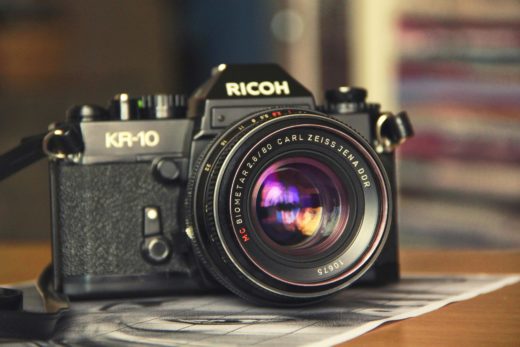
Googling, we notice an 80mm f/2.8 Biometar in M42 which sells for rather less. Google enough, though, and one will inevitably find the even cheaper 80mm f/2.8 Biometar in Pentacon Six mount. There is also a 120mm f/2.8 and a 180mm f/2.8. They’re not cheap, exactly. They’re a couple of hundred each. Most applications will need adaptors and reducers. There’s nothing shorter than 50mm and the 50 itself is only f/4. The upside is that they’re huge, which makes people pay you more money, and will natively cover anything smaller than IMAX. The deep mount facilitates adaptation to anything, and focal reducers turn that 50/4 into a 35/2.8 which will still cover full frame.
We might cautiously conclude that the best route to a fashionably stripy set of Zeiss lenses is in fact to get a set of Pentacon lenses which might have come out of the same building anyway. As to the results, at f/5.6, they’re straightforward. Wide open, it’s… swear boxes at the ready – painterly. In fact, it’s as painterly as licking the floor of Jackson Pollock’s studio after a busy week. Still, that’s what the people want, and you can get the multi-coated ones if you like. So, slap some Simmod cine rings on the front and put them in a nice pelican case, because nothing speaks more highly of optical excellence than lens caps with engraved 1970s logotype.
If we want to go really cheap, though, there are other options from the old East Germany that we’ll discuss soon.