



At the end of 2025, I created a Little-Johnny type character for my radio and podcast show, CapicúaFM. Our graphic designer created the visual image and I picked and polished an appropriate AI voice for the character. I am certainly not the first person to have done this. Little-Johnny characters and jokes have been used for traditional AM/FM radio skits for many decades. Before the existence of AI voices, radio professionals would create them either by having their own voice for doing character voices (with or without a voice changer function) or ask another voiceover individual to do it. Even though I personally don’t have that unique talent of doing character voices, I do know how to write the appropriate dialog for those scenes or sketches between the character, my co-host and myself. In my case, I can use the character to portray an existing popular viewpoint —with which I may disagree, and then counter it with my own opinion. I can also create situations where the character gets into trouble or falls in love with another character and even announces his upcoming wedding. Ahead, I’ll give some examples of character names used in different languages and embed the two episodes where our new character has already appeared on CapicúaFM, once scheduled and once by «sneaking into the studio without permission or being invited».
Similar equivalent names I have discovered
In addition to the one I created (ahead in this article): I have discovered the following examples:
- In Connecticut, US in the eighties, there was one called Hozay Smith (an intentional misspelling of the name José) who spoke English. Hozay Smith was an imaginary sidekick voiced by DJ Chris Evans on WKCI (KC101) in New Haven, Connecticut, US. Evans created the funny, wisecracking character, who was featured on the morning show until new management changed the format in the late 80s/early 90s. The actual frequency is 101.3 MHz, but they abbreviate it as just 101, which makes it palindromic, in addition to being shorter.
- The Swiss character Oin-Oin in French, whose series on Radio Suisse Romande became a local staple.
- Hecklefish continues to be the sarcastic, computer-generated goldfish co-host character of the popular YouTube conspiracy theory channel, The Why Files, run by host AJ Gentile.
In Castilian: Jaimito, Pepito or Juanito according to the region
In the Castilian language (frequently but inaccurately called «Spanish»), there is a similar character used, although his name varies depending upon the country. In Spain, Venezuela and some other Castilian-speaking areas in the Américas, he is known as Jaimito. In others, he is know as Pepito or Juanito. In this case, the character was born outside of radio or podcasting, as a way of telling jokes. It was later used on AM/FM radio, to my recollection with character voices done by the same radio announcer. Because my CapicúaFM is heard worldwide, I need to call him by all three names to have the audience realize who he is.


Our graphic artist Andreína created the above image for the first episode where the character appeared on CapicúaFM in December 2025. In that one, he was officially «invited» and introduced.
Later, in January 2026, he «snuck into the studio», without any prior announcement or invitation:
My occasional co-host and renowned linguist, voiceover talent and Spaniard singer, María Esnoz, and I were in midway of verbally conjugating a particular Castilian podcasting verb I had coined back in the aughties. Jaimito/Pepito/Juanito appeared «unexpectedly» in the studio. When I questioned him about why he had «sneaked into the studio» he apologized for doing it, tried to justify his presence to help us with the conjugation and to announce his upcoming wedding and invite us.

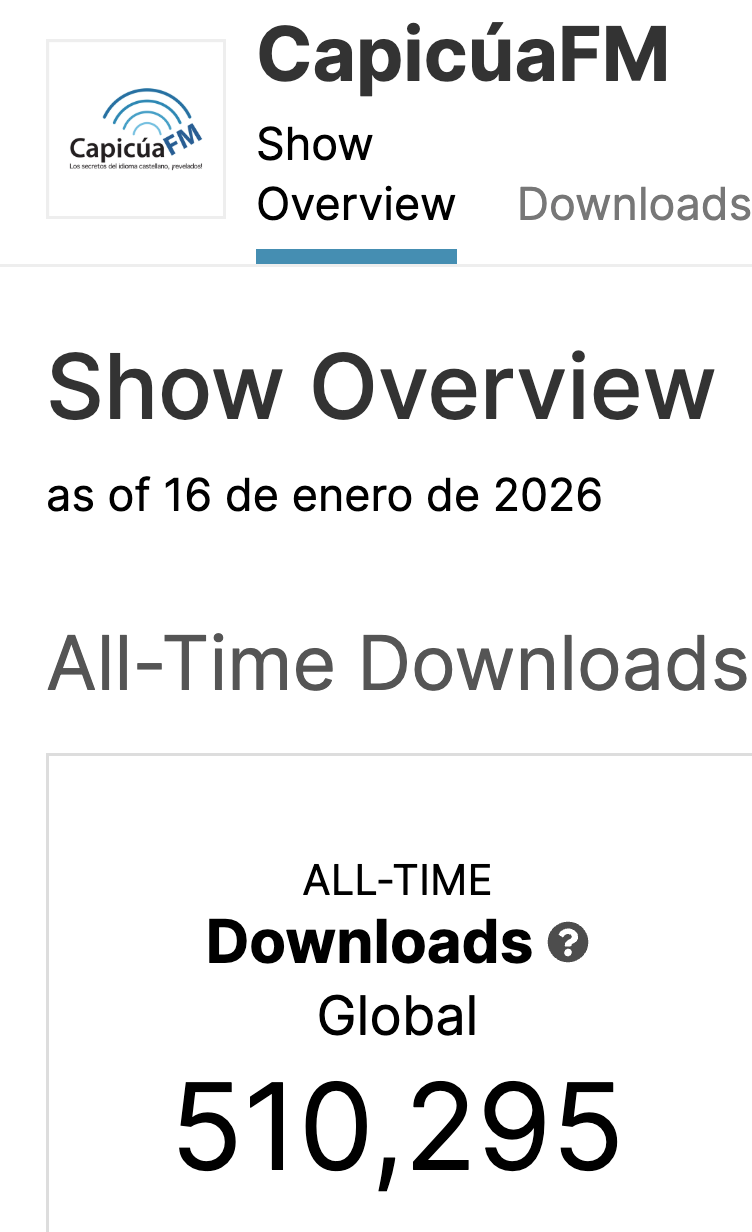
CapicúaFM published its first episode in June 2014 and reached its first palindromic anniversary (11 years) in June 2025. According to Podtrac (one of the two measurement systems we use), it had surpassed 510,295 unique plays as of mid January 2026. Of cource, CapicúaFM has a Branded RSS, as I covered in my ebook called Branded RSS Podcasting. If you would like to discuss anything related to podcasting or website creation/hosting, contact me here.
Lee este artículo en buen castellano
La creación de un personaje tipo Juanito-Pepito-Juanito para radio o podifusión: imagen y voz
(Re-)Subscribe for upcoming articles, reviews, radio shows, books and seminars/webinars
Stand by for upcoming articles, reviews, books and courses by subscribing to my bulletins.
In English:
- Email bulletins, bulletins.AllanTepper.com
- In Telegram, t.me/TecnoTurBulletins
- Twitter (bilingual), AllanLTepper
En castellano:
- Boletines por correo electrónico, boletines.AllanTepper.com
- En Telegram, t.me/boletinesdeAllan
- Twitter (bilingüe), AllanLTepper
Most of my current books are at books.AllanTepper.com, and also visit AllanTepper.com and radio.AllanTepper.com.
FTC disclosure
None of the listed individuals or companies mentioned above has paid for this article. Some of the manufacturers listed above have contracted Tépper and/or TecnoTur LLC to carry out consulting and/or translations/localizations/transcreations. So far, none of the manufacturers listed above is/are sponsors of the TecnoTur, BeyondPodcasting, CapicúaFM or TuSaludSecreta programs, although they are welcome to do so, and some are, may be (or may have been) sponsors of ProVideo Coalition magazine. Some links to third parties listed in this article and/or on this web page may indirectly benefit TecnoTur LLC via affiliate programs. Allan Tépper’s opinions are his own. Allan Tépper is not liable for misuse or misunderstanding of information he shares.