

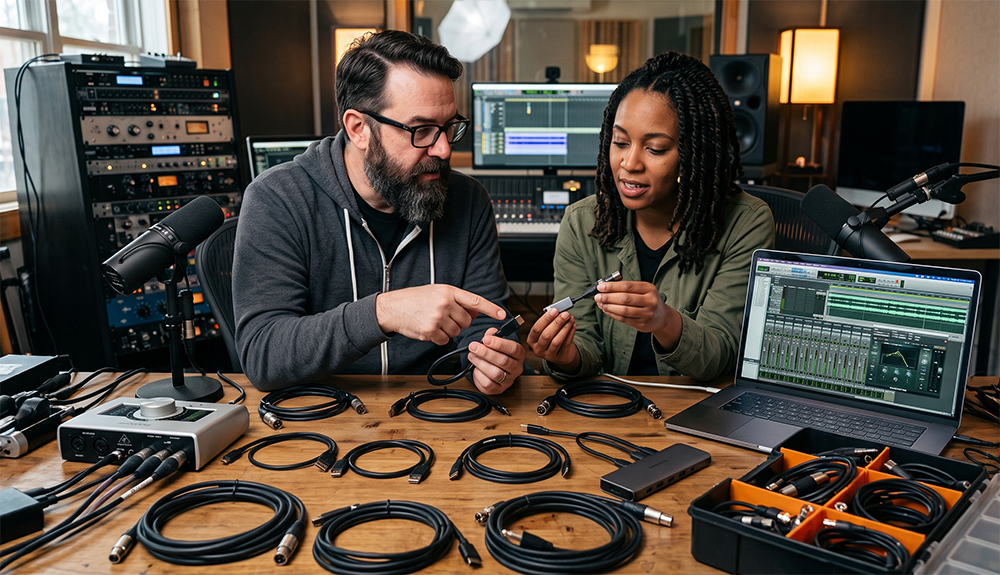

For as standard and ubiquitous certain cables can be in the media production landscape, there is no such thing as a perfect “one-size-fits-all” cable that is compatible with everything. It’s simply not possible.
HDMI is one of the most common types of video display cables out there, but you might find yourself needing to hook up a legacy device to a modern display, but the hardware simply does not use HDMI. Or you might have two broadcast solutions serving specific different niches, and thus use different connectors, but you need to perform some sort of wizardry to get those devices to communicate.
Conversion cables are the middleman solution to such predicaments, acting as the liaison needed to get a production back on track if cross-compatibility is ever required.
Companies such as Hosa Technology have built entire product lines around solving these compatibility challenges, offering everything from simple adapter cables to multi-channel snakes and specialized power solutions. The right choice ultimately depends on the type of signal you’re carrying and the equipment you’re connecting.
Specialized Cables for Audio, Data, and Power Rigs
For example, a balanced snake cable such as the Hosa STX-802F XLR3F to 1/4-inch TRS Balanced Snake is designed for professional audio environments where multiple balanced channels need to travel between mixers, patch bays, audio interfaces, or stage boxes. Rather than running several individual cables, a snake helps streamline installations while reducing clutter and making troubleshooting easier. Its XLR-to-TRS configuration is especially useful when integrating equipment that uses different professional connector standards while maintaining balanced signal integrity.
Not every conversion challenge involves analog audio, however. As USB-equipped production hardware continues to replace legacy interfaces, dependable data cables have become just as important. A cable such as the Hosa USB-203AB USB 2.0 A-to-B cable provides the familiar connection used by countless audio interfaces, digital mixers, MIDI controllers, and recording peripherals, allowing computers to communicate reliably with production hardware without requiring additional adapters.
Power compatibility is another consideration that’s often overlooked until setup day. Equipment sourced from different manufacturers, or destined for different regions, may require different connector configurations. Products like Hosa’s Neutrik-to-Hosa NEMA power cable help bridge those gaps, allowing compatible professional equipment to integrate into existing power infrastructure while maintaining the durability expected in demanding production environments.
Active AV Hardware for Complex Signal Management
Of course, there comes a point where a simple conversion cable isn’t enough. When multiple sources, displays, resolutions, or signal formats enter the equation, dedicated AV hardware becomes the more practical solution. This is where manufacturers like Kramer step in, offering purpose-built products that perform many of the same compatibility functions as conversion cables while adding signal management, distribution, and processing capabilities for more complex installations.
Take the Kramer VP-440X presentation switcher and scaler, for example. Rather than simply adapting one connector to another, it serves as the hub of an AV system, allowing users to switch between multiple presentation sources while scaling video to match the connected display. Integrated HDBaseT support further extends video, audio, control, and Ethernet over a single Category cable, making it well suited for conference rooms, classrooms, and collaborative spaces where long cable runs and multiple input types are common.
Signal distribution presents another challenge that no passive cable can solve. The Kramer VM-4H2 1:4 4K HDR HDMI Distribution Amplifier takes a single HDMI source and simultaneously feeds up to four displays while maintaining support for resolutions up to 4K/60Hz, HDR10, and HDCP 2.2. By equalizing and re-clocking the signal, the unit helps preserve signal integrity across longer cable runs, making it ideal for digital signage, control rooms, hospitality environments, and any installation where identical content needs to appear on multiple displays.
Legacy formats are equally important in professional production workflows. Broadcast environments continue to rely heavily on SDI infrastructure, while many modern displays and presentation systems are HDMI-based. The Kramer FC-332 3G HD-SDI to HDMI Format Converter bridges those two worlds, converting professional SDI signals for HDMI-equipped displays and monitors without requiring an entirely new signal chain. It’s a practical solution for integrating broadcast cameras, switchers, and other SDI-based equipment into today’s HDMI-centric production environments.
Building a Reliable Hybrid Workflow
Whether the solution is as simple as a purpose-built conversion cable or as sophisticated as a dedicated switcher, scaler, distribution amplifier, or format converter, the objective remains the same: ensuring every piece of equipment in an AV system communicates reliably. As production environments become increasingly hybrid, combining legacy hardware with modern IP and HDMI technologies, having the right mix of cables and signal management hardware can make the difference between a seamless installation and hours of troubleshooting.