


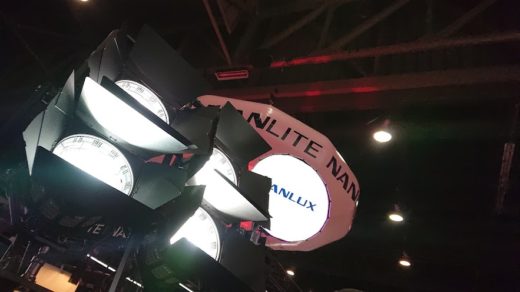
Today, your narrator is going to abuse his position to complain about a standard that should exist, but doesn’t.
One of the champagne problems of LED lighting is is – or at one time was – so easy to battery power. That taught a certain type of person to expect lights to run all day from pocket-sized power supplies while simultaneously engaging in a wattage race which quickly made that impossible.
There are still many dubious expectations about lighting twelve-hour shoots over a full city block from a backpack full of camera batteries. Those expectations can be hard to fulfil, even given sensitive modern cameras. Happily, that approach has provoked cunning inventors to field some really large batteries. If there’s a question left to ask, it’s about the proliferation of battery-powered lights based on a core technology – in LEDs – which operates at low voltage, and a battery technology – in lithium-ion – which also operates at low voltage.
Between the two, though, we tend to expect mains power, which doesn’t necessarily make all that much sense. After all, a lithium ion cell mostly produces about three and a bit volts, depending on its state of charge. The blue-emitting LEDs which form the beating heart of most of the world’s movie lighting require (entirely coincidentally) about three and a bit volts.
Of course, that’s a ludicrous oversimplification. No movie light bigger than a few watts is made out of a single LED, and both batteries and lights need carefully-built control electronics for safety and long life. Even so, there’s been a move among manufacturers of big floor batteries (not to mention generator-sized battery packs on wheels) to provide DC power connectors compatible with various kinds of LED light, commonly including options in the few-hundred-watts range.
Cutting out the middlemen
Usually, lights like that use a mains power supply to generate some intermediate-level DC supply for the LED’s controller. Unlike HMI bulbs, LEDs are driven with DC power. Often, that intermediate level supply is at something like 48V, which is available from some floor batteries. Yes, it’s common to convert the power coming out of those floor batteries to mains, and then let the LED’s mains power supply convert it back down again – but if that seems a little redundant, well, it is.
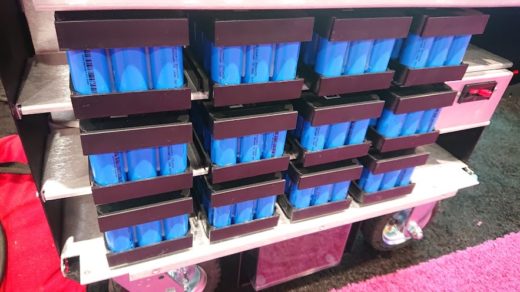
Cutting out those middlemen might create an overall solution which would, in principle, be smaller, lighter, cheaper, more reliable and more efficient, as well as involving fewer pieces of hardware and the cables which connect them together. Battery manufacturers which want to make this happen are often forced to engage in a degree of reverse-engineering to determine how to supply power to big lights. There are already too many standards involved and many of them are not very ideal. DC power in the 12-volt range has long been supplied over 4-pin XLRs, although they are typically rated at no more than 10 amps, and therefore no more than around 120W.
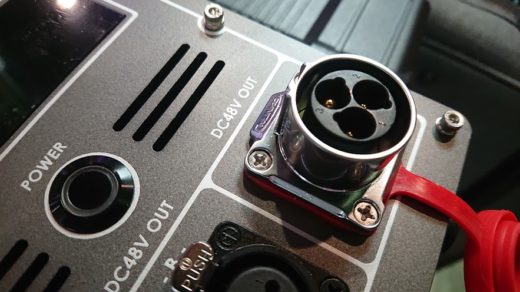
3-pin XLRs are established for 24-volt power (whether or not that is a good idea on a film set where they are also likely to be used for sound) and their larger pin area can handle more current. Still, the 16-amp ratings sometimes mentioned can be a little optimistic in practice, and even then the maximum is under 400W. SpeakON connectors, which handle 16A more reliably, have emerged as an alternative.
Still, standardisation clearly beckons. European set electricians will be familiar with the IEC 60309 connector series, sometimes called ceeform, or pin-and-sleeve in the USA. The standard is familiar in its red and blue incarnations for single- and multiple-phase mains power respectively. The violet and white options, intended for low-voltage DC power, are physically robust and available in capacities up to 32A. For even larger loads, Anderson Power Products has long been selling its Powerpole connectors for high power, low voltage DC, with ultra-beefy options up to 500A (more than enough to run a currently-hypothetical 18K LED from 48V power, though it’d need very large cable).
Flexibility
Whether or not we actually want five hundred amp, low-voltage DC power flying around film sets is another matter. There are reasons that we use high voltages to transmit power long distances. Even at low voltages, high power handling creates concerns of its own: low voltage electricity might not risk electric shock, but it can burn things. Many battery packs might not actually be particularly low voltage, anyway – connect enough cells end to end, as in an electric car (or large-scale movie power bank), and the voltage increases accordingly.
Still, standardisation of low-voltage DC power might make it practical to build various configurations of batteries from the available equipment and connect them to various loads. That would offer flexibility and extract more value from investments in gear. In short, if there are a couple of 24-volt batteries available, it is frustrating to realise that there is usually no easy way to connect them to a medium-sized LED light requiring 48V power.
The only objection to all this seems to arise from certain specific places where unions define their jurisdiction by voltage. Either way, the film industry seems to be moving rather unevenly toward a future in which DC power takes at least some of the load. The slightly chaotic approach we see now risks limiting effectiveness and creating incompatibility, causing things to be less awesome than they could be.