


One of the trickier things about camerawork is that it very rarely gets end-user feedback. If the end user is the lay audience, it’s probably no bad thing that cinematography tends to be invisible, but that does mean that unless the photography is up for an award, it doesn’t tend to get talked about outside the specialist press.
Or at least, not usually. 2025 has seen YouTube has been abuzz with a huge range of very different opinions, published under widely varying titles including “Why don’t movies look like movies anymore?” by Patrick Tomasso, “Why Movies Don’t Look Like Movies Anymore” by tographer, or “Why Don’t Movies Look Like Movies Anymore” by Variant. It’s become such a common complaint that the presenter of “Why Movies Just Don’t Feel Real Anymore” actually apologises for complaining. He probably shouldn’t; he’s not alone. Consider “Why Movies Don’t Look Real Anymore” by Jimmy on Film, and perhaps the founder of the movement, “Why Don’t Movies Look Like That Anymore?” by Gateways to Forgotten Dreams.
A trend emerges.
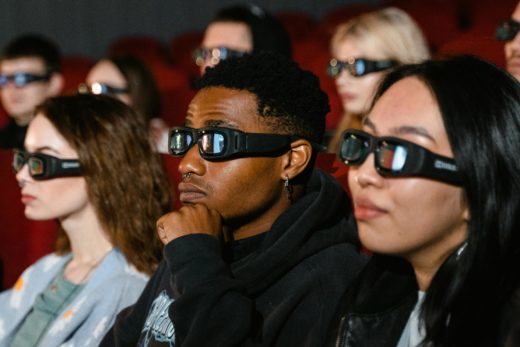
Pointing emphatically into a fisheye
It’s difficult to be objective about just how much a movie looks like – well – a movie. Dog shows worked for years to assess just how much a Schnauzer looks like a Schnauzer, but students of filmmaking mostly have to rely on less objective measures.
One example which comes up – and not to pick on anyone – is Wicked. That’s a little unfair, not least because it made a fortune, but creatively unfair too, because it’s so tempting to intercut scenes from Wicked with The Wizard of Oz, and Oz could hardly look more wildly different. Neither film has a look which would be typical in the other’s time, although from a technical perspective the steadiness, sharpness and dynamic range of Wicked would make the average 1930s media technologist eat his spats in a fit of pique. Perhaps more influentially, the older film was made at a time when colour was new and expensive and producers would wish to show their working – and boy, did they. Even at the time, one critic considered the colour in Oz to be “raw, eye-straining [and with a] complete lack of restraint” (Russell Maloney in The New Yorker of August 12, 1939).
Still, similar criticism has been levelled at everything from superhero films to crowd-pleasing sci-fi, genres which low-sat, low-con pictures traditionally do not suit (though of course, they might). In any case, one might hope that the film industry has long since moved beyond compromising its creative integrity out of financially-motivated obsession with an impressive new technology. One might fear, however, that twenty years of unhealthily obsessing over dynamic range has made people pathologically cautious about deliberately clipping highlights in the grade – no matter how nice the rolloff is, and even when that’s what the production needs.
So The Wizard of Oz might be contrasty and colourful for the same reasons that stereo 3D movies have someone pointing emphatically into a fisheye lens. The modern industry is, we’d hope, less interested in showcasing technological capability.
C-word
Our YouTube friends also propose that wider angles have become more normal, moving the audience from an observational to a personal perspective which the creator argues is less c… cinem… cinemat… sorry, I can’t. But call it what we like, an almost unconscious drift toward wider angles might be no surprise in a world where ever-larger sensors extract ever-wider frames from ever-longer lenses. Characterising that as a universally bad thing, though, is tricky in the light of Christopher Doyle’s renowned work on Fallen Angels, which is often so wide it risks featuring both the operator’s ears simultaneously.
At the same time – somehow – there is also discussion of very shallow depth of field, provoked by longer lenses. Shallow depth of field is arguably an obsession inherited from the early- to mid-2000s era of digital cinematography on tiny sensors where it took special measures. Take the same approach on a much, much bigger chip, and we find ourselves trapped in a flat, detail-free, depthless fog which can look like a bad visual effect straight out of the camera.
So, according to YouTube, less-desirable images can be created by wide lenses, narrow lenses, shallow depth of field, deep depth of field, high contrast and low contrast.
But snark aside, if there is a word of truth here, it is that people have been heavily conditioned to prize dynamic range, and refuse to compromise it for anything. Given the misty-eyed memories of, say, Kodachrome, this is hard to rationalise. Kodak’s most famous reversal stock achieved a dynamic range, depending who you believe, of eight to twelve stops. Low cost digital cinema cameras now outperform it.
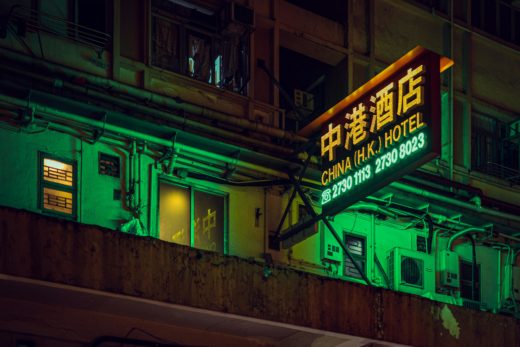
So yes, there are some identifiable issues of creative conservatism which sometimes push images toward lower contrast, less saturation, less hard or directional light, and, overall, less of something that both photographers and cinematographers might vaguely call punch. At risk of performing an amateur psychoanalysis, it is not quite clear whether audiences want movies that look like 80s movies, or that they simply associate that image style with better writing.
Of course, this whole thing might also be a case of bandwagon-jumping by the kind of YouTuber who talks like a film theory Ph.D., but given the audience share YouTube now occupies, it seems that someone, somewhere ought to be paying attention to what the people want.