

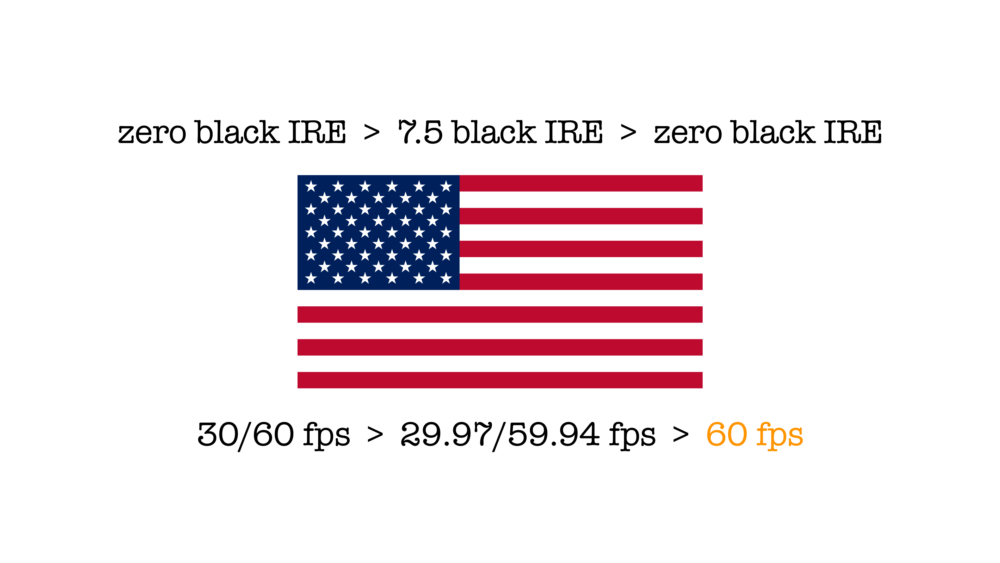

In 1941, the National Television System Committee established the first of two «necessary» evils with its initial analog grayscale (aka «monochrome») television system with EIA standard 170. This Committee (NTSC) was created the prior year by the US-FCC (Federal Communications Commission). Both events happened way before color TV. In 1941, this Committee decided that it was «necessary» to set a 7.5% (7.5 IRE) difference between blanking and black (setup) to ensure that noise did not cause the black level to be interpreted as a sync pulse, and to help manage issues with CRT (cathode-ray tube) brightness levels… and even avoid the potential blowing up of transmitters (that last part is undocumented folklore). Japanese engineers strongly disagreed with this and always maintained analog black level at zero IRE for Japanese TV broadcast, as much later did all versions of PAL and SECAM color systems. Fortunately, we received no transmitter explosion reports from Japanese TV stations or PAL/SECAM TV stations, so those alleged concerns were likely either too conservative or myths. In other details, the original grayscale EIA standard 170 was exactly 60.00 fields per second or exactly 30.00 frames per second. The second necessary evil came in 1953, when the original greyscale signal was manipulated to add color-after-the fact. Unlike the first evil covered above —which could have been avoided (as Japanese television proved), the second evil was truly necessary to reach the goal: to make a colorized system which would be backward-compatible with TV sets made for the prior greyscale EIA standard 170. At that time in 1953, the original EIA standard 170 (with its sacred 60.00 field rate) was modified to approximately 59.94 fields per second and the sacred 30.00 frames per second rate was changed to approximately 29.97 frames per second, as part of the new NTSC colorized system. Those two first transitions were painful, but were both decided and implemented way before I was born. The rest of this article is to review how we made (and may be making) the painful transition back, first to return to the full luminance range from zero to 100 «IRE*» in the digital video & television age, and second (optionally) back to exactly 60.00 fps. (The analog PAL and SECAM television worlds were fortunately exempt from these «necessary» evils and transitions back and forth. They always had consistent rates of 25.00/50.00 and black at zero IRE, in addition to higher spatial resolution and better color consistency compared with colorized NTSC.)
Is it okay to use the term IRE when discussing digital video?
While IRE (Institute of Radio Engineers) units are technically a holdover from analog video voltage measurements (0-100IRE), it is commonly accepted in modern production to use them for monitoring digital video luminance: 0-100% (expressed as 0-1023 for 10-bit video in the DaVinci Resolve’s waveform monitor) as a functional, relative reference. IRE provides a simplified, consistent, standardized scale for exposure and signal mapping.
Key points regarding IRE in digital video:
- Definition: IRE represents the dynamic range of luminance, where 0 IRE is pure black (excluding the US-NTSC 7.5 IRE «necessary» evil, which only existed with analog video, never with proper digital video) and 100 IRE is pure white.
- Digital Translation: Digital video scopes often map 0-100 IRE to the legal digital signal range, i.e. with the digital waveform monitor feature included with many Feelworld and Osee monitors, (although others use 16-235 in 8-bit, or 64-940 in 10-bit, as I covered in 2013 in NewTek’s new waveform monitor graticule), making 0-100 IRE a convenient, standardized tool for checking brightness, even though it is not measuring voltage anymore.
When we first made the painful transition back to the full range of 0-100 IRE instead of 7.5 IRE to 100 IRE
As video producers living in the US-NTSC world, we first had to make the proper yet painful transition back to the full range of 0-100 IRE instead of 7.5 IRE to 100 IRE when three things happened, chronologically:
- When video camcorders first began recording on digital magnetic tape (and later onto disk or cards) instead of analog. Many (but not all) of the consumer camcorders sold in the US were using NTSC-J (Japanese). Prosumer and Broadcast video camcorders had either a physical DIP switch or a menu setting between zero IRE black and 7.5 IRE black. Some of those only affected the analog output, while others (due to a design flaw) improperly raised the internal recording black level to 15 IRE (32 on the 8-bit digital scale)! I am not making this up. Both Adam Wilt and I published several articles about this in the palindromic year of 2002, six years before the birth of ProVideo Coalition in 2008. The most famous article (in English) was Adam Wilt’s We’ve Been Setup! in DV magazine. My most famous one (in Castilian) was Los negros todavía no tienen igualdad in Producción & Distribución, together with JVC’s very well produced Dirty Little Secrets video. In the same year, the three of us (Adam Wilt, JVC and I) were all doing our absolute best to help people survive that painful transition back to the full range of 0-100 IRE, away from the so-called «necessary» evil of 7.5 IRE black covered in the first paragraph above, without messing it up when moving material from analog to digital and back.
- When the first professional video cards came out to the market to capture analog videotapes to the first non-linear video editing programs for computers, many had a menu setting that properly handled adjusting the analog ports to be 7.5 IRE black or zero IRE according to the situation, be it for capturing analog material (input) or dumping an edited project back to analog videotape (output). As long as it was set properly and we understood what it meant, we were fine.
- In 2009, all NTSC analog over-the-air broadcast had to cease in the United States in favor of DTV (digital television) using the new ATSC 1.0 system, whether or not it had the optional H in front of those three letters to be HDTV (high definition television). At that point, the 7.5 IRE ceased to exist in the over-the-air signal as well. If you are doing the math, that was seven years after the palindromic year of 2002, with all of the events covered in the first bullet from this section, and one year after the birth of ProVideo Coalition.
The (still optional) transition back to 60.00 fps
As I explained in the initial paragraph of this article, US broadcast television had exactly 60.00 fields per second between 1941 and 1953. Starting in 1953 (way before I was born), all US TV stations had to change to approximately 59.94 fields per second (approximately 29.97 frames per second) as they added color to the prior greyscale system in such a way that the signal was still visible on existing greyscale (aka «monochrome») TV sets.
Despite the deceptive rounding in many camera and camcorder menus that state numbers like «30» and «60», these same cameras and camcorders nearly always record either approximately 29.97 or 59.94 fps. (A notable exception are Blackmagic cameras, some of which offer all four options: 29.97, 30, 59.94 and 60, where they are actually offering all those rates.)
Up to and including ATSC 1.0 in the United States, either all or most ATSC broadcasting in the United States have been using the approximate 29.97 or 59.94 to avoid sync issues with classic footage, despite the claims of the marketing divisions of some TV stations and networks, who round the numbers up to the closest integer. While ATSC 3.0 (NextGen TV) can allow for different frame rates, 59.94 remains the standard for the vast majority of current over-the-air broadcasting in the United States.
Despite 59.94 being the standard for the vast majority of current over-the-air broadcasting in the United States, we must acknowledge the following:
- Most video gaming is exactly 60.00 fps (progressive frames per second).
- Although online platforms like Amazon Prime Video Direct, Bunny, YouTube and Vimeo indeed accept non-integer rates like 23.976 (aka 23.98), 29.97 and 59.94, they happily accept integer rates like 24.00 and 60.00 too.
- DCI-compliant theaters generally only accept integer frame rates, and some accept 60.00p, but not all.
So when do we need to (or should we) make a transition from 59.94 to 60.00?
My short answer is: When there is a very good reason to do so. Here are a few examples of that:
- When the deliverable video is not going to traditional over-the-air broadcast and the majority of the material is natively non-integer, i.e. video gaming footage, something shot at exactly 60.00 when set that way in a Blackmagic camera and there is nothing gained by going to non-integer from that material.
- When the the deliverable video must be played in a DCI-compliant theater capable of 60.00p rates.
- When the deliverable video must be played with certain video wall controllers which demand non-integer 60.00 fps (progressive frame per second).
- When classic interlaced analog NTSC material is digitized with a device like the two new ones I’m evaluating for a review, where both do a high-quality realtime interlace and upscale from standard definition 59.94i to 1080p at 60.00p (progressive frames per second) to retain all of the original temporal information as seen with with a CRT display, and (at least with its current firmware) does not allow retaining the original 59.94 rate: only 60.00, but otherwise seems very good.
Scope of this article
This article mainly covers two specific «necessary» evils from 1941 and 1953 which affected NTSC-US, not NTSC-J or any type of PAL or SECAM. Although it mentions it somewhat, this article is not focused on the transition from interlaced video to progressive, nor the move from 4:3 to 16:9 aspect ratio, since those did happen with all other video standards (not just in the United States) and I have covered them in many other recent articles.
Lee este artículo en buen castellano
Vídeo y televisión estadounidense: el proceso de revertir los males «necesarios» de 1941 y 1953
(Re-)Subscribe for upcoming articles, reviews, radio shows, books and seminars/webinars
Stand by for upcoming articles, reviews, books and courses by subscribing to my bulletins.
In English:
- Email bulletins, bulletins.AllanTepper.com
- In Telegram, t.me/TecnoTurBulletins
- Twitter (bilingual), AllanLTepper
En castellano:
- Boletines por correo electrónico, boletines.AllanTepper.com
- En Telegram, t.me/boletinesdeAllan
- Twitter (bilingüe), AllanLTepper
Most of my current books are at books.AllanTepper.com, and also visit AllanTepper.com and radio.AllanTepper.com.
FTC disclosure
None of the listed individuals or companies mentioned above has paid for this article. Allan Tépper earns royalties on the sales of his own books. Some of the manufacturers listed above have contracted Tépper and/or TecnoTur LLC to carry out consulting and/or translations/localizations/transcreations. So far, none of the manufacturers listed above is/are sponsors of the TecnoTur, BeyondPodcasting, CapicúaFM or TuSaludSecreta programs, although they are welcome to do so, and some are, may be (or may have been) sponsors of ProVideo Coalition magazine. Some links to third parties listed in this article and/or on this web page may indirectly benefit TecnoTur LLC via affiliate programs. Allan Tépper’s opinions are his own. Allan Tépper is not liable for misuse or misunderstanding of information he shares.