


Strada Connect is an impressive feat of peer-to-peer networking that has crossed ProVideo Coalition’s radar many times in the past, with the platform making its debut at NAB 2026 and soon upping the ante at the following Cine Gear show with Strada 2.0.
Now, Strada has come to Europe to further show off 2.0’s capabilities at IBC 2026, showcasing the what it means to air-drop footage across the Atlantic without ever uploading to the cloud.

Strada Connect Takes Europe
Europe is an interesting test for a technology built around distributed media. Production teams here routinely operate across national borders, languages, regulatory regimes and different approaches to infrastructure. A post-production team in London might be working with footage stored in Amsterdam, an editor in Prague and a client in Paris. A broadcaster in Germany might need to collaborate with a colorist in Spain while keeping original media on infrastructure it already owns.
In a conventional cloud workflow, that can mean centralizing enormous quantities of media simply to make collaboration possible.
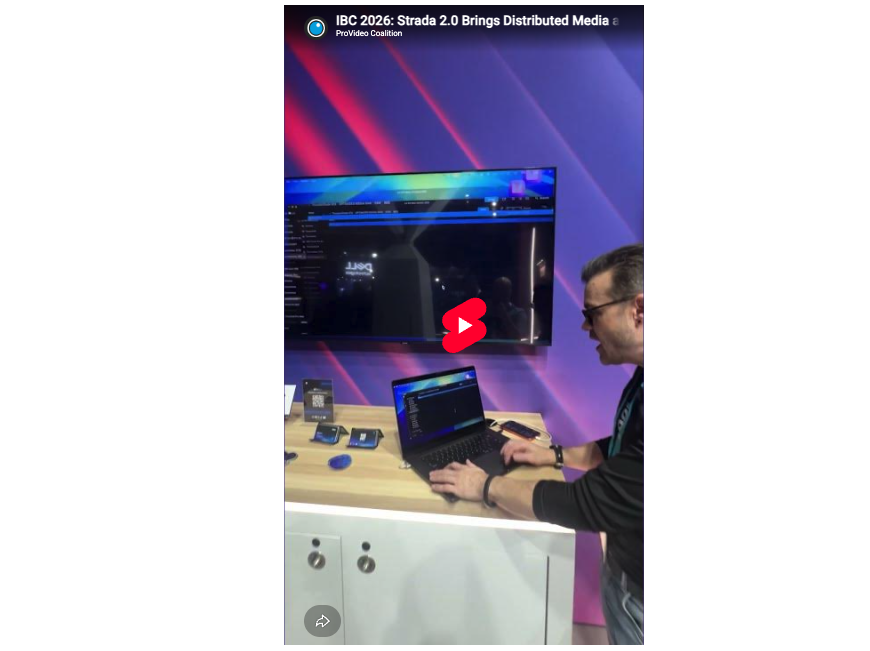
Strada’s argument is that it doesn’t have to, and they proved it at IBC with a demonstration that transferred footage from an iPhone in Amsterdam to a Mac in Los Angeles where an editor got working immediately. It underscored the basic premise behind Strada Connect that remains remarkably straightforward.
Rather than asking a production team to upload its media to a centralized cloud service, Strada connects computers and storage directly through its peer-to-peer network. With Strada 2.0, remote storage can appear as a virtual drive, allowing users to browse and preview material without first downloading the entire library. Strada also positions the technology as a way to work with remote files directly from familiar creative applications, effectively making remote media behave more like local media. That distinction matters when the material involved is measured in terabytes rather than gigabytes.
Users can also trigger server side proxy generation on the remote computer, and the demo they had to show around how fast and easy this was at IBC was truly impressive.
Beyond the system that is designed to work across cities, states and continents, even over consumer-grade internet connections, opportunities with language features open up an entirely new value proposition for production companies. International production teams routinely generate material in multiple languages, and the need to locate, understand and repurpose that material can become a bottleneck of its own. Luckily, this is where Strada’s AI-enhanced metadata features come into play.
The company’s current V2.0 vision includes bulk transcription and translation, with transcripts exportable as SRT or VTT files for use as closed captions. Strada also describes searchable tags and transcriptions, alongside timestamped information about faces, text and labels appearing in footage, which has obvious European applications.
A broadcaster could be working with interviews in French, German and Italian. A production company could be preparing an English-language version of material originally recorded in Spanish. A multinational creative team could search transcripts to find a particular quote without knowing precisely which language the source material was recorded in. Translation becomes part of the media workflow rather than an entirely separate process.
The most interesting thing about Strada 2.0 may ultimately be what it says about the industry’s relationship with the cloud. Cloud storage solved a very real problem: it gave distributed teams a common place to put their media. For a production company that has already invested in local storage, this turns the economics of remote collaboration on their head. Instead of asking, “How much cloud storage do we need?” the question becomes a much more proactive, “How can we make the storage we already own available to the people who need it?”
Uploading everything to a centralized service isn’t always the most efficient way to connect those existing resources. Strada is betting that networking technology has advanced enough to make those silos useful again. Its peer-to-peer architecture effectively turns geographically separated storage into a distributed production environment.