

For years, the conversation around Avid Media Composer has lived in a strange tension between reality and perception. On one hand, it remains the backbone of high-end feature film and television editorial. On the other hand, many editors, especially freelancers and independent creators, still see it as closed, enterprise-focused tool, and not part of their day-to-day work.
At NAB 2026, that tension came through clearly in a conversation I had with Avid’s Danny Hollingsworth, where our discussion was about new features, industry perception, and where Media Composer is actually headed. What emerged is a picture of a company trying to evolve in a very intentional way, with openness and AI at its center.
A big part of that story starts with the idea of openness, which is something Avid has talked about for years. The introduction of the Extensions SDK is central to that effort. It allows not just large partners, but individual developers and even working editors, to build tools directly into Media Composer. If that sounds like other editing tools you might be familiar with, you’re correct.
Danny framed it in a way that makes the shift clear. “The reality is, is this can be leveraged by anyone… an individual… you’re able to leverage the same hooks that we’re giving… and you can start building… different integrations, plug in different tools together.”
That idea of “anyone” is important here. This is not just about opening the door to third-party vendors. It is about enabling editors to solve their own workflow problems, whether that is through automation, custom panels, or AI-driven tools that fit their specific needs.
From the editor’s perspective, that shift is long overdue. As I put it during the conversation, “I think there has to be a perception that to do that for Avid, it was difficult… but that’s not the case.”
Danny did not push back on that perception. Instead, he acknowledged it directly. “We’ve spoken about being open for a long time… but a perception has been it’s closed. I think if you look at this NAB… it’s the first time you can really say it’s not just saying open but acting open.”
That may be one of the most important takeaways from the entire conversation. Avid is not just adding features. It is trying to change how people think about the platform.

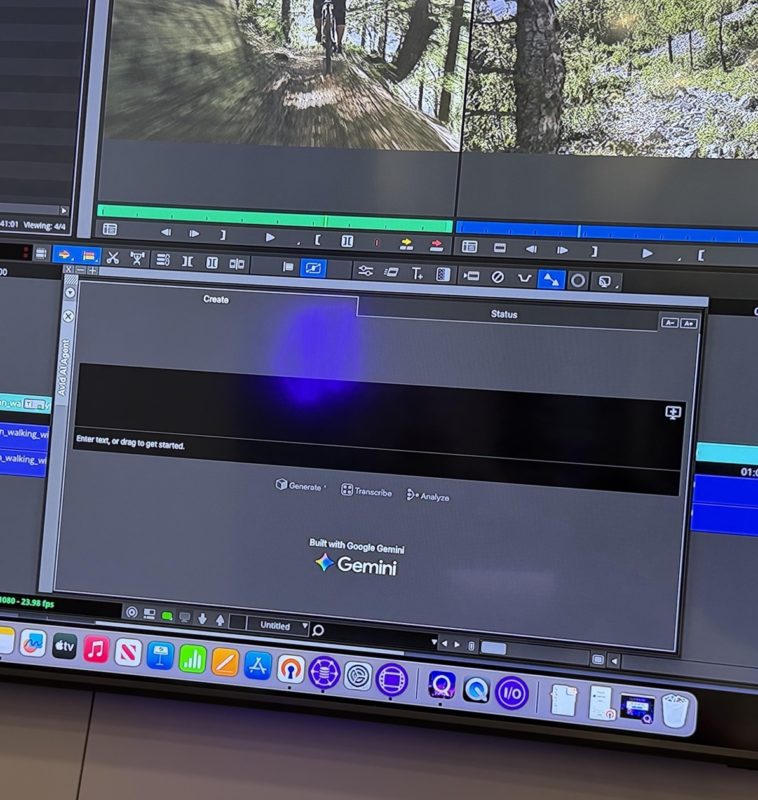
That shift toward openness connects directly to the most talked-about feature at the booth, which is the integration with Google Gemini. What stands out immediately is that this is not being treated as a separate AI tool or a novelty panel. It is being embedded directly into the Media Composer via its own Gemini panel.
Danny described the current state as a tech preview, but one that is evolving quickly. “It’s able to do some stuff. But I think it’s the beginning… by the time we even come to release, you’ll see it will have evolved.”
The first layer of that integration is transcription, which might not sound exciting at first, but becomes more interesting when you look at how it is implemented. Gemini expands language support and can improve accuracy, but more importantly, it feeds directly into the existing Media Composer workflow.
As Danny explained, “So practical AI for… the normal editorial workflow… it’s not a separate ‘I have to learn this new workflow.’ It’s just built into the core Media Composer workflow.”
That detail is critical. Editors are not being asked to leave their timeline or adopt a new interface. Instead, the AI enhances what is already there, enabling text-based editing, search, and organization. We’ve had transcript-based editing for awhile now in Avid but Gemini will expand what Media Composer can do.
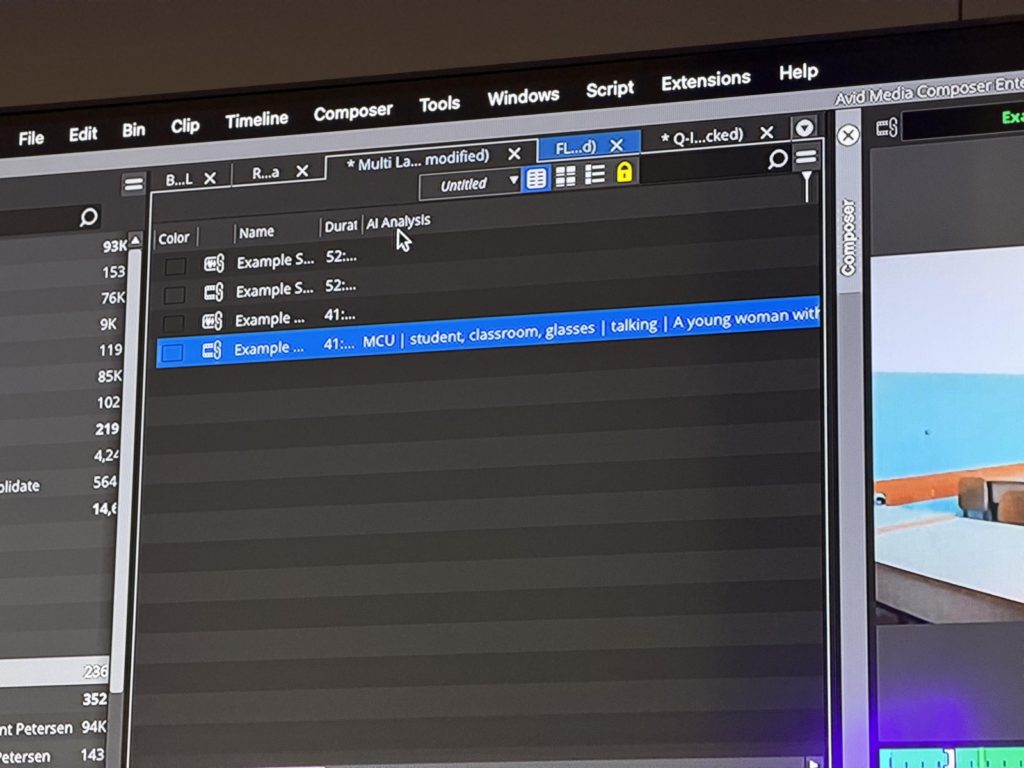
From there, the integration moves into automated analysis and metadata generation. Gemini can analyze footage, generate logging information, and enrich clips with metadata that can be used to search and organize material more effectively. For editors dealing with hundreds of hours of footage, this is not just a convenience. It is a meaningful shift in how material can be navigated and assembled.

But the most forward-looking capability is the ability to generate video directly inside the timeline. And this won’t be some enterprise-only connection. Any Google Gemini account should work, but these details will be ironed out as it ships in the future.
Danny described a scenario that will feel familiar to anyone who has worked in long-form editing. “Normally… I have a storyboard… or… just a black plate… and I just have a description of what’s going to happen…” Editors may have a description but no footage or pre-vis. What Gemini introduces is the ability to fill that gap, at least temporarily. “What we’re able to do… is… generate… an asset that you can then put into your timeline.”
That changes how ideas are communicated. Instead of describing a future shot, you can show something approximating it. Instead of cutting around missing material, you can keep building the sequence. That will, of course, depend on your company’s or production’s willingness to use generative AI.
Avid is being careful about how this is framed. “Our goal here is to not replace that work, but actually to enhance it so you can continue your creative story, stay in the timeline… and then when the real asset comes in, you just plug it in.” Pre-vis placeholder tools aren’t new, but generating them with a promot is.
That positioning matters, especially in an industry that is still grappling with the implications of generative AI. The conversation touched on that tension as well. “What we’re showing is a tech preview… we’re kind of working through all of those scenarios… at the very least we want to be able to flag… something is generative.”
Beyond AI, there is another shift happening that may prove just as important over time. Avid is taking features that were traditionally locked behind enterprise infrastructure and bringing them into the standard Media Composer experience.
One example that came up is dynamic relinking and media indexing, which historically required larger systems like MediaCentral.
Danny described how that is changing. “We’re bringing… the same capability… into… standard Media Composer… without having to have big infrastructure… it will run on your local Media Composer.”
For working editors, this is the kind of change that directly impacts daily workflow. It simplifies proxy handling, makes relinking more reliable, and allows for more flexible media management without requiring additional systems.
At one point, I raised a broader concern that reflects what many editors have been feeling. “Since it’s been purchased by private equity… it feels like it’s pushing back more toward the enterprise side of things and less toward… the single freelance editor.”
Danny’s response was interesting because it did not dismiss the concern outright. “… perception is reality. So it means that we’re not doing as good a job of telling that.”
That acknowledgment points to a deeper issue. Even if Avid is evolving technically, the perception of the company may still be rooted in an Avid of old. But at the same time, it doesn’t help that some of the most reliable faces of Avid community and support have either been let go or are no longer on the NAB floor for customers to meet face-to-face. Being able to thank the human who fixed a licensing issue in a critical time goes a long way to making an editor a loyal customer. That kind of history can help bridge to the future.
That becomes especially relevant when you look at the broader editing landscape, where tools like DaVinci Resolve have gained traction by being accessible, affordable, and widely adopted by independent creators. Avid’s response is not to compete directly on price or simplicity, but to expand access while maintaining its core strengths.
Media Composer First still exists as a free entry point, and educational access remains a key part of the strategy. More importantly, the core editing experience remains consistent across versions. As Danny put it, “It’s not a dumbed down… it will give you the foundation… when you’re ready to go into a professional space.”
Taken together, this conversation suggests that Avid is in the middle of a meaningful transition. The Extensions SDK opens the door for customization and individual innovation. The Gemini integration shows how AI can be embedded directly into editorial workflows in a way that feels practical and immediate. And the shift toward making enterprise-level capabilities more broadly available suggests that Avid is trying to reach a wider audience without abandoning its high-end roots.
The technology is compelling, but the bigger story is about direction. Avid is trying to move from being perceived as closed to being experienced as open, from being enterprise-only to being relevant across the full spectrum of editors, and from treating AI as an add-on to making it part of the creative process itself.
Whether that shift fully lands will depend not just on what Avid builds next, but on whether editors are willing to take another look at what Media Composer has become.