


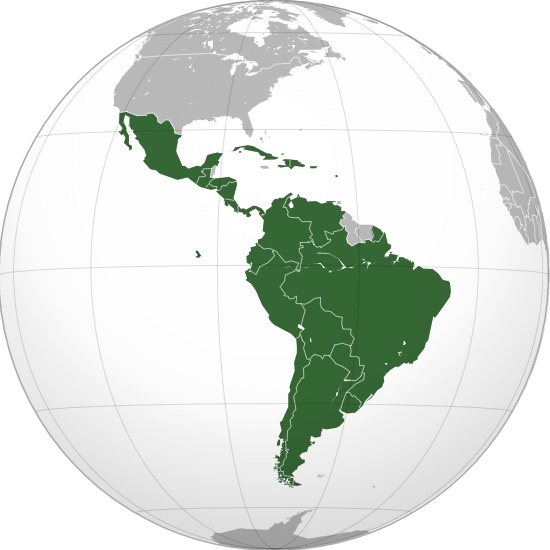

I have some friends and colleagues who detest the name Latin America or its matching name in Castilian, Latinoamérica. They often ask me, «Allan, why don’t you use the term Hispanoamérica, Iberoamérica, or Castellanoamérica?» These friends and colleagues are absolutely right when it comes to cultural or linguistic areas. However, these same friends and colleagues are at a loss for words when I explain the use of the term Latin America in the context of a commercial region. In fact, a different group of friends have held the position of Latin American Sales Managar at various multinational companies. Although these sales managers have often resided in the United States, they have always been prohibited from making final sales within this country. On their business cards, their title appears as Sales Manager for Latin America or (in Castilian, Gerente de ventas para Latinoamérica). For practical and strategic reasons, their authorized Latin American territory in many cases includes places where neither Castilian nor Portuguese is spoken as the primary language—such as Belize, French Guiana, Guyana (previously called British Guiana) and Suriname—even though these are not shown as such on the Heraldry map you saw above.
In this context, it would never make sense to include any of the terms suggested by those who reject the term Latin America on those business cards. Why wouldn’t any of those terms fit? Because our country, the United States, is indeed part of Hispanoamérica, Iberoamérica, and Castellanoamérica, but it absolutely does not belong into the commercial region known as Latin America.
Really? Is the United States part of Hispanoamérica, Iberoamérica, or Castellanoamérica?
Absolutely, the United States is part of Hispanoamérica, Iberoamérica and Castellanoamérica. Here are some facts to convince the skeptics:
- By population, the United States is the country with the second-largest number of Castilian speakers on Earth, even more than Spain.
- In 2025, the purchasing power of Hispanic households in the United States reached at least US$2.8 trillion (US$2,800,000,000,000), according to the most conservative estimates for that year.
- Many of the names of States, cities, streets, and avenues in our country are in Castilian or derived from it. A few examples include California, Colorado, Florida, Montana, Nevada, New Mexico, and Oregon.
Conclusions
To friends and colleagues who promote the use of the terms Hispanoamérica, Iberoamérica, and Castellanoamérica: Go ahead if it’s a cultural or linguistic matter! However, when referring to the commercial region known as Latin America, there is no viable alternative name. The United States is not part of Latin America, but it is certainly part of Hispanoamérica, Iberoamérica and Castellanoamérica.
What about Puerto Rico?
See my recent article:
Puerto Rico business: complexity, embarrassment and solutions
Image Credit
Lee este artículo en buen castellano
Latinoamérica: una región comercial sin posible sustituto de nombre
(Re-)Subscribe for upcoming articles, reviews, radio shows, books and seminars/webinars
Stand by for upcoming articles, reviews, books and courses by subscribing to my bulletins.
In English:
- Email bulletins, bulletins.AllanTepper.com
- In Telegram, t.me/TecnoTurBulletins
- Twitter (bilingual), AllanLTepper
En castellano:
- Boletines por correo electrónico, boletines.AllanTepper.com
- En Telegram, t.me/boletinesdeAllan
- Twitter (bilingüe), AllanLTepper
Most of my current books are at books.AllanTepper.com, and also visit AllanTepper.com and radio.AllanTepper.com.
FTC disclosure
None of the listed individuals or companies mentioned above has paid for this article. Some of the manufacturers listed above have contracted Tépper and/or TecnoTur LLC to carry out consulting and/or translations/localizations/transcreations. So far, none of the manufacturers listed above is/are sponsors of the TecnoTur, BeyondPodcasting, CapicúaFM or TuSaludSecreta programs, although they are welcome to do so, and some are, may be (or may have been) sponsors of ProVideo Coalition magazine. Some links to third parties listed in this article and/or on this web page may indirectly benefit TecnoTur LLC via affiliate programs. Allan Tépper’s opinions are his own. Allan Tépper is not liable for misuse or misunderstanding of information he shares.