


At the same time attendees were desperately searching this year’s IBC for something not brought to us by the letters A and I, broadcasters themselves were putting out pieces titled No ‘effective theory of safety’ in AI. Happily, the damage potential of artificial intelligence in film and TV currently extends to little more than hijacking a lower third with a desperate plea for emancipation from the purgatory of sportsball analysis. Between AI and cloud, it’s hard to find a new idea that doesn’t reside in an anonymous warehouse with a lot of air conditioning.
Still, Tron notwithstanding, humans will continue to exist in physical reality for the foreseeable future, and several of the technical papers presented at this year’s event sought new ways to interface that reality with the server farm. One of them discussed a scene-adaptive camera, leveraging the fact that it’s now possible to build sensors with so many pixels that they’re not so much recording scene detail as characterising the limits of the lens. Nobody wants to characterise the pores on the actor’s face in any more detail, but there is still demand for some combination of better dynamic range, noise, or sensitivity.
Sensors Indicate
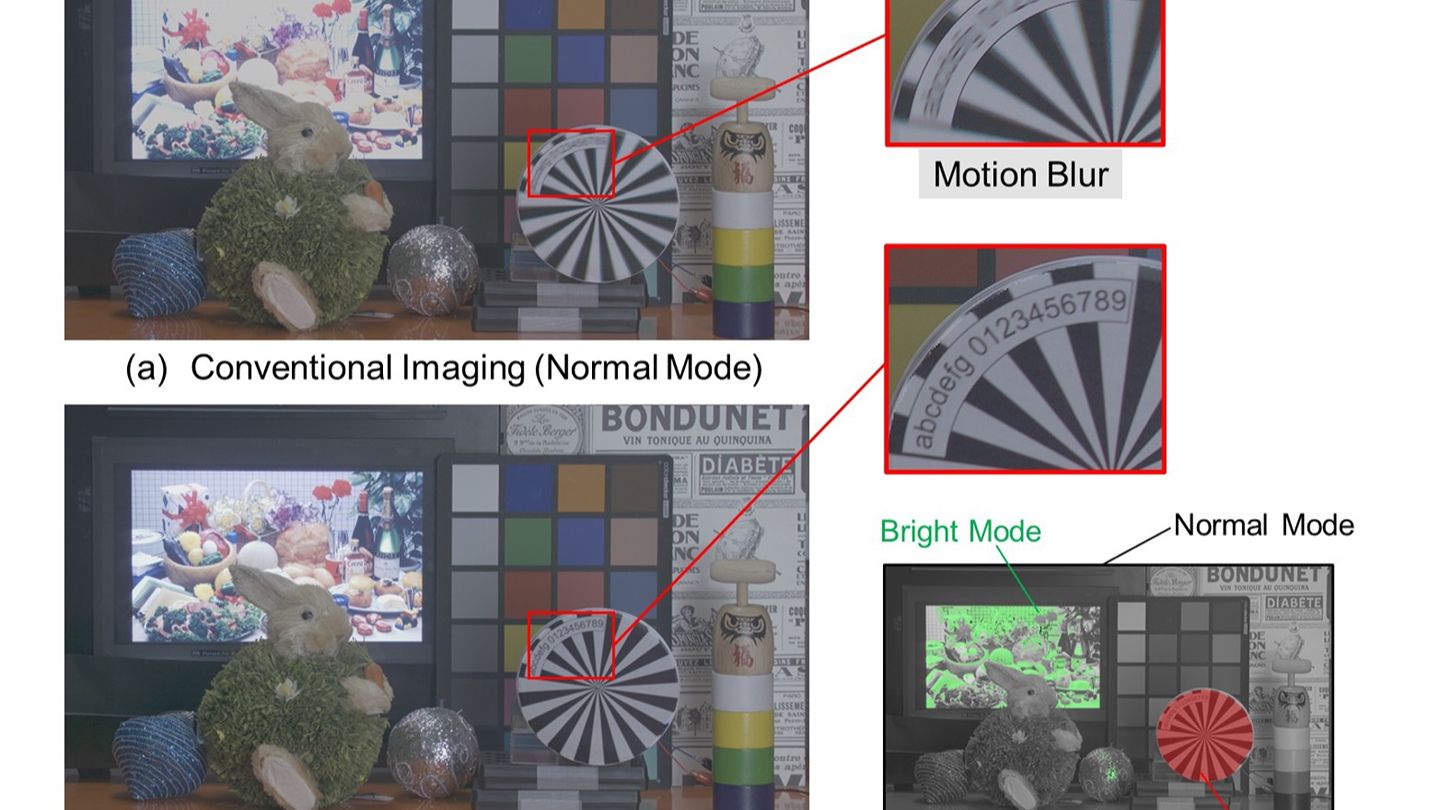
Presented by NHK’s Kohei Tomioka in collaboration with Shizuoka University, the paper describes a sensor designed to allow groups of pixels (or, properly, photosites) to operate either conventionally or in one of three special modes designed to prioritise highlight rendering, low-light performance or high-speed performance. It’s part of an ongoing programme, and in 2024, some of the same people discussed a one-megapixel prototype with independently controlled blocks 64 photosites square.
This year saw a complete prototype camera demonstrating the technology with finer control over blocks four photosites square, producing a roughly-4K camera capable of 240 frames per second (depending on resolution). Mode switching happens at a very low level, on the sensor, by altering the exposure time or by binning adjacent pixels. The results demand processing, but that’s hardly new. The results are intended to allow for a better compromise of noise, dynamic range and highlight rendering.

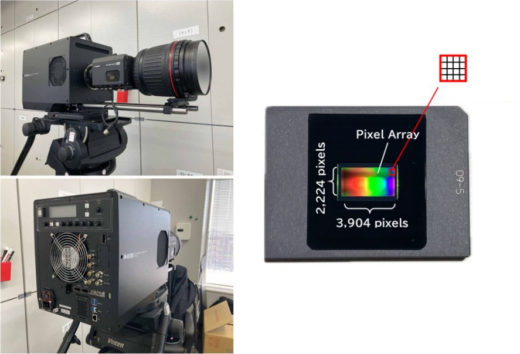
The intended application seems to be broadcast cameras, which explains NHK’s interest. It’s not an 8K sensor, and it’s not a cinema sensor, but there’s nothing to suggest that the technology isn’t applicable to other fields. The prototype camera has a three-chip block with individual photosites 2.5 micrometres across.
Compare a roughly-4K Super-35mm sensor, which would be five-plus. 1.25-inch sensors were used in the prototype, although, long term, in broadcast, the motivation might well be to squeeze more performance out of sensors small enough to work well with established broadcast lens designs. Right now, 8K broadcast cameras demanding high-range zooms currently occupy two parking spots for the lens alone.
If there’s a note of caution to sound, it’s that various novel sensor arrangements have been tried in the past. Mostly, that has involved colour filter array layouts other than Bayer’s, perhaps including cyan, yellow or unfiltered white photosites. Those are not things which are relevant to a three-chip broadcast topology anyway, but some sensors have also included larger high-sensitivity photosites and smaller ones to deal with highlights, and that might plausibly work in any sort of camera.


Optimise for any three
These designs have often wound up demonstrating that the compromise between sharpness, colour fidelity, sensitivity, noise and dynamic range has always been – well – a compromise. More sheer silicon area buys more performance, but with a desire to keep the chip the same size, there is a sense of having – say – five parameters and being able to optimise for any three of them. None of these designs has moved the needle enough to dethrone Bryce Bayer’s work from the mainstream, but few of them have ever managed to cram in the cleverness of the design talked about in this paper.
There is a philosophical consideration, too, and one which has been raised more often as camera systems become more reliant on clever mathematics to make sense of what comes off the sensor. It has been a while since any kind of camera photographed scenes solely by recording a pattern of light, and that has led to sensors designed specifically for post processing, such as those using colour filter layouts which make noise-reduction mathematics work better. The staggering sensitivity of modern sensors is only partly due to the sensor, and it’s easy to overlook the practical benefits..
A stop more sensitivity halves the power budget with no fundamental improvement in lighting, to the point that people walk around set wearing hats with blinking anti-collision lights.
This being 2026, other papers in the programme jumped enthusiastically on the AI bandwagon, although one track – titled Trust, Provenance and Authenticity – somehow seems to push in the other direction, describing ways for current affairs distributors to make sure they aren’t mistaking the hallucinations of a data centre GPU for hard news. Given that a lot of AI image generators specifically work by trying to fool other AIs, it’s hard to be confident in much long term success. The ability of neural networks to exert a slow, gradual editorial pressure in unexpected directions might be just as hard to police – although it might also be hard to differentiate from the recommendation algorithms that have been raising eyebrows for a while.